Montana's reservation-majority counties average 60 of 100 on distress, more than twice the rest
Each state is shaded by how distressed its households are, from green (least) to red (most), with data through September 2026. Montana scores 8 out of 100.
Montana's three poorest counties are also its three most distressed: Glacier, Roosevelt and Big Horn. Glacier County, around Cut Bank, is more distressed than 90% of U.S. counties. Statewide, strain is light; the share of Montana renters whose rent takes at least half their income, 18.9% in 2024, was the 5th lowest share in the country. At the other end, Jefferson and Stillwater counties, near Helena and Billings, are two of the nation's 100 least distressed.
- Score
- 8/100
- Data through
- September 2026
- Edition
- October 2026
Next edition expected March 2027
How Montana ranks among the states
Montana ranks 47th of the 50 states and D.C., among the five least distressed. Where Montanans’ income comes from also stands out. In 2024, dividends, interest and rent made up 27.1% of all the income Montanans received, the 3rd highest share in the country (U.S. Bureau of Economic Analysis). Wages and salaries made up 41.5%, tied for 3rd lowest. These income figures sit beside very little debt trouble in Montana; we haven’t measured whether one explains the other.
What drives the score
Each measure is ranked against the other states and D.C. on its own. A part averages the ranks of its measures on a 0 to 100 scale. The jobs part and the renters’ part each hold one measure, so each is that measure’s rank. Montana’s four parts average 17. The State Distress Index score is a different number. It counts how many of the other 50 places average lower across the four parts than Montana does: only four do (Vermont, New Hampshire and the two Dakotas), so Montana scores 8. On this scale, a state that scores 80 is more distressed than 80% of states.
- Collections and bankruptcy25Montana’s highest part, though still low. In early 2025, 10.7% of Montanans with a credit record had a debt in collections, 22nd lowest among the states and D.C.; bankruptcy filings ran far below the U.S. rate (see bankruptcy).
- Late payments17In early 2025, 8.9% of Montana card borrowers were 90 days or more behind, 5th lowest of the states and D.C., with car loans and mortgages also below the national shares.
- Jobs15Unemployment averaged 3.2% over June through August 2026, against 4.1% for the country.
- Renters’ housing costs9Montana’s lowest part. In 2024, 18.9% of renter households paid half or more of their income for rent and utilities, 5th lowest in the country (see rent against income).
Montana is less distressed than Idaho and Wyoming and more distressed than both Dakotas
Idaho, to the west, scores highest of the four neighbors. North Dakota scores 0, the lowest possible, which means no other state or D.C. has a lower four-part average. All five states fall in the least distressed of the five score groups on the map.
State Distress Index score, 0 to 100.
Montana spent every quarter from mid-2006 to early 2025 in the less distressed half of the states
At its worst
The highest score Montana reached in the chart’s years was 40, in the third and fourth quarters of 2019, when it ranked 31st most distressed. The lowest was 4, in the last quarter of 2024 and the first of 2025, ranking it 49th most distressed.
What moved it
Two parts lifted the 2019 high. New Census renter figures raised the renters’ part from 26 to 52 in the third quarter of 2019, and the jobs part, after climbing for several years, reached 56 by the year’s end. By early 2025 the jobs part had dropped to 11. The jobs part compares Montana’s unemployment with other states’, so it fell as Montana’s yearly rate went from 3.5% in 2019 to 3.0% in 2024. Over the same years the U.S. rate went from 3.7% to 4.0%.
Since the chart ends
Our quarterly scores run only through early 2025, when Montana stood at 4, ranked 49th most distressed. Newer data put it at 8, ranked 47th most distressed. The 2025 Census renter figures cut the renters’ part from 28 to 9, while the jobs part rose from 11 to 15. Montana’s four-part average fell, from 21 to 17, yet its score rose, because more of the other states now average lower than Montana does.
Montana’s distress score never climbed past 40, its 2019 high, and sank to 4 by the end of 2024
Montana’s State Distress Index score each quarter, 0 to 100, from the third quarter of 2006, the first with all four parts, through the first quarter of 2025.
How many people live in Montana? More each year since 2020, and all of the growth came from people moving in
Montana had 1,144,694 residents on July 1, 2025, by the Census Bureau’s estimate. That was 5.3% more than in July 2020, growth tied for 10th fastest among the 50 states and D.C. over those five years. Deaths outnumbered births in every year from 2021 through 2025, so the gain came from people arriving from other states and abroad.
Residents, July 1, 2025
1,144,694
Census Bureau population estimate
Growth since July 2020
5.3%
Tied for 10th highest of the states and D.C.
Residents 65 and older
20.1%
U.S. 17.2%
Tied for 7th highest of the states and D.C. for 2020 to 2024
Growth is well below its 2021 pace. Moves from other states added 20,693 people in the year to July 2021 but 6,348 in the year to July 2025, as the table shows.
| Year to July 1 | Births minus deaths | Net moves from other states | Total change |
|---|---|---|---|
| 2021 Total change 19,260 | −1,420 Net moves from other states 20,693 | 20,693 | 19,260 |
| 2022 Total change 15,117 | −1,781 Net moves from other states 15,474 | 15,474 | 15,117 |
| 2023 Total change 9,079 | −406 Net moves from other states 9,017 | 9,017 | 9,079 |
| 2024 Total change 6,945 | −223 Net moves from other states 5,263 | 5,263 | 6,945 |
| 2025 Total change 7,137 | −90 Net moves from other states 6,348 | 6,348 | 7,137 |
Census Bureau population estimates, Vintage 2025. The total also counts people moving in from abroad and a small adjustment the bureau makes, so the first two columns don’t add up to it.
Montana’s 56 counties range from Yellowstone, around Billings, the most populous, to Petroleum, with 554 residents. Strain is concentrated in a handful of those counties, as the next sections show. Montana’s counties, ranked →
Montana’s three poorest counties are also its three most distressed: Glacier, Roosevelt and Big Horn
Of Montana’s 56 counties, Glacier County, whose seat is Cut Bank, had the highest poverty rate in 2024, 25.9%, by the Census Bureau’s estimate. It is also the state’s most distressed county on our County Distress Index, which scores strain on household budgets in all 3,144 U.S. counties. Glacier scores 90, so it is more distressed than 90% of those counties. Roosevelt and Big Horn counties hold the next two places on both lists. No Montana county reaches the nation’s 100 most distressed. At the other end, Jefferson and Stillwater counties score 1 and rank among the 100 least distressed in the country.
Montana’s three most distressed counties hold most of the Blackfeet, Crow and Fort Peck reservations; the two least distressed lie near Helena and Billings
Each county is shaded by its County Distress Index score, 0 to 100, for all 56 Montana counties.
Loading the county map…
The county map could not be loaded. Every county is in the lists on this page.
Most distressed
| Rank | County | Score | Poverty |
|---|---|---|---|
| 1 | Glacier | 90 | 25.9% |
| 2 | Big Horn | 78 | 22.2% |
| 3 | Roosevelt | 74 | 22.8% |
| 4 | Musselshell | 71 | 14.5% |
| 5 | Sanders | 65 | 13.9% |
| 6 | Rosebud | 65 | 16.3% |
| 7 | Lincoln | 58 | 15.1% |
| 8 | Blaine | 55 | 18.1% |
| 9 | Wheatland | 53 | 17.3% |
| 10 | Silver Bow | 53 | 12.9% |
Least distressed
| Rank | County | Score | Poverty |
|---|---|---|---|
| 52 | Fallon | 6 | 9.3% |
| 53 | Sweet Grass | 6 | 9.8% |
| 54 | Daniels | 5 | 11.4% |
| 55 | Stillwater | 1 | 8.3% |
| 56 | Jefferson | 1 | 7.4% |
Place among Montana’s 56 counties, 1 = most distressed. Ranks use unrounded scores, so Sanders and Rosebud both show 65 yet sit fifth and sixth, and Stillwater and Jefferson both show 1. Poverty is the Census Bureau’s 2024 estimate for each county.
Every county, by score
Most of Montana sits in the least distressed group: 36 of its 56 counties score under 30, and they are home to 73.0% of Montanans. Glacier alone scores 80 or more, with 1.2% of the state’s people. The three counties in the 70s are Big Horn, Roosevelt and Musselshell.
1 score 80–100
3 score 70–79
10 score 30–49
Mineral, Lake, Custer, Deer Lodge, Pondera, Golden Valley, Hill, Chouteau, Cascade, Petroleum
36 score 0–29
Sheridan, Ravalli, Yellowstone, Granite, Madison, Garfield, Powell, Toole, Phillips, Liberty, Flathead, Wibaux, Missoula, Fergus, Dawson, Carter, Broadwater, McCone, Teton, Meagher, Beaverhead, Prairie, Treasure, Lewis and Clark, Valley, Judith Basin, Park, Richland, Carbon, Gallatin, Powder River, Fallon, Sweet Grass, Daniels, Stillwater, Jefferson
Golden Valley is among Montana’s poorest counties but not among its most distressed
Our county score weighs late payments, debts in collections and bankruptcy, jobs and renters’ costs alongside poverty and income, so a poor county can rank well down the distress list. Golden Valley County, around Ryegate, has the fourth highest poverty rate in Montana, 20.2%, yet ranks 16th most distressed. With 835 residents, it is one of the state’s smallest counties, and its jobs part falls in the less distressed half of Montana’s counties. Musselshell County, around Roundup, runs the other way: its poverty rate is tied for 18th highest in the state, but it is the fourth most distressed county. These poverty rates are the Census Bureau’s 2024 Small Area Income and Poverty Estimates; other surveys can rank Montana’s counties differently.
The five highest poverty rates in Montana
| County | Poverty | Distress rank |
|---|---|---|
| Glacier | 25.9% | 1st |
| Roosevelt | 22.8% | 3rd |
| Big Horn | 22.2% | 2nd |
| Golden Valley | 20.2% | 16th |
| Blaine | 18.1% | 8th |
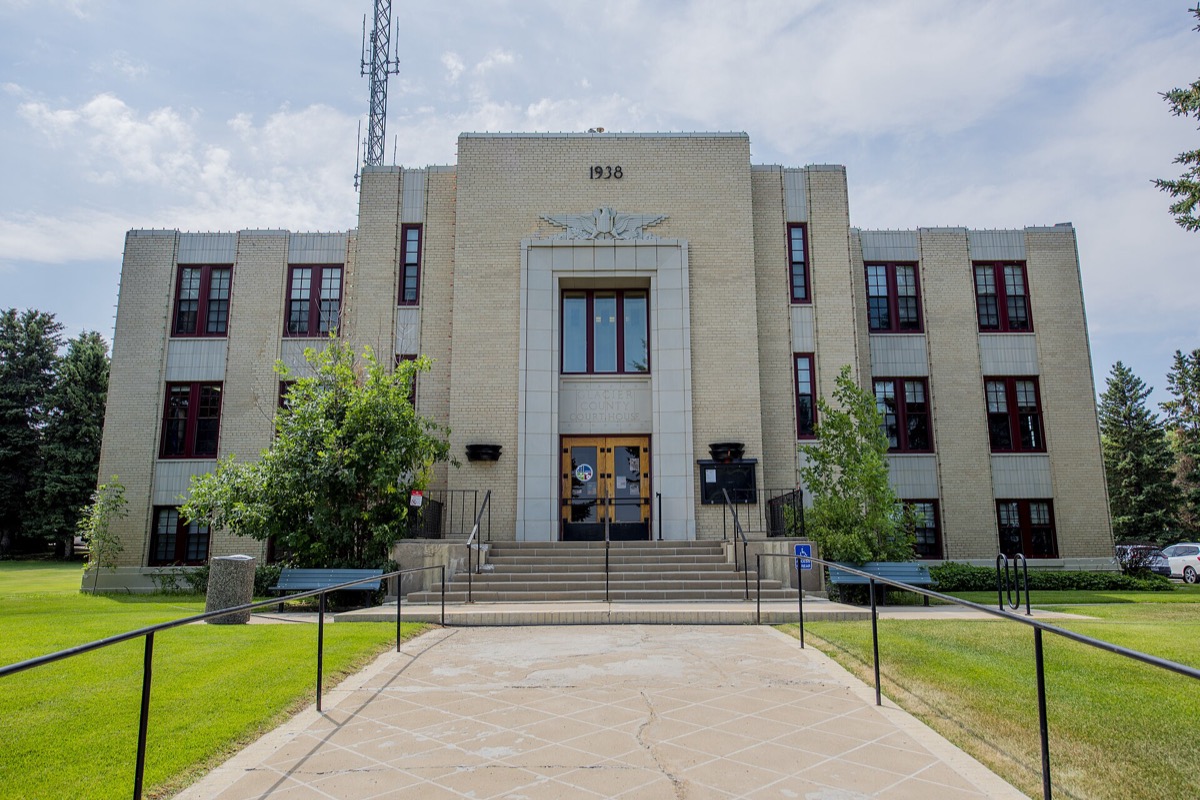
The Glacier County Courthouse in Cut Bank, photographed in May 2012. The building went up in 1938 and 1939, during an oil boom in the county, and joined the National Register of Historic Places in 2013. Glacier is now Montana’s most distressed county, at 90, and its median household income in 2024 was $54,492, against $75,520 for the state.
Source: U.S. Census Bureau; American Default Research; National Park Service, National Register of Historic Places (listing 13000446). Photo: J.B. Chandler, CC BY-SA 3.0, via Wikimedia Commons.

Gallatin County has Montana’s highest median household income and a high renters’ cost score
Gallatin County, around Bozeman, had the state’s highest median household income in 2024, $100,953, and its lowest poverty rate, 7.1%. Gallatin’s County Distress Index score is just 8. One part of that score runs the other way. The renters’ costs part, built from rent set against renters’ incomes, reaches 80 out of 100, the 4th highest of Montana’s 56 counties.
County Distress Index (American Default Research); U.S. Census Bureau, Small Area Income and Poverty Estimates, 2024.
Are Montana’s reservation counties more distressed than the rest of the state? By far
Yes. Using the Census Bureau’s 2020 land records, we picked out the seven counties that each hold more than half of one of Montana’s seven Indian reservations. Weighted by population, their County Distress Index scores average 60. The other 49 counties average 23. The seven are home to 8.9% of Montanans but include five of the state’s ten most distressed counties.
| County (seat) | Reservation | Reservation land in the county | Score | Poverty, 2024 |
|---|---|---|---|---|
| Glacier (Cut Bank) Score 90 · Poverty, 2024 25.9% | Blackfeet Reservation land in the county 89.5% | 89.5% | 90 | 25.9% |
| Big Horn (Hardin) Score 78 · Poverty, 2024 22.2% | Crow Reservation land in the county 89.3% | 89.3% | 78 | 22.2% |
| Roosevelt (Wolf Point) Score 74 · Poverty, 2024 22.8% | Fort Peck Reservation land in the county 53.1% | 53.1% | 74 | 22.8% |
| Rosebud (Forsyth) Score 65 · Poverty, 2024 16.3% | Northern Cheyenne Reservation land in the county 54.7% | 54.7% | 65 | 16.3% |
| Blaine (Chinook) Score 55 · Poverty, 2024 18.1% | Fort Belknap Reservation land in the county 81.3% | 81.3% | 55 | 18.1% |
| Lake (Polson) Score 47 · Poverty, 2024 14.9% | Flathead Reservation land in the county 52.1% | 52.1% | 47 | 14.9% |
| Hill (Havre) Score 38 · Poverty, 2024 14.8% | Rocky Boy’s Reservation land in the county 69.5% | 69.5% | 38 | 14.8% |
Our grouping. Land shares are the part of each reservation’s land area that lies in the county, from the Census Bureau’s 2020 reservation-to-county relationship file; they are not the share of the county that is reservation land. Score: County Distress Index, 0 to 100. Poverty: Census Bureau, Small Area Income and Poverty Estimates.
The table below sets the seven beside Montana’s five most populous counties, which hold 54.5% of Montana’s residents, and beside every other county. Each group’s score and poverty rate weight its counties by population.
| Group (ours) | Counties | Share of people | Score, weighted | Poverty, 2024 |
|---|---|---|---|---|
| The seven reservation counties above Score, weighted 60 · Poverty, 2024 18.4% | Seven Share of people 8.9% | 8.9% | 60 | 18.4% |
| Every other county Score, weighted 26 · Poverty, 2024 11.1% | 44 Share of people 36.5% | 36.5% | 26 | 11.1% |
| Five most populous: Yellowstone, Gallatin, Missoula, Flathead, Cascade Score, weighted 21 · Poverty, 2024 8.7% | Five Share of people 54.5% | 54.5% | 21 | 8.7% |
Our calculation from County Distress Index scores and Census Bureau 2024 poverty rates, weighted by the populations our index uses. “Every other county” leaves out both the reservation counties and the five most populous. Shares are of the people in all 56 counties and may not total 100% after rounding.
What the grouping can’t tell you
A county’s score covers everyone who lives there, tribal members and others alike, and our index records neither race nor tribal membership. The reasons behind any county’s score aren’t in our data, so this page doesn’t offer an explanation.
Strain isn’t confined to the reservation counties. Musselshell, Sanders, Lincoln, Wheatland and Silver Bow also rank among Montana’s ten most distressed without holding most of a reservation. Sanders does hold part of one: 37.0% of the Flathead Reservation’s land lies there. Every county’s page, ranked →
What changed in Montana in the past year
-
Oct. 6, 2026
A month-long strike at Sibanye-Stillwater’s Montana mine and smelter ended
Union workers at the Stillwater Mine and the company’s smelter and refinery in Columbus, the seat of Stillwater County, walked out on Sept. 3. On Oct. 6 the union approved a three-year contract, a company spokesperson told the Montana Free Press; the paper did not report its terms. On our County Distress Index, Stillwater County scores 1, among Montana’s least distressed counties.
Montana Free Press, the strike begins and the strike ends
-
July 31, 2026
The Homeowner Assistance Fund’s last application day for mortgage help
Montana Housing set July 31 at 5 p.m. as the last day to apply for help catching up on a mortgage or clearing a lien, and March 31 as the last day for utility help. The program spends federal pandemic relief money (see foreclosure). In May 2025, the Montana Department of Commerce said the program’s funding would expire Sept. 30, 2026.
Montana Housing, Homeowner Assistance Fund; Montana Department of Commerce, release of May 14, 2025
-
July 1, 2026
Many Medicaid expansion adults must report work or other activity
Medicaid expansion adults ages 19 to 64 who aren’t in an excluded group must document 80 hours a month of work, community service, school or job training, the state health department says. American Indian and Alaska Native members are among the groups left out of the rule. The department ties the change to the 2025 federal law known as H.R. 1; neither of the department’s pages cited here gives a count of people affected.
Montana Department of Public Health and Human Services, Medicaid changes and release of June 30, 2026
-
Feb. 1, 2026
NorthWestern Energy’s new electric and gas rates were set to start
On Nov. 19, 2025, the Montana Public Service Commission let NorthWestern count $246 million of its Yellowstone County Generating Station in the base on which NorthWestern’s rates are built. The utility had asked for $289 million. NorthWestern’s rate page says the new rates begin Feb. 1. By NorthWestern’s own estimate, a 750 kWh monthly electric bill falls $2.16 against January rates, and a 65-therm gas bill rises $1.62.
Montana Public Service Commission, Nov. 19, 2025; NorthWestern Energy, Montana rate review facts
-
Jan. 1, 2026
Montana’s minimum wage went up with inflation
The state minimum wage rose to $10.85 an hour from $10.55, an increase tied to inflation, the state labor department’s notice says. Montana’s labor department has set the next step, to $11.20, for Jan. 1, 2027 (see what to watch).
Is Montana a poor state? Fewer Montanans are poor than Americans overall, but incomes trail most states
By the poverty rate, no. Census figures put 10.4% of Montanans below the poverty line in 2024, against 12.1% nationwide, tied for 17th lowest among the 50 states and D.C. (Census Bureau, Small Area Income and Poverty Estimates). By income, the picture is weaker. The typical household earned $75,520, which is 17th lowest among the 50 states and D.C., while the U.S. median was $81,604.
Residents in poverty
10.4%
U.S. 12.1%
Tied for 17th lowest of the states and D.C. for 2024
Median household income
$75,520
U.S. $81,604
17th lowest of the states and D.C. for 2024
Children in poverty
11.7%
U.S. 15.5%
Tied for 13th lowest of the states and D.C. for 2024
Montana’s poverty rate has fallen most years since 2013, and the chart below follows it against the nation’s from 1989.
Montana’s poverty rate fell to 10.4% in 2024, the lowest of any year in the available series, which start in 1989
Share of Montanans and of all Americans living below the poverty line, 1989 to 2024, from the Census Bureau’s yearly estimates. Census Bureau state figures are absent for 1990 to 1992 and 1994.
Where Montana’s income comes from
Paychecks make up a smaller share of Montana’s income than of almost any other state’s, as the ranking section above shows (see how it ranks); the national wage share in 2024 was 49.7%. Benefit payments, such as Social Security, Medicare and Medicaid, made up 18.8% of Montanans’ income, close to the U.S. share of 18.3%. Income per resident came to $69,240, below the national $73,204 (U.S. Bureau of Economic Analysis).
Montana is also older than most states. Over 2020 to 2024, 20.1% of residents were 65 or older, and 14.5% reported a disability, 14th highest among the states and D.C. (Census Bureau, American Community Survey).
SNAP reaches fewer Montanans than it did before the pandemic
SNAP, the federal food benefit once called food stamps, reached 72,352 Montanans in July 2026, the U.S. Department of Agriculture counts. That is 6.3% of the 2025 population, a smaller share than in all but eight states. The count was 8.0% lower than in July 2025 and well under the 105,498 Montana averaged from October 2019 through February 2020.
Set against the poverty rate, Montana’s SNAP count equals about 61 people for every 100 below the poverty line; nationwide the figure is about 87 (our calculation, July 2026 SNAP against 2024 poverty). SNAP’s income limit sits above the poverty line, so the two groups aren’t the same people. We haven’t found a source that explains why Montana’s ratio is lower, and a smaller count isn’t proof of less need.
Applications for SNAP and Medicaid go through Montana’s health department →
Why other sites give Montana a different poverty rate
The Census Bureau’s QuickFacts page shows 10.2%, a one-year estimate from the bureau’s American Community Survey. This page uses the bureau’s Small Area Income and Poverty Estimates, which cover the state and every county in one set. Sites built on the survey can also name Roosevelt County, not Glacier, as the poorest.
Benefit programs use a separate yardstick, the federal poverty guideline: $15,960 a year for a single person in 2026 (U.S. Department of Health and Human Services). Rent against income →
Is Montana expensive to live in? For renters, rent takes a smaller bite of income than in most states
Montana renters pay less than renters in most states. Their median rent was $1,081 a month over 2020 to 2024, by the Census Bureau’s survey, against a national median of $1,413. A year of that rent equals 17.2% of the typical Montana household’s 2024 income; for the whole country it equals 20.8% (our calculation). We don’t track prices for groceries, utilities or homes, so we can’t rank Montana’s overall cost of living.
Median rent, a month
$1,081
U.S. $1,413
18th lowest of the states and D.C. for 2020 to 2024
Renters paying 30% or more of income for housing
40.4%
U.S. 47.6%
Tied for 5th lowest of the states and D.C. for 2020 to 2024
MIT’s yearly budget for one adult’s basic needs
$50,409
21st highest of the states and D.C., updated Feb. 15, 2026
Commercial cost-of-living calculators put Montana above the national average, by different amounts: RentCafe’s by 11%, Salary.com’s by 5%. Neither counts debts or late payments, which our score does.
The chart below tracks how many renters pay half their income or more for housing, in Montana and nationwide, in every year the Census Bureau’s one-year survey was published.
The share of Montana renters spending half their income on housing fell to 18.9% in 2024, the lowest of any year since 2005
Renter households whose rent and utilities take half or more of their income, Montana and the U.S., from the Census Bureau’s one-year surveys, 2005 to 2024; the bureau published none for 2020.
That one share is the whole renters’ part of the State Distress Index, Montana’s lowest part (see how it ranks). County figures can differ: Gallatin County’s renters’ costs score is among the highest in the state (see Gallatin).
What it takes to get by in Montana, by MIT’s estimate
MIT’s Living Wage Calculator sets the cost of basic needs for one adult without children in Montana at $50,409 a year before taxes. A family of four with both parents working needs $124,710, it estimates (updated Feb. 15, 2026).
Rent takes a bigger share of income in Montana than in Wyoming or the Dakotas
Of Montana’s four neighbors, only Idaho comes out higher when a year of median rent is set against median household income.
| State | Rent, a month | Median household income | Rent as share of income |
|---|---|---|---|
| Idaho Rent as share of income 18.4% | $1,238 Median household income $80,852 | $80,852 | 18.4% |
| Montana Rent as share of income 17.2% | $1,081 Median household income $75,520 | $75,520 | 17.2% |
| Wyoming Rent as share of income 15.5% | $992 Median household income $76,975 | $76,975 | 15.5% |
| South Dakota Rent as share of income 14.6% | $946 Median household income $77,494 | $77,494 | 14.6% |
| North Dakota Rent as share of income 14.3% | $954 Median household income $80,132 | $80,132 | 14.3% |
Rent: median gross rent a month, 2020 to 2024 (Census Bureau, American Community Survey). Income: median household income, 2024 (Census Bureau, Small Area Income and Poverty Estimates). Share: twelve months of rent divided by income, our calculation. Rent and housing costs in every state →
What is Montana’s unemployment rate? Among the lowest in the country, with payroll jobs a little below last year’s count
Montana’s jobless rate was 3.2% in August 2026, tied for 8th lowest among the 50 states and D.C., by the U.S. Bureau of Labor Statistics’ count. The national rate was 4.1%, and Montana’s own rate a year earlier was 3.4%. BLS counted 522,100 jobs on Montana’s nonfarm payrolls that month, a preliminary figure 0.9% below a year earlier. BLS did not list that change as statistically significant.
Unemployment rate
3.2%
U.S. 4.1%
Tied for 8th lowest of the states and D.C. for August 2026
Yearly average unemployment rate
3.3%
U.S. 4.3%
9th lowest of the states and D.C. for 2025
Personal income per resident
$69,240
U.S. $73,204
25th lowest of the states and D.C. for 2024
BLS released September state rates on Oct. 20, too late for the October 2026 figures, which use August data. The chart below shows how Montana’s rate has compared with the nation’s since 1990.
Montana’s unemployment rate has not been above the nation’s in any published month since May 2001
Share of Montana’s and the nation’s labor force out of work and looking for a job, by month, seasonally adjusted, January 1990 to August 2026. October 2025 is missing: BLS didn’t publish it because of the 2025 lapse in federal funding.
Big Horn County has Montana’s highest unemployment rate
| County | Seat | Rate |
|---|---|---|
| Big Horn | Hardin Rate 6.2% | 6.2% |
| Lincoln | Libby Rate 5.1% | 5.1% |
| Glacier | Cut Bank Rate 5.0% | 5.0% |
| Yellowstone | Billings Rate 3.1% | 3.1% |
| Missoula | Missoula Rate 2.8% | 2.8% |
| Gallatin | Bozeman Rate 2.3% | 2.3% |
| Carter | Ekalaka Rate 1.4% | 1.4% |
August 2026, not adjusted for seasonal swings, so these rates don’t match the state rate above like for like. The three highest rates of Montana’s 56 counties come first, then the counties around Billings, Missoula and Bozeman, then Carter, the lowest. Source: U.S. Bureau of Labor Statistics.
Montanans file unemployment claims with the state’s labor department, and its labor market information office publishes the state’s own job figures. The minimum wage rose on Jan. 1, 2026 (see what changed).
Are Montanans behind on their bills? Less often than people in all but four states
In early 2025, 11.0% of Montanans with a credit record had a debt 90 or more days late, the Federal Reserve Bank of Philadelphia found. That share was 5th lowest of the 50 states and D.C., against 17.2% for the whole country, our population-weighted average of the states. These figures count household debt, not state government debt.
Montana’s shares are below the U.S. shares on all four kinds of trouble the chart below compares, from debts in collections to late mortgage payments.
Among the 50 states and D.C., Montana’s share is 22nd lowest on collections, 5th lowest on cards, 12th lowest on car loans and tied for 7th lowest on mortgages. Each U.S. bar is our population-weighted average of the states.
Collections fell sharply. At the end of 2019, 18.8% of Montanans with a credit record had a debt in collections; by early 2025 the share was 10.7%. Most of that fall came between mid-2022 and mid-2023, the stretch in which the three big credit bureaus took most medical debts off credit reports.
Our data can’t show how much of Montana’s fall came from that change, and a debt missing from a report may still be owed. Nationwide, people with a medical collection on their report went from about 14% in March 2022 to about 5% in June 2023 (Consumer Financial Protection Bureau).
Card trouble moved the other way. At the end of 2019, 7.1% of Montana card borrowers were 90 days or more behind, against 8.9% in early 2025.
Counted in dollars, Montana mortgages are tied for the smallest share far behind in the country
The Federal Reserve Bank of New York measures the share of money owed that is 90 or more days late, not the share of people. At the end of 2025, 0.5% of Montana mortgage dollars were that far behind, against 0.9% nationwide. Among the states and D.C., Montana ranks tied for lowest. Car-loan and card dollars ran under the U.S. shares as well.
| Loan type | Montana | U.S. | Montana 2019 | U.S. 2019 |
|---|---|---|---|---|
| Mortgage | 0.5% End of 2025 U.S. 0.9% Montana 2019 0.6% · U.S. 2019 1.0% | 0.9% | 0.6% | 1.0% |
| Credit card | 9.8% End of 2025 U.S. 12.4% Montana 2019 7.1% · U.S. 2019 8.1% | 12.4% | 7.1% | 8.1% |
| Auto loan | 4.0% End of 2025 U.S. 5.2% Montana 2019 4.0% · U.S. 2019 4.9% | 5.2% | 4.0% | 4.9% |
Share of balances 90 or more days past due, end of 2025 and end of 2019 (Federal Reserve Bank of New York, Consumer Credit Panel/Equifax). This is a second measure: it counts dollars, not people, so these shares won’t match the Philadelphia Fed chart. They also still include some old debts that lenders have written off but keep reporting.
Montanans owe less per person than Americans overall
Household debt came to $58,390 per Montanan with a credit report at the end of 2025, against $63,200 for the U.S. (Federal Reserve Bank of New York). Mortgages one or two months behind, an early stage of trouble, were 1.2% of Montana mortgages in September 2025, against 1.6% nationally (Consumer Financial Protection Bureau).
| Measure | Montana | U.S. | Rank |
|---|---|---|---|
| Household debt per person with a credit report, end of 2025 25th lowest | $58,390 U.S. $63,200 | $63,200 | 25th lowest |
| Card balances per person with a credit report, end of 2025 21st lowest | $3,850 U.S. $4,350 | $4,350 | 21st lowest |
| Mortgages with less than 10% equity, mid-2026 17th lowest | 3.4% U.S. 4.7% | 4.7% | 17th lowest |
Ranks are among the 50 states and D.C.; debt and card balances come from the Federal Reserve Bank of New York. Equity: Federal Housing Finance Agency, second quarter of 2026. Debt by state →
Bankruptcy in Montana: the filing rate is less than half the nation’s, even after three yearly increases
Montanans filed 830 bankruptcy cases in 2025, or 72.5 for every 100,000 residents (2025 population), by the count of the Administrative Office of the U.S. Courts. That rate was 7th lowest among the 50 states and D.C.; the nation’s was 166.3. Filings rose 12.8% from 2024, faster than the national rise of 11.1%.
The 2025 total was Montana’s highest since 2020 and the third yearly rise in a row after a low of 591 in 2022. It was still below the 1,318 cases filed in 2019. Newer court figures show filings still climbing: 943 cases in the 12 months through June 2026.
Most Montana cases are Chapter 7, which cancels many debts outright, though a filer can lose property that state law leaves unprotected. Chapter 13 cases, in which a filer repays part of the debt under a court-approved plan of three to five years, made up 15.8% of Montana’s 2025 filings. Nationwide the share was 35.9%; Montana’s was tied for 6th lowest among the states and D.C.
The table below lists filings in selected years and in every year since 2019.
| Year | Filings |
|---|---|
| 2005 | 5,899 |
| 2010 | 3,108 |
| 2015 | 1,320 |
| 2019 | 1,318 |
| 2020 | 1,201 |
| 2021 | 654 |
| 2022 | 591 |
| 2023 | 677 |
| 2024 | 736 |
| 2025 | 830 |
Cases of every chapter in the U.S. Bankruptcy Court for the District of Montana, selected years and each year since 2019. The available series run from 2001 to 2025 with 2004 missing; 2005 saw the most cases of the years on file and 2022 the fewest. Source: Administrative Office of the U.S. Courts, Table F-2. Bankruptcy filings in every state →
How does foreclosure work in Montana? A trustee can sell the home without a lawsuit, but not sooner than 120 days after notice
Montana’s name for a deed of trust is a trust indenture, and it names a trustee, a third party who can run the sale. When a trust indenture secures a home loan on 40 acres or less, the lender can sell the home through a trustee without going to court (Montana Code Annotated 71-1-304). The lender may also choose to go through the courts. The sale can’t take place until at least 120 days after the notice of sale is recorded (71-1-313).
The notice must be mailed by certified mail to the borrower at least 120 days before the sale. It must also be posted on the property at least 20 days ahead and printed in a local newspaper once a week for three weeks (71-1-315). Until the time set for the sale, the borrower can cancel the foreclosure by paying what is overdue, plus costs and capped fees (71-1-312 and 71-1-320).
After a trustee’s sale, the lender can’t sue the borrower for any balance left over (71-1-317), and the borrower has no right to buy the home back (71-1-318). The buyer may take possession on the 10th day after the sale (71-1-319). On a home the borrower lives in, federal rules generally bar the mortgage company from starting foreclosure until payments are more than 120 days late.
- Court needed for a trustee’s sale
- No
- Earliest sale after the notice
- 120 days
- Leftover balance after a trustee’s sale
- Can’t be collected
- Right to buy the home back after the sale
- None
What the law says for a home you live in, financed with a trust indenture on 40 acres or less. Sources: Montana Code Annotated §§ 71-1-304, 71-1-313, 71-1-315, 71-1-317 and 71-1-318; federal rule 12 CFR 1024.41. How foreclosure works in Montana →
Montana was awarded $50.0 million from the federal Homeowner Assistance Fund and had helped 1,872 households with it, according to the U.S. Treasury’s report for the first quarter of 2026. The fund’s last application day was July 31, 2026 (see what changed). Housing counselors and legal aid are listed in Montana’s foreclosure guide.
Montana mortgage complaints to the CFPB: trouble with payments leads the list
The Consumer Financial Protection Bureau logged 735 mortgage complaints from Montana between 2012 and mid-October 2026. Trouble during the payment process came up in 242 of them, more than any other issue. Loan servicing, payments and escrow came next, at 128, just ahead of loan modification, collection and foreclosure, at 116.
- Sept. 30, 2026 Rocket Mortgage Trouble during payment process: Trying to communicate with the company to fix an issue while managing or servicing your loan Closed with explanation
- Sept. 29, 2026 Rocket Mortgage Trouble during payment process: Trying to communicate with the company to fix an issue while managing or servicing your loan Closed with explanation
- Sept. 23, 2026 Freedom Mortgage Struggling to pay mortgage: Trying to communicate with the company to fix an issue related to modification, forbearance, short sale, deed-in-lieu, bankruptcy, or foreclosure In progress
- Sept. 2, 2026 PennyMac Trouble during payment process: Trying to communicate with the company to fix an issue while managing or servicing your loan Closed with monetary relief
- Aug. 29, 2026 Idaho Housing and Finance Association Trouble during payment process: Trying to communicate with the company to fix an issue while managing or servicing your loan Closed with explanation
- Aug. 7, 2026 Village Capital Struggling to pay mortgage: Trying to communicate with the company to fix an issue related to modification, forbearance, short sale, deed-in-lieu, bankruptcy, or foreclosure Closed with explanation
- Aug. 6, 2026 Ocwen / Onity Group Trouble during payment process: Escrow, taxes, or insurance Closed with explanation
- Aug. 2, 2026 Selene Finance Struggling to pay mortgage: Foreclosure Closed with explanation
- July 30, 2026 Freedom Mortgage Trouble during payment process: Trying to communicate with the company to fix an issue while managing or servicing your loan Closed with explanation
- July 21, 2026 Rocket Mortgage Struggling to pay mortgage: Trying to communicate with the company to fix an issue related to modification, forbearance, short sale, deed-in-lieu, bankruptcy, or foreclosure Closed with explanation
Montana’s 10 newest complaints about paying a mortgage or getting help with one, newest first, from the Consumer Financial Protection Bureau’s public database as of October 2026. Complaints about taking out a new loan are left out, and so are any naming a credit reporting company. Each is one person’s account, which the bureau doesn’t verify, and a complaint doesn’t prove a company did anything wrong. Every Montana mortgage complaint at the Consumer Financial Protection Bureau →
What to watch before the next edition
Each date below comes from the agency named with it, nearest first.
-
Nov. 1, 2026
Montana’s ban on SNAP purchases of candy and sugary drinks is set to start
Montana’s rule barring SNAP purchases of candy, sugary drinks, energy drinks and shelf-stable desserts is scheduled to start, after a delay, the state health department says. It doesn’t change who qualifies or how much a household gets.
Montana Department of Public Health and Human Services, SNAP food restriction; U.S. Department of Agriculture, Food and Nutrition Administration, food restriction waivers
-
Nov. 20, 2026
October jobless rates for every state
The U.S. Bureau of Labor Statistics plans to release October state unemployment rates at 10 a.m., and November’s on Dec. 18. Montana’s August rate, the one this page ranks, was 3.2%.
-
Nov. 30, 2026
First half of property taxes due, the first year of new homestead rates
County treasurers usually mail property-tax bills in late October, and the first half is due Nov. 30 or 30 days after the postmark, whichever is later. For tax year 2026, the Montana Department of Revenue applies a tax rate of 0.76% to the first $378,000 of market value for a home its owner lives in or rents out long term. Second homes and short-term rentals get a flat 1.90%. We don’t measure property-tax bills, so this page can’t say how much they changed.
Montana Department of Revenue, 2026 property tax information and residential property
-
Jan. 1, 2027
Minimum wage and Medicaid renewals change on the same day
The minimum wage is set to rise to $11.20 an hour. The same day, the state health department says, most Medicaid expansion adults move to eligibility checks every six months. American Indian and Alaska Native members are left out of that change. For expansion adults, coverage backdated before an application shrinks from three months to one.
Montana’s labor department, state minimum wage; Montana Department of Public Health and Human Services, Medicaid changes
Where Montana ranks highest and lowest
| Measure | Montana | U.S. | Rank | Latest data |
|---|---|---|---|---|
| Bankruptcy filings, change from 2024 Tied for 13th highest · 2025 | 12.8% U.S. 11.1% | 11.1% | Tied for 13th highest | 2025 |
| Household debt per person with a credit report 25th lowest · End of 2025 | $58,390 U.S. $63,200 | $63,200 | 25th lowest | End of 2025 |
| People with a debt in collections 22nd lowest · Early 2025 | 10.7% U.S. 13.2% | 13.2% | 22nd lowest | Early 2025 |
| Median rent, a month 18th lowest · 2024* | $1,081 U.S. $1,413 | $1,413 | 18th lowest | 2024* |
| Card dollars 90+ days late Tied for 10th lowest · End of 2025 | 9.8% U.S. 12.4% | 12.4% | Tied for 10th lowest | End of 2025 |
| Unemployment rate, three-month average Tied for 9th lowest · June–August 2026 | 3.2% U.S. 4.1% | 4.1% | Tied for 9th lowest | June–August 2026 |
| Car-loan borrowers 90+ days late 12th lowest · Early 2025 | 5.5% U.S. 8.5% | 8.5% | 12th lowest | Early 2025 |
| Residents getting SNAP food benefits (2025 population) 9th lowest · July 2026 | 6.3% U.S. 10.5% | 10.5% | 9th lowest | July 2026 |
| Renters paying 30% or more of income for housing Tied for 5th lowest · 2024* | 40.4% U.S. 47.6% | 47.6% | Tied for 5th lowest | 2024* |
| Bankruptcy filings per 100,000 residents (2025 population) 7th lowest · 2025 | 72.5 U.S. 166.3 | 166.3 | 7th lowest | 2025 |
| Share of bankruptcy filings under Chapter 13 Tied for 6th lowest · 2025 | 15.8% U.S. 35.9% | 35.9% | Tied for 6th lowest | 2025 |
| Renter households spending half or more of income on housing 5th lowest · 2024 | 18.9% U.S. 26.1% | 26.1% | 5th lowest | 2024 |
| Card borrowers 90+ days late 5th lowest · Early 2025 | 8.9% U.S. 13.5% | 13.5% | 5th lowest | Early 2025 |
| People with any debt 90+ days late 5th lowest · Early 2025 | 11.0% U.S. 17.2% | 17.2% | 5th lowest | Early 2025 |
| Mortgage dollars 90+ days late Tied for lowest · End of 2025 | 0.5% U.S. 0.9% | 0.9% | Tied for lowest | End of 2025 |
Rows follow Montana’s place among the 50 states and D.C., from its highest to its lowest, and equal printed values share a place. Only the yearly change in bankruptcy filings puts Montana in the top third. * Census Bureau five-year survey, 2020 to 2024; the half-of-income renter share is the bureau’s one-year survey for 2024. People-based late-payment and collections rows: Federal Reserve Bank of Philadelphia. Dollar rows and debt per person: Federal Reserve Bank of New York. Sources for every row are listed in Sources and method. Download this table: CSV.
Questions about Montana
How many people live in Montana?
Montana had 1,144,694 residents on July 1, 2025, by the U.S. Census Bureau’s estimate, 5.3% more than in July 2020. Deaths outnumbered births each year from 2021 to 2025, so the growth came from people moving in. Population →
What is the poorest county in Montana?
Glacier County, by the Census Bureau’s 2024 Small Area Income and Poverty Estimates: 25.9% of its residents lived below the poverty line, the highest of Montana’s 56 counties. Wheatland County had the lowest median household income, $47,920. Sites using a different Census survey may name Roosevelt County. Montana’s counties →
Is Montana a poor state?
Not by poverty: 10.4% of Montanans were below the poverty line in 2024, tied for 17th lowest among the 50 states and D.C. (U.S. Census Bureau). Incomes are lower than in most states, though: the typical household earned $75,520. On our State Distress Index, which measures late payments, collections, bankruptcy, jobs and renters’ housing costs rather than income, Montana is the 47th most distressed state. Is Montana poor? →
What is Montana’s unemployment rate?
Montana’s August 2026 rate was 3.2%; the national rate was 4.1% (U.S. Bureau of Labor Statistics). Big Horn County had the highest county rate that month, 6.2%. To file a claim, go to the state’s labor department. Jobs and unemployment →
Is Montana expensive to live in?
For renters, less than most states, measured against income. Median rent was $1,081 a month over 2020 to 2024 (U.S. Census Bureau), and 40.4% of renters paid 30% or more of their income for housing, against 47.6% nationally. We don’t measure grocery, utility or home prices. Rent against income →
What is the minimum wage in Montana?
It is $10.85 an hour in 2026 and is set to rise to $11.20 on Jan. 1, 2027, under the state’s yearly inflation adjustment (Montana’s labor department, minimum wage page).
Cite or reuse Montana’s data
Quote or reuse any figure here; please credit American Default Research.
State Distress Index
Montana
47thmost distressed state
of the 50 states and D.C.
More distressed than 8% of the other states and D.C.
Montana is the 47th most distressed of the 50 states and D.C. on American Default Research’s State Distress Index, which measures strain on household finances. In early 2025, 11.0% of Montanans with a credit record had a debt 90 or more days late (Federal Reserve Bank of Philadelphia). Montana’s seven counties that each hold most of one Indian reservation’s land (our grouping), weighted by population, average 60 on American Default Research’s County Distress Index, against 23 for its other 49 counties.
Reporters who want an interview or a custom cut of the data can email press@americandefault.org
Sources and method
We gather the data, run the numbers and research each state ourselves.
This edition: October 2026 · Next edition expected March 2027
- Late payments and collections, share of peopleFederal Reserve Bank of Philadelphia, Consumer Credit Explorerend of 2019 to early 2025
- Household debt and dollars behindFederal Reserve Bank of New York, Consumer Credit Panel / Equifaxend of 2019 and end of 2025
- Bankruptcy filingsAdministrative Office of the U.S. Courts, Table F-22001 to 2025
- Unemployment by month and year for Montana, its counties and the U.S.; payroll jobsU.S. Bureau of Labor Statistics, Local Area Unemployment Statistics, August 2026 state release and Current Population SurveyJan. 1990 to Aug. 2026
- Poverty and typical household income, Montana and every countyCensus Bureau, Small Area Income and Poverty Estimates1989 to 2024
- Renter households spending half or more of income on rent and utilitiesCensus Bureau, American Community Survey, one-year estimates2005 to 2024
- Rent, housing costs, age and disabilityCensus Bureau, American Community Survey, five-year estimates; QuickFacts, Montana2020 to 2024
- Population, births, deaths and movesCensus Bureau, population estimates, Vintage 2025July 2020 to July 2025
- Reservation land by countyCensus Bureau, 2020 reservation-to-county relationship file; the seven reservations as listed by Montana’s tribal nations directory2020
- Income per resident and the mix of income sourcesU.S. Bureau of Economic Analysis2024
- SNAPU.S. Department of Agriculture, Food and Nutrition Administrationthrough July 2026
- Mortgages 30 to 89 days late; mortgage complaints; medical debts on credit reportsConsumer Financial Protection Bureau: Mortgage Performance Trends; complaint database; Recent changes in medical collections on consumer credit recordsSept. 2025; October 2026; March 2022 to June 2023
- Mortgages with little equityFederal Housing Finance Agency, National Mortgage Databasesecond quarter of 2026
- Cost of basic needsMIT Living Wage Calculatorupdated Feb. 15, 2026
- Cost-of-living calculatorsRentCafe and Salary.comread Oct. 21, 2026
- Mortgage help fundU.S. Treasury, Homeowner Assistance Fundthrough early 2026
- Foreclosure lawMontana Code Annotated, Title 71, chapter 1, part 3 (§§ 71-1-304 to 71-1-320); 12 CFR 1024.412025 code, read Oct. 21, 2026
- Poverty guidelineU.S. Department of Health and Human Services2026
- Housing counselorsU.S. Department of Housing and Urban DevelopmentOctober 2026
- What changed and what to watchMontana Free Press, Montana Housing, Montana Department of Public Health and Human Services, Montana Public Service Commission, NorthWestern Energy, Montana’s labor department, Montana Department of Revenue, U.S. Bureau of Labor Statistics. Each item links the page it was read on (see what changed)Sept. 2025 to Jan. 2027
- PhotoJ.B. Chandler, via Wikimedia Commons, CC BY-SA 3.0May 29, 2012
Seven measures go into the State Distress Index for every state: unemployment; card, car-loan and mortgage borrowers 90 or more days behind; debts in collections; bankruptcy filings; and renters paying half their income for housing. Each measure is ranked against the other states and D.C., and the ranks fall into four parts of equal weight. Where a part holds several measures, it takes their average. The score is the percentage of the other 50 places with a lower four-part average, rounded down to a whole number. The full method →
We write with AI tools, and Ross Kilburn checks and reviews every page before it's published.
Get the next Montana edition by email
One email each time a new Montana edition is out; the next is expected in March 2027. Unsubscribe anytime.
Thanks, that helps.