New Mexico had the highest SNAP share of any state: 20.4% of residents in June 2026
Each state is shaded by how distressed its households are, from green (least) to red (most), with data through September 2026. New Mexico scores 66 out of 100.
In June 2026, 20.4% of New Mexico residents received SNAP food benefits, the highest share of any state and twice the national share. Its poverty rate was the nation’s 5th highest in 2024, but its 2025 bankruptcy rate was the 9th lowest among the 50 states and D.C. Jobs and late car-loan payments push up its distress score. Cibola and McKinley counties are among the most distressed, while Los Alamos is the nation’s least distressed county.
- Score
- 66/100
- Data through
- September 2026
- Edition
- October 2026
Next edition expected March 2027
How New Mexico ranks among the states
Among the 50 states and D.C., New Mexico ranks 18th for financial distress, and heavy borrowing isn’t the reason. Household debt per person with a credit report, $49,260 at the end of 2025, was the 13th lowest of any state (Federal Reserve Bank of New York), and bankruptcy filings were the 9th lowest per resident. Even so, many fall behind: in early 2025, 19.8% of New Mexicans with a credit record had a debt 90 or more days late, the 12th highest share (Federal Reserve Bank of Philadelphia). The biggest push now comes from jobs (see jobs).
What drives the score
Four parts make up the score. Late payments uses three measures (card, car-loan and mortgage borrowers far behind), collections and bankruptcy uses two, and jobs and renters’ housing costs one each. Each measure gets a 0-to-100 score against the other states, and each part is the average of its measures. New Mexico’s four parts average 62; 66% of the other states and D.C. have a lower average, and that share is the score.
- Jobs82Unemployment averaged 4.8% from June to August 2026, tied for 10th highest among the 50 states and D.C., against 4.1% for the U.S.
- Late payments73In early 2025, 10.6% of New Mexico car-loan borrowers were 90 or more days behind, the 9th highest share. Card borrowers fell behind at the national rate, 13.5%.
- Renters’ housing costs48In 2024, 25.7% of renter households spent half or more of their income on housing, tied for 16th highest and near the U.S. share of 26.1%.
- Collections and bankruptcy46New Mexicans filed 77.9 bankruptcy cases per 100,000 residents in 2025 (2024 population), the 9th lowest rate. In early 2025, 15.9% of New Mexicans with a credit record had a debt in collections, the 13th highest share.
Beside its neighbors
Of New Mexico’s four neighbors, Texas and Arizona score higher. Oklahoma scores a little lower, and Colorado far lower.
State Distress Index score, 0 to 100. Utah touches New Mexico only at the Four Corners, so it isn’t counted. Texas households earn more, $79,723 for the typical one in 2024 against $67,838 in New Mexico (Census Bureau), yet Texas scores higher on distress.
Which way it’s heading
At its worst
New Mexico scored 96 and ranked 3rd most distressed from the third quarter of 2017 through the first quarter of 2018. It was among the ten most distressed states in every quarter from late 2014 to early 2020. Its yearly unemployment rate ranked among the five highest of any state from 2015 to 2019, and in 2016 its rate, 6.8%, was the highest of any state (Bureau of Labor Statistics).
Its least distressed point
In the first quarter of 2009, in the Great Recession, New Mexico scored 30 and ranked 36th most distressed. Its jobless rate stayed lower than most states’: 7.1% for 2009, against 9.3% nationwide. The jobs part scored 17 that quarter and renters’ housing costs 25. A shorter dip came in the second quarter of 2020, when the jobs part fell to 19 and the score to 54 before climbing back by the end of that year.
Since the history ends
When the history ends, in the first quarter of 2025, New Mexico scored 68 and ranked 17th. Today, with newer figures, it scores 66 and ranks 18th. Two parts moved most and nearly cancel out: jobs rose from 60 to 82, and the renters’ part fell to 48 with the Census Bureau’s 2025 estimate.
New Mexico climbed from 36th most distressed in 2009 to 3rd in 2017, then eased through early 2025
New Mexico’s quarterly State Distress Index score on a 0-to-100 scale, from mid-2006 through the first three months of 2025. The renters’ part changes once a year, when the Census estimate updates, which causes some of the steps.
Is New Mexico a poor state?
Yes, by most measures, though it isn’t the poorest. Its poverty rate was 15.8% in 2024, the 5th highest of the 50 states and D.C., behind Louisiana, Mississippi, D.C. and West Virginia. Its child poverty rate was 20.5%, the 4th highest rate (Census Bureau, Small Area Income and Poverty Estimates). The typical household earned $67,838, the 8th lowest income, against $81,604 nationwide.
Residents in poverty
15.8%
U.S. 12.1%
5th highest of the 50 states and D.C., 2024
Children in poverty
20.5%
U.S. 15.5%
4th highest of the 50 states and D.C., 2024
Median household income
$67,838
U.S. $81,604
8th lowest of the 50 states and D.C., 2024
New Mexico’s poverty rate is the lowest in any Census estimate since 1989, but still above the nation’s
Percent of people below the poverty line in New Mexico and the nation, 1989 to 2024. The Census Bureau skipped some years before 1997.
Among the four highest poverty rates from 2009 to 2023
In each yearly Census estimate from 2009 to 2023, New Mexico’s poverty rate ranked among the four highest of any state. In 2024 it ranked 5th highest, outside the four highest for the first time since 2008, and the rate is its lowest in all 32 Census estimates since 1989. Income per person, which counts investment income and government benefits as well as pay, was $58,249 in 2024, the 4th lowest (Bureau of Economic Analysis).
Why is New Mexico so poor?
Our data can’t say why, but it shows how income is made up and who lives here. Government benefits such as Social Security, Medicare and Medicaid made up 25.3% of personal income in 2024, the 4th highest share, and wages 46.2%, below the U.S. share of 49.7% (Bureau of Economic Analysis). A disability affects 17.0% of residents, the 6th highest share, and 12.0% of adults have no high school diploma, tied for 6th highest (Census Bureau, 2020 to 2024).
The highest share of residents on SNAP
In June 2026, 435,290 New Mexicans got SNAP food benefits, 20.4% of residents (2024 population), the highest share of any state and about twice the U.S. share of 10.7% (U.S. Department of Agriculture). The count has fallen every month after October 2025 and is below its average from October 2019 to February 2020, before the pandemic, of 446,972. It began falling before new federal work rules took effect in January (see what changed). A smaller count isn’t smaller need: the poverty rate is still the 5th highest.
For 2026, the federal poverty line is $15,960 a year for a single person and $33,000 for four people. New Mexico uses the same figures as the rest of the lower 48 (U.S. Department of Health and Human Services).
To apply for SNAP or Medicaid in New Mexico: YES New Mexico →
New Mexico’s poorest and most distressed counties
By the Census Bureau’s poverty rate, the poorest county is Socorro, at 28.5% in 2024. Luna County, around Deming, has the lowest typical household income, $41,456 (Small Area Income and Poverty Estimates). On our County Distress Index, which rates household financial distress in every U.S. county, Cibola County, around Grants, is the most distressed in New Mexico, just ahead of McKinley County, around Gallup. Both score 95, meaning each is more distressed than 95% of U.S. counties. Los Alamos is the least distressed of all 3,144 U.S. counties.
New Mexico holds both ends of the county scale: Cibola and McKinley at the most distressed end, Los Alamos at the least distressed
Every New Mexico county colored by its County Distress Index score (0 to 100), with data through August 2026.
Loading the county map…
The county map could not be loaded. Every county is in the lists on this page.
Most distressed
| Rank | County | Score | Poverty |
|---|---|---|---|
| 1 | Cibola | 95 | 25.9% |
| 2 | McKinley | 95 | 26.2% |
| 3 | Luna | 92 | 23.9% |
| 4 | Socorro | 92 | 28.5% |
| 5 | Chaves | 89 | 21.6% |
| 6 | Doña Ana | 81 | 17.9% |
| 7 | San Juan | 80 | 18.2% |
| 8 | Hidalgo | 80 | 24.0% |
| 9 | Valencia | 79 | 15.0% |
| 10 | Curry | 78 | 16.8% |
Least distressed
| Rank | County | Score | Poverty |
|---|---|---|---|
| 29 | Eddy | 55 | 15.1% |
| 30 | Harding | 47 | 14.4% |
| 31 | Sandoval | 43 | 9.4% |
| 32 | Santa Fe | 40 | 10.9% |
| 33 | Los Alamos | 0 | 3.8% |
Ranked within New Mexico, 1 = most distressed. Cibola and McKinley both show 95, but Cibola ranks first on its unrounded score; the same goes for any other counties showing equal scores. The poverty column gives each county’s 2024 rate from the Census Bureau.
Every county, by score
Of New Mexico’s 33 counties, 8 score 80 or more, and 26.0% of New Mexicans live in them. Bernalillo County, home to Albuquerque, ranks 26th most distressed in the state; Doña Ana County, home to Las Cruces, 6th; and Santa Fe County 32nd. Los Alamos is the only county below 30.
12 score 70–79
Valencia, Curry, San Miguel, Roosevelt, Catron, Otero, Grant, Torrance, Lea, Sierra, Colfax, Taos
9 score 50–69
Quay, Guadalupe, Mora, Lincoln, Union, Bernalillo, De Baca, Rio Arriba, Eddy
1 score 0–29
Poorest isn’t always most distressed
A county’s distress score has five equal parts, and poverty is one measure inside one of them. That part also counts child poverty, household income, disability and health coverage. Late payments, collections and bankruptcy, jobs, and housing costs fill the other four. Socorro, the poorest county, ranks 4th on distress, and McKinley and Cibola are among the four poorest as well as the two most distressed. San Miguel County, around the town of Las Vegas, has the 3rd highest poverty rate but ranks 11th on distress. Hidalgo, around Lordsburg, is 5th poorest but 8th on distress: in both, fewer borrowers are behind on their loans than in most New Mexico counties. Going the other way, Valencia County, around Los Lunas, ranks 9th on distress with a poverty rate of 15.0%, below the state’s.
The five poorest counties
| County | Poverty | Distress rank |
|---|---|---|
| Socorro | 28.5% | 4th |
| McKinley | 26.2% | 2nd |
| San Miguel | 26.0% | 11th |
| Cibola | 25.9% | 1st |
| Hidalgo | 24.0% | 8th |
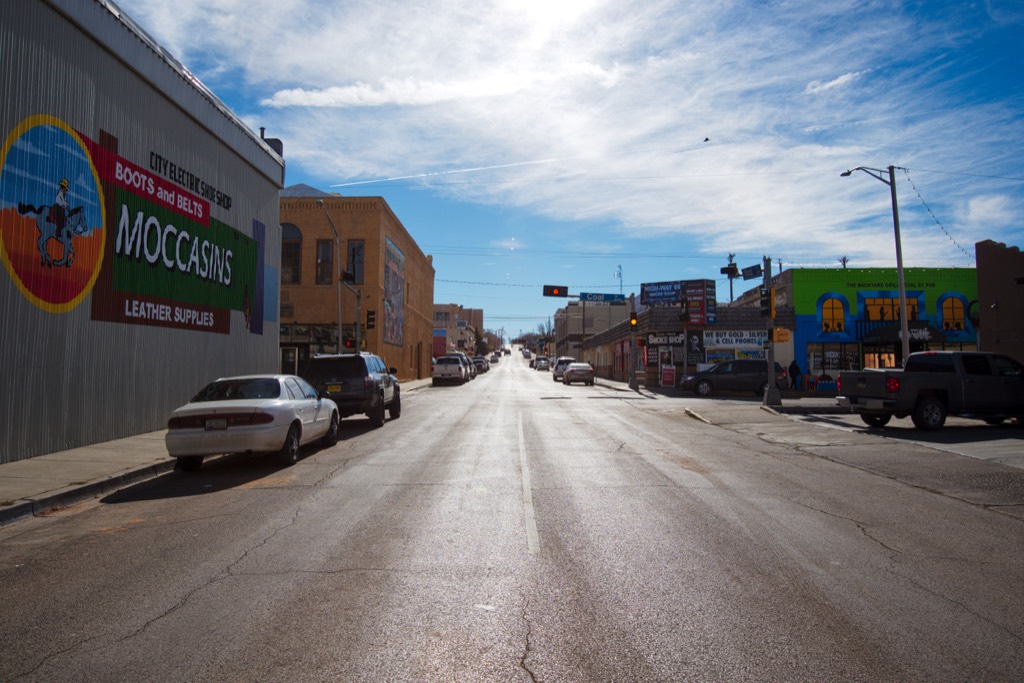
South 3rd Street in downtown Gallup, the seat of McKinley County, photographed in 2018. McKinley scores 95 on our County Distress Index, the second most distressed county in New Mexico. The Census Bureau put its 2024 poverty rate at 26.2% and its median household income at $45,517. Its jobless rate was 6.9% in August 2026, not adjusted for seasonal swings (Bureau of Labor Statistics).
Sources: U.S. Census Bureau; U.S. Bureau of Labor Statistics. Photo: Troy Sankey, Wikimedia Commons, CC BY-SA 4.0.

Is New Mexico expensive to live in?
Housing costs less than in most of the country, but incomes are lower too. The median rent, $1,067 a month from 2020 to 2024, was the 16th lowest of the 50 states and D.C., against $1,413 nationwide (Census Bureau). That rent takes 18.9% of the typical New Mexico household’s income, a little less than the 20.8% it takes nationally (our calculation). About one in four renter households, 25.7% in 2024, spent half or more of their income on housing. We don’t track the prices of food, gas or other goods, so we can’t rank New Mexico’s overall cost of living, and we have no figures for Albuquerque alone.
Median monthly rent
$1,067
U.S. $1,413
16th lowest of the 50 states and D.C., 2020 to 2024 (Census Bureau)
Share of typical income that rent takes
18.9%
U.S. 20.8%
Our calculation: Census Bureau rent, 2020 to 2024, and household income, 2024
Basic yearly budget, one adult, no children
$45,607
20th lowest of the 50 states and D.C. (MIT Living Wage Calculator, in 2025 dollars)
About one in four New Mexico renters spends half their income or more on housing, close to the U.S. share
Share of renter households paying 50% or more of income for rent and utilities, New Mexico and the United States, 2005 to 2024. No 2020 figure.
How much money you need to get by
MIT’s Living Wage Calculator puts the yearly cost of basic needs for one adult with no children in New Mexico at $45,607 before taxes, the 20th lowest of the 50 states and D.C. (2025 dollars). That covers necessities such as housing, food, health care and transportation, nothing more. For comparison, half of New Mexico households earned less than $67,838 in 2024.
Two changes reached household bills in the past year: child care became free for families at any income in November 2025, and PNM’s electric rates rose in April (see what changed).
Housing costs and homeownership: New Mexico beside the nation
| Measure | New Mexico | U.S. | Rank |
|---|---|---|---|
| Renter households paying 30% of income or more for housing 25th highest | 45.0% U.S. 47.6% | 47.6% | 25th highest |
| Owner households paying 30% of income or more for housing 26th highest | 20.5% U.S. 22.5% | 22.5% | 26th highest |
| Homes lived in by their owners Tied for 15th highest | 70.0% U.S. 65.2% | 65.2% | Tied for 15th highest |
Ranks among the 50 states and D.C., 2020 to 2024 (Census Bureau, American Community Survey). Rent and housing costs, state by state →
What changed in New Mexico in the past year
-
Oct. 6, 2026
Regulators’ staff ask for an investigation of PNM’s estimated bills
PNM, an electric company, told the New Mexico Public Regulation Commission on July 20 that a shortage of meter readers in Alamogordo and Ruidoso could mean more than two months of estimated bills; by Aug. 28 the problem had spread across its service area. PNM suspended late fees and shutoffs, offered payment plans and was reading meters normally again by mid-September. After a Sept. 29 town hall in Alamogordo, the commission’s public-interest staff asked it to open a formal investigation, including independent meter tests, to find out whether customers were overcharged. Alamogordo is in Otero County, the 14th most distressed county in the state.
-
April 1, 2026
PNM electric bills take their second step up
The second half of a rate increase the New Mexico Public Regulation Commission approved in May 2025 added about $6.23 a month to the average PNM home bill; a similar step came in July 2025. The money goes to wildfire prevention, grid upgrades and battery storage. As part of the approval, PNM must put $1.5 million of its own money into its Good Neighbor Fund, which helps customers who struggle to pay.
-
March 10, 2026
Free child care for every family becomes state law
Since Nov. 1, 2025, New Mexico has paid for child care for families at any income. The governor signed Senate Bill 241 into law on March 10, 2026; the state says it is the first to guarantee no-cost child care. Between the launch and the signing, 12,666 more families and 16,706 more children enrolled, and more than half of the new enrollees already qualified under the old income limits, the governor’s office said. Co-pays can return only under set economic conditions, and then only for households earning more than $163,920 a year.
-
Jan. 1, 2026
Federal health plan credits shrink; a state fund keeps paying
The larger federal tax credits for marketplace health plans expired Dec. 31, 2025. New Mexico’s Health Care Affordability Fund kept lowering premiums and out-of-pocket costs for people who buy coverage through BeWell, the state’s marketplace: lawmakers approved $17.3 million in an October 2025 special session to run through June 30, 2026, on top of the $21.5 million they approved in January 2025.
-
Jan. 1, 2026
New federal SNAP work rules begin
New federal work requirements for SNAP began Jan. 1, 2026, applied as each household renews; the New Mexico Health Care Authority estimates that about 35,277 SNAP members now face them. After holding steady from April to October 2025, the state’s SNAP count started falling in November 2025, before the rules took effect. It went from 457,974 people in October 2025 to 435,290 in June 2026 (U.S. Department of Agriculture). The count alone doesn’t say why it fell.
New Mexico Health Care Authority, federal SNAP changes (estimated as of July 8, 2026)
-
Nov. 10, 2025
The state backs up food benefits during the federal shutdown
With November SNAP benefits in doubt during the federal government shutdown, lawmakers in a special session passed House Bill 1, letting the state spend up to $20 million a week from its reserves on food benefits through the week of Jan. 19, 2026, only if federal money failed. The state had already paid full November benefits on Nov. 7 for families whose benefits were due between Nov. 1 and Nov. 8.
New Mexico’s unemployment rate rose over the past year even as jobs grew
New Mexico’s unemployment rate was 4.7% in August 2026, up from 4.1% a year earlier. New Mexico was one of 10 states where the rise was large enough for the Bureau of Labor Statistics to count it as a real change. Over the same year, employers in the state added 14,500 jobs, a 1.6% gain that tied Louisiana and South Carolina for the fastest of any state. The two figures come from different surveys: the jobless rate counts people where they live, and the job count tallies jobs where employers are, the bureau notes. New Mexico’s rate has been above the nation’s every month since January 2026, though in August the bureau did not count the gap as a real difference.
Unemployment rate, June to August 2026
4.8%
U.S. 4.1%
Tied for 10th highest of the 50 states and D.C.
Growth in jobs, August 2025 to August 2026
1.6%
Tied with Louisiana and South Carolina for the largest gain of any state; 907,400 jobs in August 2026, preliminary (Bureau of Labor Statistics)
Residents
2,125,498
0.3% more than in 2020, tied for 8th lowest among the 50 states and D.C., 2025
New Mexico’s jobless rate has been above the nation’s every month since January 2026
Monthly jobless rate for New Mexico and the nation, adjusted for seasonal swings, from January 1990 through August 2026. The federal shutdown left October 2025 without a figure.
Luna County has one of the highest jobless rates in the country
Luna County, on the Mexican border around Deming, had a jobless rate of 11.4% in August 2026, not adjusted for seasonal swings, the highest in New Mexico and the 5th highest of the 3,143 U.S. counties with an August rate. Los Alamos was the lowest in the state, at 2.2% (Bureau of Labor Statistics).
Is New Mexico’s population growing?
The state is barely growing. It had 2,125,498 residents in 2025, slightly fewer than its 2024 peak of 2,126,774, and 0.3% more than in 2020 (Census Bureau). We don’t track why people move.
Jobless rates in selected counties
| County | Rate |
|---|---|
| Luna (Deming) | 11.4% |
| McKinley (Gallup) | 6.9% |
| Hidalgo (Lordsburg) | 6.6% |
| Cibola (Grants) | 6.0% |
| Doña Ana (Las Cruces) | 5.3% |
| Bernalillo (Albuquerque) | 4.7% |
| Santa Fe | 4.2% |
| Eddy (Carlsbad) | 3.5% |
| Los Alamos | 2.2% |
August 2026, not adjusted for seasonal swings. Luna, McKinley and Hidalgo had the three highest rates in the state; Los Alamos had the lowest. Source: Bureau of Labor Statistics. Unemployment, state by state →
Unemployment claims are filed with the New Mexico Department of Workforce Solutions. The U.S. Bureau of Economic Analysis publishes the size of New Mexico’s economy.
How many New Mexicans are falling behind on bills?
About one in five. In early 2025, 19.8% of New Mexicans with a credit record had a debt 90 or more days late, the 12th highest share among the 50 states and D.C., against 17.2% for the U.S. (Federal Reserve Bank of Philadelphia). We weight the states by population to get the national figure. That counts household debts such as car loans, credit cards and mortgages, not state government debt.
Borrowing is lower than in most states. At the end of 2025 New Mexicans owed $49,260 per person with a credit report, against $63,200 nationwide, and $3,520 a person on credit cards, 10th lowest of the 50 states and D.C. (Federal Reserve Bank of New York). Car loans stand out: by the share of borrowers far behind, New Mexico ranks 9th highest.
New Mexico’s place among the 50 states and D.C., counting from the highest: car loans 9th, mortgages tied for 12th, debts in collections 13th, cards 21st. Each U.S. bar is our population-weighted average of the states.
The share of card borrowers 90 or more days behind climbed from 11.1% at the end of 2019 to 13.5% in early 2025. The share with a debt in collections fell from 24.3% to 15.9% over the same years. Most of that fall came between early 2022 and mid-2023, from 20.1% to 14.7%, so it doesn’t mean fewer people were unable to pay. In 2022, the three big credit bureaus said they would stop reporting certain medical debts. Nationwide, the share of people with a medical collection on their record went from about 14% in March 2022 to about 5% in June 2023 (Consumer Financial Protection Bureau).
Mortgages: a little more trouble than the U.S.
In September 2025, 1.8% of New Mexico mortgages were 30 to 89 days late, an early stage of falling behind, against 1.6% nationwide (Consumer Financial Protection Bureau). In the second quarter of 2026, 5.2% of mortgages had less than 10% equity, a thin cushion if a home must be sold (Federal Housing Finance Agency).
| Measure | New Mexico | U.S. | Rank |
|---|---|---|---|
| Mortgages 30 to 89 days late, Sept. 2025 Tied for 16th highest | 1.8% U.S. 1.6% | 1.6% | Tied for 16th highest |
| Mortgages with under 10% equity, second quarter of 2026 15th highest | 5.2% U.S. 4.7% | 4.7% | 15th highest |
| People with a credit record scoring below 620, early 2025 Tied for 12th highest | 15.3% U.S. 13.8% | 13.8% | Tied for 12th highest |
Ranks among the 50 states and D.C. Late mortgages: Consumer Financial Protection Bureau. Equity is what the home is worth minus what’s owed on it: Federal Housing Finance Agency. Credit scores: Federal Reserve Bank of Philadelphia, with the U.S. figure our population-weighted average of the states.
A second measure: dollars behind
The New York Fed measures money rather than people: how much of what’s owed is at least 90 days overdue. At the end of 2025 New Mexico’s share of car-loan dollars seriously behind was tied for 10th highest, and its share of card dollars was 18th highest. In 2019 both were closer to the top among the states: tied for 5th highest for car loans and tied for 7th highest for cards.
| Loan type | New Mexico | U.S. | New Mexico 2019 | U.S. 2019 |
|---|---|---|---|---|
| Credit card | 11.9% End of 2025 U.S. 12.4% New Mexico 2019 9.0% · U.S. 2019 8.1% | 12.4% | 9.0% | 8.1% |
| Auto loan | 6.1% End of 2025 U.S. 5.2% New Mexico 2019 6.4% · U.S. 2019 4.9% | 5.2% | 6.4% | 4.9% |
| Mortgage | 1.0% End of 2025 U.S. 0.9% New Mexico 2019 1.4% · U.S. 2019 1.0% | 0.9% | 1.4% | 1.0% |
Share of balances 90 or more days past due, end of 2025 and end of 2019. Source: Federal Reserve Bank of New York, Consumer Credit Panel / Equifax. This counts dollars, not people, so it doesn’t line up with the Philadelphia Fed shares above.
How much New Mexicans owe
At the end of 2019, New Mexicans owed $41,000 per person with a credit report, $2,860 of it on cards. Both have grown since but stayed below the U.S. figures (Federal Reserve Bank of New York). Household debt, state by state →
New Mexicans file for bankruptcy at less than half the U.S. rate
New Mexicans filed 1,660 bankruptcy cases in 2025, or 77.9 for every 100,000 residents (2024 population), the 9th lowest rate of the 50 states and D.C., against 167.1 nationwide (U.S. Courts). Filings have still risen three years in a row, up 16.9% in 2025 alone, to the most since 2020. Almost all are Chapter 7 cases, 86.3%, the 3rd highest share. In Chapter 7, a court trustee sells any property the law doesn’t protect to pay creditors, and most remaining debts are wiped out. Only 12.9% were Chapter 13, which repays debts through a court plan over three to five years; nationwide the share is 35.9%.
| Year | Filings |
|---|---|
| 2018 | 3,274 |
| 2019 | 3,046 |
| 2020 | 2,423 |
| 2021 | 1,510 |
| 2022 | 1,075 |
| 2023 | 1,193 |
| 2024 | 1,420 |
| 2025 | 1,660 |
Bankruptcy cases filed in the U.S. Bankruptcy Court for the District of New Mexico, by calendar year. Source: Administrative Office of the U.S. Courts, Table F-2. Bankruptcy filings, state by state →
How foreclosure works in New Mexico
Most New Mexico home foreclosures go through a court. For a home loan covered by the state’s Home Loan Protection Act, the mortgage company must first send a notice giving you at least 30 days to catch up. You can also catch up and keep the loan any time before the home’s title changes hands. Federal rules generally add a wait: on a home you live in, the company usually can’t begin until you’re more than 120 days behind. After the court’s judgment, the sale can’t happen for at least 30 days. After the sale, you can still buy the home back within nine months of the court’s order approving it, unless the mortgage shortens that to as little as one month. The Second Judicial District Court in Albuquerque runs the Statewide Foreclosure Settlement Program, which helps homeowners and lenders reach an agreement. Despite the name, it only covers districts that have joined it, so ask your district court whether it’s offered in your county.
- Goes through a court
- Usually
- Notice to catch up before the case
- 30 days
- Wait from judgment to sale
- 30 days
- Window to redeem (buy back) the home after the sale
- Up to 9 months
- Lender can seek the balance left after the sale
- Yes
- Homestead protection from most creditors
- $150,000
What the law says. The homestead amount is the figure in the statute, adjusted for inflation every two years since July 2025, and it doesn’t apply to the mortgage itself. Sources: New Mexico Statutes 58-21A-6; Chapter 39, Article 5 (court sales, including 39-5-18 and 39-5-19); 42-10-9; federal rule 12 CFR 1024.41; Second Judicial District Court, Statewide Foreclosure Settlement Program. How foreclosure works in New Mexico →
New Mexico received $55.8 million from the federal Homeowner Assistance Fund; through the first quarter of 2026 it had helped 5,703 households with mortgage payments and other housing costs (U.S. Treasury).
What New Mexico homeowners complain about most: problems making payments
New Mexicans have filed 1,911 mortgage complaints with the Consumer Financial Protection Bureau since December 2011. The biggest group, 502, was about trouble during the payment process. Next came loan servicing, payments and escrow (371); then loan modifications, collections and foreclosure (337). The bureau used those two categories until April 2017.
- Oct. 4, 2026 BMO Bank Payment process: escrow, taxes or insurance Closed with explanation
- Sept. 28, 2026 BMO Bank Payment process: hard to reach the company to fix a loan problem Closed with non-monetary relief
- Sept. 19, 2026 Ally Financial Payment process: hard to reach the company to fix a loan problem Closed with explanation
- Sept. 17, 2026 21st Mortgage Payment process: escrow, taxes or insurance Closed with explanation
- Sept. 9, 2026 CMG Financial Payment process: escrow, taxes or insurance Closed with explanation
- Sept. 8, 2026 U.S. Bank Struggling to pay: help already in place (modification, forbearance or other relief) Closed with explanation
- Sept. 1, 2026 Freedom Mortgage Struggling to pay: hard to reach the company about a modification, forbearance or foreclosure Closed with explanation
- Aug. 31, 2026 Idaho Housing and Finance Association Payment process: escrow, taxes or insurance Closed with explanation
- Aug. 30, 2026 Ocwen / Onity Group Payment process: the loan was sold or moved to another company Closed with explanation
- Aug. 27, 2026 Ocwen / Onity Group Payment process: private mortgage insurance Closed with explanation
The ten latest New Mexico complaints about making mortgage payments or getting help with them, newest first, from the Consumer Financial Protection Bureau’s public database as of Oct. 14, 2026. Complaints about getting a loan and about credit reports are left out. The bureau doesn’t check each person’s account before publishing it. Every New Mexico mortgage complaint at the Consumer Financial Protection Bureau →
What to watch before the next edition
Scheduled dates before the next edition: a jobs report, health plan sign-up and the start of the 2027 legislative session.
-
Oct. 20, 2026
September’s state jobless rates
September’s jobless rates for every state are due from the Bureau of Labor Statistics on Oct. 20. New Mexico’s August rate was 4.7%, up from 4.1% a year earlier.
Bureau of Labor Statistics, State Employment and Unemployment, August 2026
-
Nov. 1, 2026 to Jan. 15, 2027
Health plan sign-up, with higher 2027 prices
BeWell’s open enrollment runs Nov. 1 to Jan. 15. The state approved 2027 rates that rise 24.4% on average, starting Jan. 1, 2027; 92% of BeWell enrollees qualify for state and federal premium help based on income, and the state fund is expected to keep lowering costs in 2027, the Office of Superintendent of Insurance said.
New Mexico Office of Superintendent of Insurance, Sept. 1, 2026
-
Jan. 19, 2027
The Legislature opens its 2027 session
Lawmakers may prefile bills from Jan. 4 to Jan. 15. The session opens at noon on Jan. 19 and ends at noon on March 20.
Where New Mexico ranks highest and lowest
| Measure | New Mexico | U.S. | Rank | Latest data |
|---|---|---|---|---|
| State Distress Index score 18th highest · Aug. 2026 | 66 U.S. — | — | 18th highest | Aug. 2026 |
| Residents getting SNAP food benefits Highest · June 2026 | 20.4% U.S. 10.7% | 10.7% | Highest | June 2026 |
| Share of income from government benefits 4th highest · 2024 | 25.3% U.S. 18.3% | 18.3% | 4th highest | 2024 |
| Children in poverty 4th highest · 2024 | 20.5% U.S. 15.5% | 15.5% | 4th highest | 2024 |
| Residents in poverty 5th highest · 2024 | 15.8% U.S. 12.1% | 12.1% | 5th highest | 2024 |
| Residents with a disability 6th highest · 2024* | 17.0% U.S. 13.3% | 13.3% | 6th highest | 2024* |
| Adults without a high school diploma Tied for 6th highest · 2024* | 12.0% U.S. 10.4% | 10.4% | Tied for 6th highest | 2024* |
| Car-loan borrowers 90+ days late 9th highest · Early 2025 | 10.6% U.S. 8.5% | 8.5% | 9th highest | Early 2025 |
| Unemployment rate, three-month average Tied for 10th highest · June–August 2026 | 4.8% U.S. 4.1% | 4.1% | Tied for 10th highest | June–August 2026 |
| People with a debt 90+ days late 12th highest · Early 2025 | 19.8% U.S. 17.2% | 17.2% | 12th highest | Early 2025 |
| Household debt per person with a credit report 13th lowest · End of 2025 | $49,260 U.S. $63,200 | $63,200 | 13th lowest | End of 2025 |
| Bankruptcy filings per 100,000 residents 9th lowest · 2025 | 77.9 U.S. 167.1 | 167.1 | 9th lowest | 2025 |
| Median household income 8th lowest · 2024 | $67,838 U.S. $81,604 | $81,604 | 8th lowest | 2024 |
| Income per person 4th lowest · 2024 | $58,249 U.S. $73,204 | $73,204 | 4th lowest | 2024 |
Ranks count the 50 states and D.C. * Census five-year survey, 2020 to 2024. The unemployment rate is the June to August 2026 average. Bankruptcy rates use 2024 population. For car-loan borrowers and people behind, the U.S. number averages the states, weighted by population (our calculation). Where each figure comes from: Sources and method. Download this table: CSV.
Questions about New Mexico
Why is New Mexico so poor?
There’s no single cause our data can point to. Our figures show a state where wages make up less of income than in the nation, 46.2% against 49.7%, and government benefits more, 25.3%, the 4th highest share (Bureau of Economic Analysis, 2024). Its poverty rate was among the four highest of any state in every yearly Census estimate from 2009 to 2023. It was the 5th highest in 2024, though that was New Mexico’s lowest rate in any Census estimate since 1989.
Is New Mexico the poorest state?
No. Its poverty rate, 15.8% in 2024, was the 5th highest; Louisiana, Mississippi, D.C. and West Virginia were higher. Its typical household income, $67,838, was the 8th lowest (U.S. Census Bureau). On our State Distress Index it ranks 18th most distressed.
Which county in New Mexico is the poorest?
By the U.S. Census Bureau’s 2024 estimates, Socorro County has the highest poverty rate, 28.5%, and Luna County the lowest typical household income, $41,456. On our County Distress Index, Cibola County is the most distressed in the state, and Los Alamos is the least distressed county in the country, with a poverty rate of 3.8%, tied for the lowest of any U.S. county.
How much money do you need to live in New Mexico?
MIT’s Living Wage Calculator puts basic needs for one adult with no children at $45,607 a year before taxes, in 2025 dollars, the 20th lowest of the 50 states and D.C. overall. Rent is lower than in most states: a median of $1,067 a month from 2020 to 2024 (U.S. Census Bureau). Prices for groceries, fuel and everything else aren’t part of our data.
What counts as the poverty line in New Mexico?
The federal government’s 2026 guideline: $15,960 a year for someone living alone and $33,000 for a household of four. Only Alaska and Hawaii use different numbers (U.S. Department of Health and Human Services).
Is Texas or New Mexico more distressed?
Texas. It scores 90 on our State Distress Index and New Mexico 66, though its typical household earned more in 2024, $79,723 against $67,838 (U.S. Census Bureau); see Texas’ page.
Cite or reuse New Mexico’s data
For reporting, research, grant proposals and policy work.
State Distress Index
New Mexico
18thmost distressed state
of the 50 states and D.C.
More distressed than 66% of the other states and D.C.
American Default Research’s State Distress Index, which measures household financial distress, ranks New Mexico 18th most distressed among the 50 states and D.C.. Its poverty rate, 15.8% in 2024, was the 5th highest (U.S. Census Bureau), and in early 2025, 19.8% of New Mexicans with a credit record had a debt 90 or more days late (Federal Reserve Bank of Philadelphia). On the companion County Distress Index, Los Alamos ranks as the least distressed of all 3,144 U.S. counties.
Reporters and researchers can reach us for interviews, questions or other cuts of these figures: press@americandefault.org
Sources and method
We gather the data, run the numbers and research each state ourselves.
This edition: October 2026 · Next edition expected March 2027
- Late payments, collections, credit scoresFederal Reserve Bank of Philadelphia, Consumer Credit Explorerend of 2019 to early 2025
- Household debt and dollars behindFederal Reserve Bank of New York, Consumer Credit Panel / Equifaxend of 2019 and end of 2025
- Mortgages with little equityFederal Housing Finance Agency, National Mortgage Databasesecond quarter of 2026
- Mortgages 30 to 89 days late; mortgage complaints; medical debts on credit reportsConsumer Financial Protection Bureau: Mortgage Performance Trends; complaint database; Recent changes in medical collections on consumer credit recordsSept. 2025; Oct. 14, 2026; March 2022 to June 2023
- Bankruptcy filingsU.S. Courts, Table F-22018 to 2025
- Unemployment, state, county and nationalU.S. Bureau of Labor Statistics, Local Area Unemployment StatisticsJan. 1990 to Aug. 2026
- Jobs addedU.S. Bureau of Labor Statistics, State Employment and Unemployment, August 2026Aug. 2025 to Aug. 2026
- Poverty and income, state and countyCensus Bureau, Small Area Income and Poverty Estimates1989 to 2024
- Renter households spending half their income or more on housingCensus Bureau, American Community Survey, 1-year2005 to 2024
- Rent, homeownership, housing costs, schooling, disabilityCensus Bureau, American Community Survey, 5-year2020 to 2024
- PopulationCensus Bureau, population estimates2020 to 2025
- Income per person and its sourcesBureau of Economic Analysis2024
- SNAPU.S. Department of Agriculture Food and Nutrition AdministrationBefore the pandemic; June 2025 to June 2026
- Cost of basic needsMIT Living Wage Calculator2025 dollars
- Mortgage help fundU.S. Treasury, Homeowner Assistance Fundthrough the first quarter of 2026
- Foreclosure lawNew Mexico Statutes Annotated (58-21A-6; Chapter 39, Article 5, including 39-5-18 and 39-5-19; 42-10-9); Second Judicial District Court; 12 CFR 1024.41as of 2026
- Poverty guidelineU.S. Department of Health and Human Services2026
- Housing counselorsU.S. Department of Housing and Urban DevelopmentOctober 2026
- What changed and what to watchNew Mexico Public Regulation Commission, Office of the Governor, New Mexico Health Care Authority, New Mexico Office of Superintendent of Insurance, New Mexico Legislature, Bureau of Labor Statistics; every dated item above links to the page we read it onNov. 2025 to March 2027
- County photoTroy Sankey, via Wikimedia Commons, CC BY-SA 4.02018
The score has four equal parts: late payments; collections and bankruptcy; jobs; and renters’ housing costs. Each measure is scored against the 50 states and D.C., and the score is the share of the other 50 whose average of the four parts is lower than New Mexico’s. The full method →
We write with AI tools, and Ross Kilburn checks and reviews every page before it's published.
Get the next New Mexico edition by email
One email each time a new New Mexico edition is out; the next is expected in March 2027. Unsubscribe anytime.
Thanks, that helps.