Food CPI
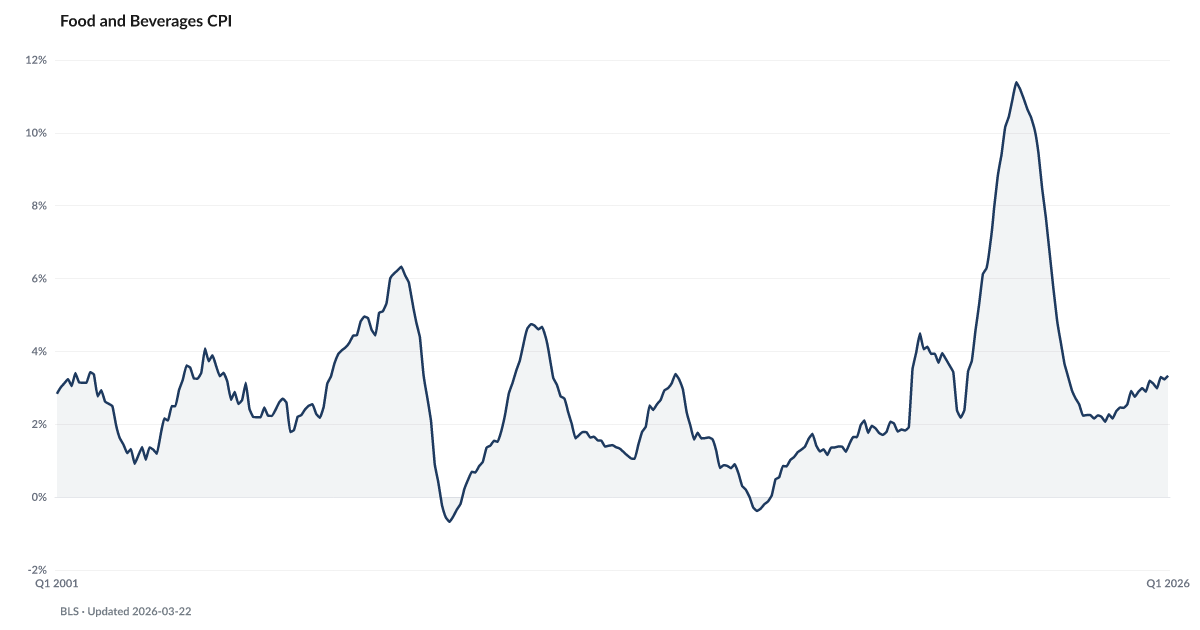
Year-over-year change in food prices
What is the current Food CPI reading?
Food CPI: 2.94% as of 2026-07. Source: U.S. Bureau of Labor Statistics (CUSR0000SAF1).
Measurement basis: Year-over-year percent change computed from the seasonally adjusted BLS Food CPI (CUSR0000SAF1); seasonally adjusted values may be revised
Food inflation is running at 2.94%. It lands on top of years of grocery-price increases that never reversed.
Food inflation came down through 2023 and 2024, reaching 2.1% in August 2024 — the softest reading since 2021. For a moment it looked like the grocery aisle had caught up to the rest of the disinflation story.
It did not hold. BLS data puts food CPI at 2.94% as of July 2026. The disinflation that carried the rest of the economy stopped short of the grocery aisle. Processing costs and the tariff regime tracked in The Import Tax are both feeding through.
What the annual rate does in any one month does not undo the cumulative increase. Grocery Prices Cumulative Change Since Jan 2020 remains far above its January 2020 baseline. Households are not paying 2020 prices. They are paying current prices.
The Grocery Gap shows the combined effect. The margin between wage growth and food prices is thin enough that an ordinary move in either one closes it, which is why the cushion is worth watching rather than the level.
Explore Further
How has Food CPI changed over time?

Most affected counties
Counties with the highest debt burden scores in the County Distress Index.
Explore all 3,144 counties →| Period | Value | YoY Change |
|---|---|---|
| Jul 2026 | 2.94% | +0.04 pp |
| Jun 2026 | 2.99% | -0.01 pp |
| May 2026 | 3.08% | +0.18 pp |
| Apr 2026 | 3.22% | +0.46 pp |
| Mar 2026 | 2.75% | -0.17 pp |
| Feb 2026 | 3.14% | +0.59 pp |
| Jan 2026 | 2.93% | +0.48 pp |
| Dec 2025 | 3.04% | +0.58 pp |
| Nov 2025 | 2.62% | +0.26 pp |
| Sep 2025 | 3.11% | +0.84 pp |
| Aug 2025 | 3.2% | +1.13 pp |
| Jul 2025 | 2.89% | +0.69 pp |
Frequently Asked Questions
What is Food CPI?
Year-over-year change in food prices
Why does Food CPI matter for financial distress?
Food CPI is one of the indicators tracked by the American Distress Index (ADI), which measures five dimensions of U.S. household financial distress: Delinquency, Default & Legal, Debt Burden, Labor, and Safety Net & Buffer. Changes in this indicator contribute to the overall distress picture.
Where does the Food CPI data come from?
This data comes from U.S. Bureau of Labor Statistics (CUSR0000SAF1). More information: https://data.bls.gov/timeseries/CUSR0000SAF1. The American Distress Index updates this indicator monthly.


Quick poll
Is this affecting you or your household?
Discussion
Get the numbers when they move.
New data drops, indicator updates, and ADI score changes — delivered when it matters. No spam.
or Create an Account for full access
Loading comments…