The Import Tax
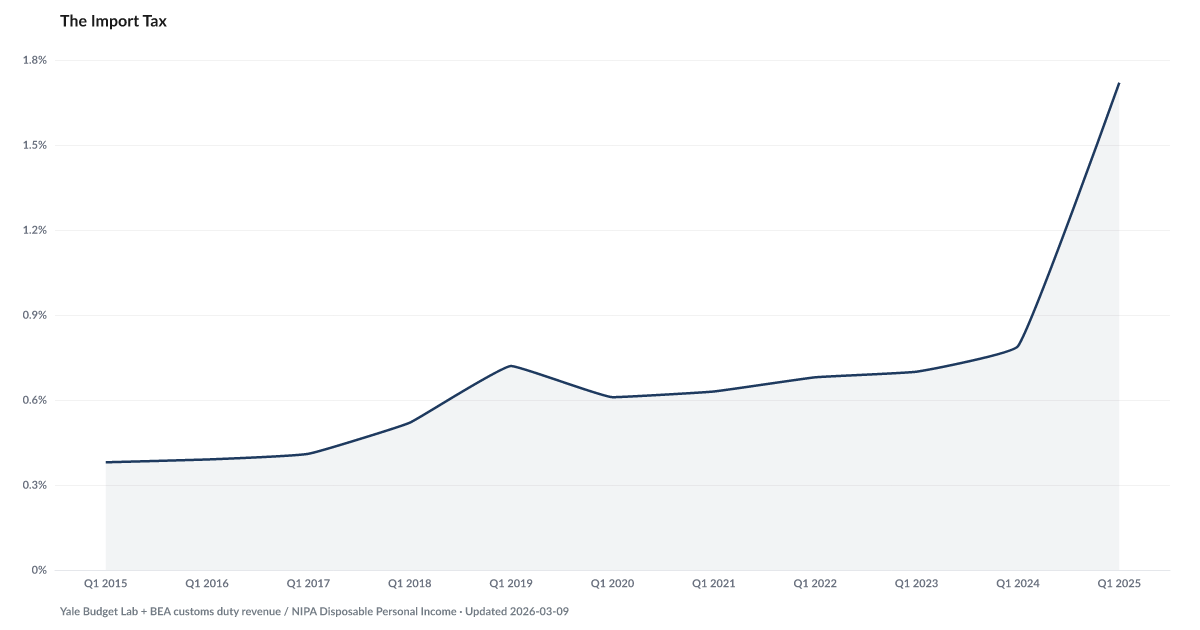
Federal customs-duty receipts as a share of aggregate disposable personal income
What is the current Import Tax reading?
Federal customs duties were 1.16% of aggregate U.S. disposable personal income in 2025. The ratio divides the U.S. Bureau of Economic Analysis annual customs-duties total by BEA annual disposable personal income. It is not a monthly import-price index, a modeled price-level effect, or an estimate of the cost borne by an average household. Source: Computed from U.S. Bureau of Economic Analysis federal customs duties and NIPA disposable personal income data retrieved via FRED.
Federal customs duties equaled 1.16% of aggregate disposable personal income in 2025, 3× the prior annual share.
This series divides annual federal customs duties by annual U.S. disposable personal income. Both inputs are Bureau of Economic Analysis National Income and Product Accounts series, published in billions of dollars and distributed through FRED.
The ratio stayed below one percent throughout 2015–2024. In 2025, it rose to 1.16%. That describes the scale of federal customs-duty collections relative to the aggregate personal-income base.
The ratio is not a household-incidence estimate. It does not determine how tariff costs are split among importers, producers, retailers, and consumers, and it is not a consumer price index or a modeled price-level effect.
Read this fiscal ratio alongside CPI Inflation, The Coverage Tax, and The Grocery Gap as separate cost-pressure measures. None of those series identifies tariff pass-through by itself.
Explore Further
Is this happening to you?
Have your grocery or household costs gone up in ways that feel disconnected from inflation headlines?
How has The Import Tax changed over time?

Most affected counties
Counties with the highest debt burden scores in the County Distress Index.
Explore all 3,144 counties →| Period | Value | YoY Change |
|---|---|---|
| 2025 | 1.16% | +0.78 pp |
| 2024 | 0.38% | -0.01 pp |
| 2023 | 0.39% | -0.15 pp |
| 2022 | 0.54% | +0.07 pp |
| 2021 | 0.47% | +0.08 pp |
| 2020 | 0.39% | -0.09 pp |
| 2019 | 0.48% | +0.14 pp |
| 2018 | 0.34% | +0.08 pp |
| 2017 | 0.26% | -0.01 pp |
| 2016 | 0.27% | -0.01 pp |
| 2015 | 0.28% | — |
Frequently Asked Questions
What is The Import Tax?
The Import Tax reports federal customs-duty receipts as a share of aggregate disposable personal income. The ratio is 1.16% in 2025; it does not estimate household incidence or monthly import-price inflation.
What does this ratio show?
It shows the scale of federal customs-duty collections relative to the aggregate disposable-income base. It does not show who ultimately bears those costs; answering that requires separate evidence about price pass-through, substitution, and household spending.
Where does this data come from?
Source: Computed from U.S. Bureau of Economic Analysis federal customs duties and NIPA disposable personal income data retrieved via FRED. For each year, the published value is federal customs duties divided by disposable personal income, with both BEA inputs expressed in billions of dollars.


Quick poll
Is this affecting you or your household?
Discussion
Get the numbers when they move.
New data drops, indicator updates, and ADI score changes — delivered when it matters. No spam.
or Create an Account for full access
Loading comments…