Motor Vehicle Insurance CPI
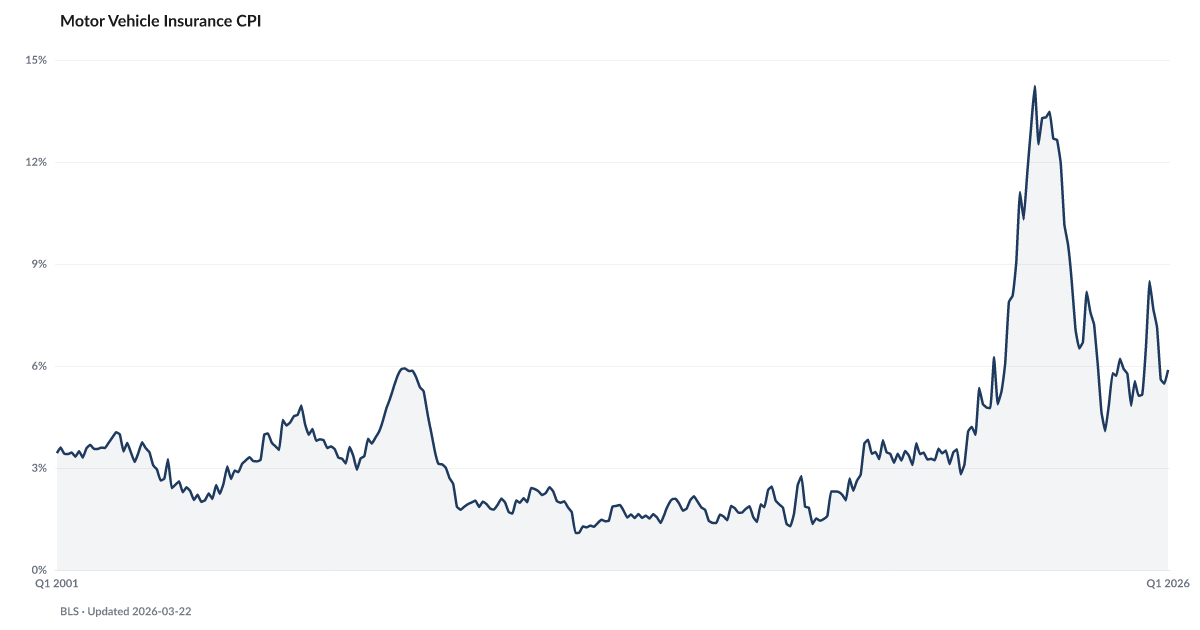
Year-over-year change in auto insurance premiums
Real Federal Minimum Wage is currently elevated — historically leads this indicator by 3 quarters. Real Federal Minimum Wage · View projections
What is the current Motor Vehicle Insurance CPI reading?
Motor Vehicle Insurance CPI: 6.62% as of 2026-07. Source: U.S. Bureau of Labor Statistics (CUSR0000SETD).
Auto insurance inflation is running at 6.62% year-over-year, well above the overall CPI rate.
Before the pandemic, auto insurance inflation ran in the low single digits. Predictable. Slow. A routine feature of driving in America.
BLS data shows it at 6.62% in July 2026. The series reached 14.2% in January 2023, and the cost base built up on the way there has not come back down.
The drivers are structural. Vehicles are more expensive to repair because they contain more sensors and electronics. Medical costs for injury claims continue climbing. Litigation and claim severity are both elevated. None of these reverse easily.
For households, insurance is required to drive legally. That makes it one of the hardest line items to trim when budgets tighten. The Repo Line tracks serious delinquency on auto loans. Households keep the car running, borrow against the wire, and then lose it. The insurance line is part of what pushes them there.
Explore Further
How has Motor Vehicle Insurance CPI changed over time?

Most affected counties
Counties with the highest debt burden scores in the County Distress Index.
Explore all 3,144 counties →| Period | Value | YoY Change |
|---|---|---|
| Jul 2026 | 6.62% | +0.08 pp |
| Jun 2026 | 7.03% | +1.88 pp |
| May 2026 | 6.13% | +1 pp |
| Apr 2026 | 5.15% | -0.41 pp |
| Mar 2026 | 6.05% | +1.22 pp |
| Feb 2026 | 5.62% | -0.15 pp |
| Jan 2026 | 4.95% | -0.96 pp |
| Dec 2025 | 5.38% | -0.84 pp |
| Nov 2025 | 6.94% | +1.23 pp |
| Sep 2025 | 7.68% | +2.82 pp |
| Aug 2025 | 8.5% | +4.41 pp |
| Jul 2025 | 6.54% | +1.9 pp |
Frequently Asked Questions
What is Motor Vehicle Insurance CPI?
Year-over-year change in auto insurance premiums
Why does Motor Vehicle Insurance CPI matter for financial distress?
Motor Vehicle Insurance CPI is one of the indicators tracked by the American Distress Index (ADI), which measures five dimensions of U.S. household financial distress: Delinquency, Default & Legal, Debt Burden, Labor, and Safety Net & Buffer. Changes in this indicator contribute to the overall distress picture.
Where does the Motor Vehicle Insurance CPI data come from?
This data comes from U.S. Bureau of Labor Statistics (CUSR0000SETD). More information: https://data.bls.gov/timeseries/CUSR0000SETD. The American Distress Index updates this indicator monthly.


Quick poll
Is this affecting you or your household?
Discussion
Get the numbers when they move.
New data drops, indicator updates, and ADI score changes — delivered when it matters. No spam.
or Create an Account for full access
Loading comments…