The Repo Line
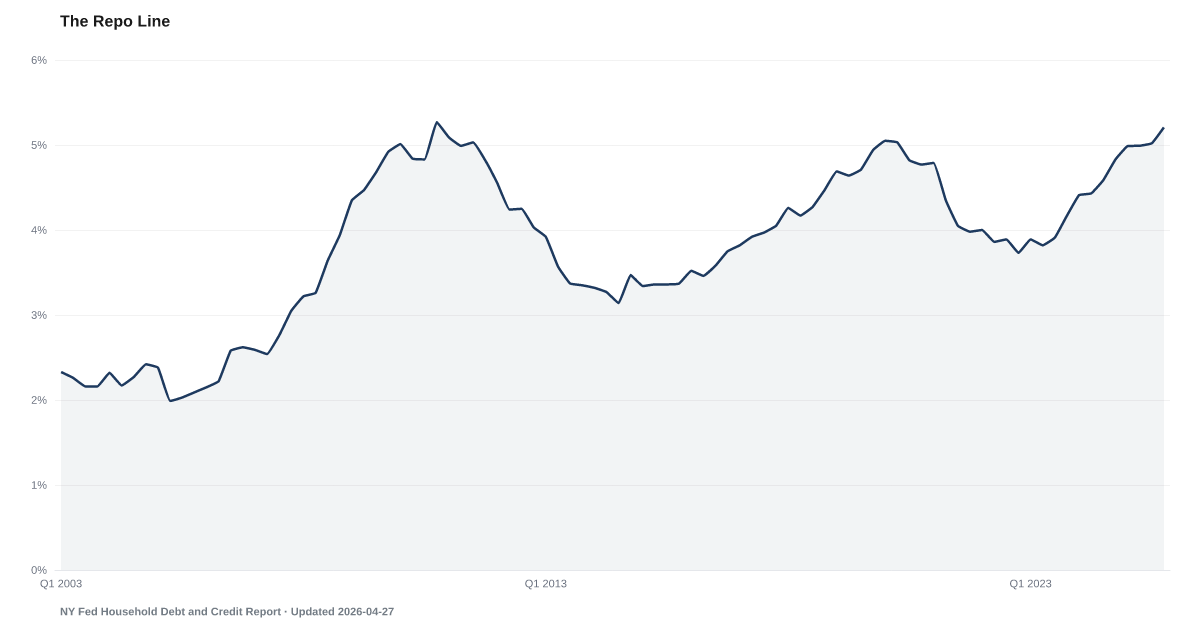
Auto loans 90+ days past due as share of total auto debt
What is the current Repo Line reading?
Auto loan serious delinquency — the share of outstanding balances 90 or more days past due — reached 5.49% in Q2 2026, according to the Federal Reserve Bank of New York. The reading is above the previous series peak recorded during the Great Recession era. This aggregate series measures delinquent balances, not individual borrowers or causes. Source: Federal Reserve Bank of New York Household Debt and Credit Report (Q2 2026).
Measurement basis: Percent of outstanding auto loan balances that are 90 or more days delinquent, using the "AUTO" series in the New York Fed table "Percent of Balance 90+ Days Delinquent by Loan Type" (unit: Percent; source: New York Fed Consumer Credit Panel/Equifax). This is a balance-level rate, not a share of borrowers.
The auto loan market has become the clearest signal of what happens when strained borrowers meet elevated borrowing costs.
Serious delinquency on auto loans — balances 90 or more days past due — reached 5.49% in Q2 2026, according to the Federal Reserve Bank of New York; that is below its series record, and up from 3.98% at the end of 2021. Unlike mortgages, where forbearance programs provided a buffer, auto loans received no comparable relief, making them an early and unfiltered signal of household financial stress.
Auto loans occupy a unique position in the household balance sheet. Borrowers typically prioritize car payments above credit cards and even some utility bills, because losing a vehicle means losing the ability to get to work. When auto loan delinquency rises to these levels, it signals that borrowers have already exhausted other options. Falling Behind confirms the broader picture: total delinquency across all consumer debt is rising in step.
The surge in auto loan distress traces directly to the pandemic-era vehicle market. Buyers who purchased vehicles in 2021–2022 paid inflated prices and, as rates rose, locked in higher monthly payments. The Card Tax illustrates the broader rate environment as credit card APRs add to the pressure. For households already managing elevated credit card debt, an underwater auto loan becomes the breaking point. Pink Slips adds another dimension: January 2026 saw the worst start-of-year layoff announcement total in many years, compounding the pressure.
Explore Further
Is this happening to you?
Are you worried about making your next car payment?
How has The Repo Line changed over time?

Most affected counties
Counties with the highest delinquency scores in the County Distress Index.
Explore all 3,144 counties →| Period | Value | YoY Change |
|---|---|---|
| Q2 2026 | 5.49% | +0.5 pp |
| Q1 2026 | 5.6% | +0.61 pp |
| Q4 2025 | 5.21% | +0.38 pp |
| Q3 2025 | 5.02% | +0.43 pp |
| Q2 2025 | 4.99% | +0.56 pp |
| Q1 2025 | 4.99% | +0.58 pp |
| Q4 2024 | 4.83% | +0.66 pp |
| Q3 2024 | 4.59% | +0.68 pp |
| Q2 2024 | 4.43% | +0.61 pp |
| Q1 2024 | 4.41% | +0.52 pp |
| Q4 2023 | 4.17% | +0.44 pp |
| Q3 2023 | 3.91% | +0.02 pp |
Frequently Asked Questions
What is the current auto loan delinquency rate?
5.49% of auto loan balances were 90 or more days past due in Q2 2026, according to the Federal Reserve Bank of New York. This is the highest reading in the published series.
What does the auto loan delinquency rate measure?
The rate is the share of outstanding auto loan balances that are 90 or more days past due. It does not measure the share of borrowers, identify a household's other debts, or establish why a payment became delinquent.
Does the series explain why delinquency increased?
No. The series records the percentage of balances that are seriously delinquent. Determining causes requires separate evidence about loan terms, income, vehicle prices, interest rates, and borrower circumstances.
Does the public series compare delinquency across income levels?
No. The public aggregate shown here does not break the reading out by household income. It should not be used to make income-group comparisons.
Where does auto loan delinquency data come from?
The Federal Reserve Bank of New York reports auto loan delinquency quarterly in its Household Debt and Credit Report, based on Consumer Credit Panel data from Equifax. The series measures the percentage of outstanding auto loan balances 90 or more days past due.


Quick poll
Is this affecting you or your household?
Discussion
Get the numbers when they move.
New data drops, indicator updates, and ADI score changes — delivered when it matters. No spam.
or Create an Account for full access
Loading comments…