Falling Behind
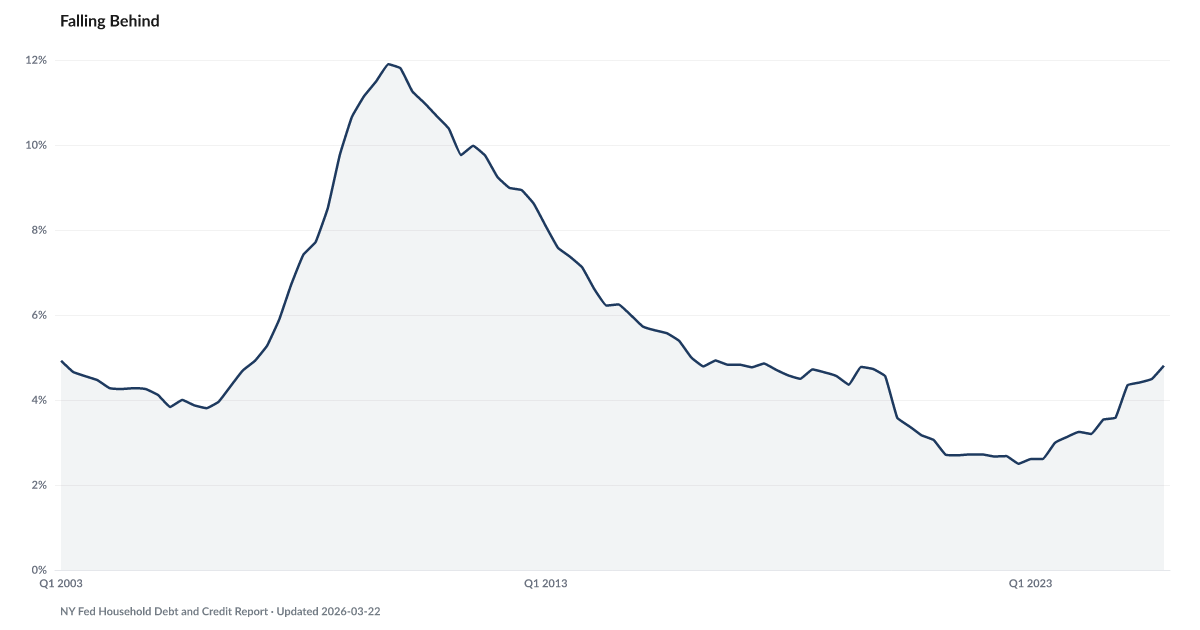
Total loan delinquency across all consumer debt types
What is the current Falling Behind reading?
The total delinquency rate across all consumer loan balances reached 4.73% in Q2 2026, according to the New York Fed's Household Debt and Credit Report. The pandemic-era policy floor that suppressed delinquency from 2020 through 2022 has fully unwound, and the rate continues climbing across most loan categories. Source: Federal Reserve Bank of New York.
The broadest delinquency measure spans mortgages, credit cards, auto loans, and student debt.
The total delinquency rate across all consumer loan balances reached 4.73% in Q2 2026, according to the Federal Reserve Bank of New York's Household Debt and Credit Report; this is the latest reading, just below the strongest level since 2020 and compares with the 2.5% pandemic-era low in Q4 2022. The pandemic relief programs — forbearance, stimulus checks, enhanced unemployment — temporarily suppressed delinquency to historically low levels. That suppression is fully unwound.
The stress is not uniform across loan types. The FHA Signal compares the Mortgage Bankers Association's FHA survey delinquency rate with the Board of Governors of the Federal Reserve System's bank-booked single-family residential mortgage delinquency rate; their populations and denominators differ, so the gap is context rather than a like-for-like borrower comparison. The Repo Line tracks the share of auto loan balances that are 90 or more days delinquent.
The Board's bank-size release separately reports credit-card delinquency for commercial banks outside the 100 largest by consolidated foreign and domestic assets and for banks ranked 1st through 100th. Those are loan-dollar ratios for bank portfolios. They do not identify borrower income, credit tier, account counts, or why the rates differ. The Other Banks reports the outside-top-100 series on its own terms.
Explore Further
Is this happening to you?
Have you missed a payment or fallen behind on any bill in the past year?
How has Falling Behind changed over time?

Most affected counties
Counties with the highest delinquency scores in the County Distress Index.
Explore all 3,144 counties →| Period | Value | YoY Change |
|---|---|---|
| Q2 2026 | 4.73% | +0.32 pp |
| Q1 2026 | 4.76% | +0.41 pp |
| Q4 2025 | 4.81% | +1.22 pp |
| Q3 2025 | 4.49% | +0.96 pp |
| Q2 2025 | 4.41% | +1.21 pp |
| Q1 2025 | 4.35% | +1.1 pp |
| Q4 2024 | 3.58% | +0.45 pp |
| Q3 2024 | 3.54% | +0.55 pp |
| Q2 2024 | 3.2% | +0.59 pp |
| Q1 2024 | 3.25% | +0.64 pp |
| Q4 2023 | 3.13% | +0.63 pp |
| Q3 2023 | 2.99% | +0.31 pp |
Frequently Asked Questions
What is the current U.S. loan delinquency rate?
The total delinquency rate across all consumer loan balances was 4.73% in Q2 2026, according to the New York Fed. This includes mortgages, credit cards, auto loans, and student loans — the full surface of household debt.
Which types of loans have the highest delinquency?
These sources use different populations, denominators, and delinquency thresholds, so they should not be ranked as one like-for-like table. FHA mortgage delinquency, credit-card delinquency at commercial banks outside the 100 largest by consolidated foreign and domestic assets, and serious auto-loan delinquency each describe their own measured loan population.
Is delinquency rising because of unemployment?
No. What is distinct about the current deterioration is that it is happening during a period of relatively low unemployment. In previous cycles, delinquency rose sharply during recessions when job losses cascaded through household finances. The current rise is happening in a labor market that has not yet materially weakened.
How does current delinquency compare to the 2008 crisis?
The current 4.73% total delinquency rate (Q2 2026) is well below the crisis peak levels of 2008–2010. However, the rate has been climbing steadily for three years from a pandemic-era floor, and the trajectory is what historians of the 2008 cycle find most worth attending to.
Where does the total delinquency data come from?
The New York Fed publishes total delinquency data quarterly in its Household Debt and Credit Report, based on a nationally representative sample from Equifax consumer credit reports covering approximately 5% of all U.S. consumers with credit files.


Quick poll
Is this affecting you or your household?
Discussion
Get the numbers when they move.
New data drops, indicator updates, and ADI score changes — delivered when it matters. No spam.
or Create an Account for full access
Loading comments…