The Coverage Tax
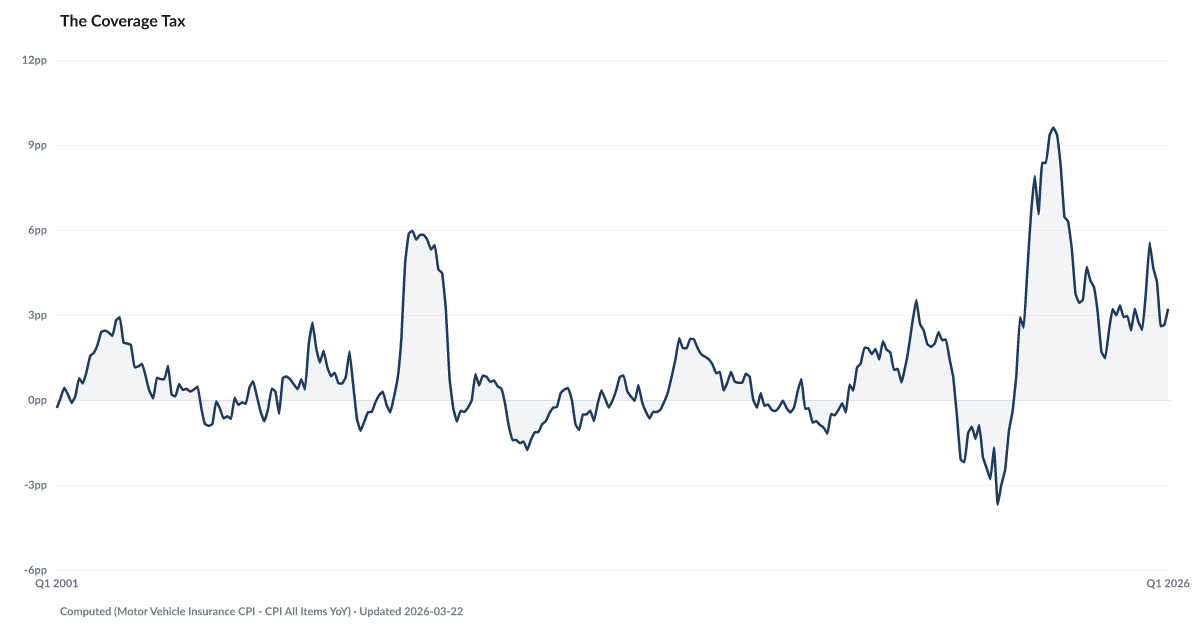
Gap between auto insurance inflation and the overall Consumer Price Index
Healthcare Inflation Premium (Medical CPI minus Overall CPI) is currently elevated — historically leads this indicator by 7 quarters. Healthcare Inflation Premium (Medical CPI minus Overall CPI) · View projections
What is the current Coverage Tax reading?
The year-over-year inflation rate for motor vehicle insurance measured against the all-items Consumer Price Index is 3.3 percentage points in July 2026. The Coverage Tax is this percentage-point gap. A positive reading means auto-insurance prices are rising faster than overall consumer prices; a negative reading means they are rising more slowly. It does not measure health insurance, premium dollars, or household coverage. Source: Computed from U.S. Bureau of Labor Statistics Motor Vehicle Insurance CPI and All Items CPI.
Car insurance inflation minus the overall Consumer Price Index sits at 3.3 percentage points. Auto coverage is a bill drivers cannot legally skip — this is how its price tracks against everything else.
Before the pandemic, auto insurance premiums ran roughly a point or less above headline inflation in most years, according to BLS data. Under one percentage point was the normal spread. That premium was boring. Predictable. A slow tax on the cost of driving that nobody paid attention to.
Then it broke. The gap hit 9.6 percentage points in mid-2023, wider than the rest of the site series outside the Great Financial Crisis. It fell through most of 2024, then climbed again from the summer of 2025. As of July 2026, auto insurance inflation runs 3.3 percentage points against the overall CPI.
This matters because auto insurance is not optional. Forty-nine states require it to legally drive to work. For households already stretched thin on The Buffer, how far auto coverage runs against headline inflation — 3.3 percentage points as of July 2026 — is the difference between making rent and missing it. The Repo Line shows why: auto loan serious delinquency is climbing in parallel with the insurance surcharge. People keep the car running on borrowed time, then lose it.
The cool-downs are misleading. The 2024 dip was a pause inside a longer climb. Normal never came back. The pre-pandemic norm of roughly one point above headline used to be the ceiling. It is now the lower bound.
Explore Further
Is this happening to you?
Has your auto insurance premium jumped even though your driving record hasn't changed?
How has The Coverage Tax changed over time?

Most affected counties
Counties with the highest debt burden scores in the County Distress Index.
Explore all 3,144 counties →| Period | Value | YoY Change |
|---|---|---|
| Jul 2026 | 3.32 pp | -0.48 pp |
| Jun 2026 | 3.57 pp | +1.1 pp |
| May 2026 | 1.96 pp | -0.79 pp |
| Apr 2026 | 1.37 pp | -1.86 pp |
| Mar 2026 | 2.77 pp | +0.32 pp |
| Feb 2026 | 3.19 pp | +0.22 pp |
| Jan 2026 | 2.56 pp | -0.36 pp |
| Dec 2025 | 2.72 pp | -0.62 pp |
| Nov 2025 | 4.25 pp | +1.25 pp |
| Sep 2025 | 4.65 pp | +2.22 pp |
| Aug 2025 | 5.56 pp | +4.08 pp |
| Jul 2025 | 3.8 pp | +2.1 pp |
Frequently Asked Questions
What is The Coverage Tax?
The Coverage Tax subtracts all-items CPI inflation from motor vehicle insurance CPI inflation. The July 2026 reading is 3.3 percentage points; positive values mean auto-insurance prices are rising faster than overall consumer prices.
Why does this matter?
Auto insurance is a recurring cost for drivers and is commonly required by law or by an auto lender. This series shows whether its price inflation is outrunning overall inflation; it does not measure any individual household's bill.
Where does this data come from?
Source: Computed from U.S. Bureau of Labor Statistics Motor Vehicle Insurance CPI and All Items CPI. The calculation compares year-over-year motor vehicle insurance CPI inflation with year-over-year all-items CPI inflation.


Quick poll
Is this affecting you or your household?
Discussion
Get the numbers when they move.
New data drops, indicator updates, and ADI score changes — delivered when it matters. No spam.
or Create an Account for full access
Loading comments…