Charge-Off Rate on Credit Card Loans
Credit card debt written off as uncollectable
What is the current Charge-Off Rate on Credit Card Loans reading?
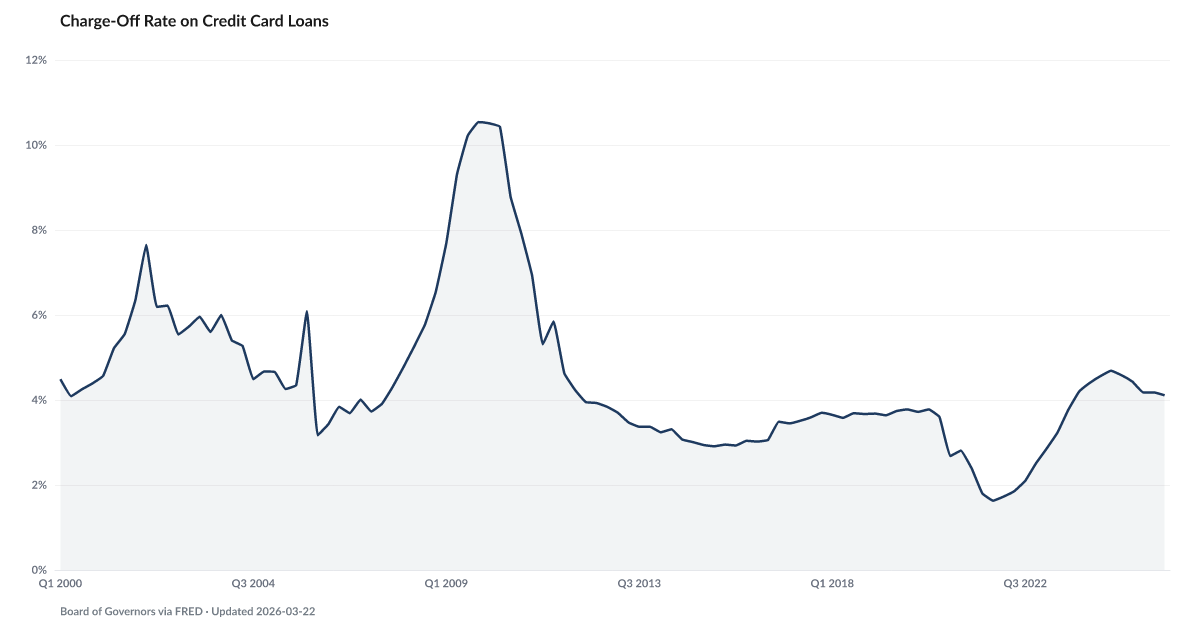
The annualized net charge-off rate on credit card loans was 3.84% in Q1 2026, according to Board of Governors of the Federal Reserve System Call Report data. It expresses net charge-offs as a percentage of average credit card loan balances. This aggregate rate is separate from delinquency and does not show an individual account's payment sequence or why a balance was charged off.
Banks are writing off credit card debt at 3.84% — a level last sustained in 2011, compared with 1.63% during the pandemic era.
The Federal Reserve credit-card charge-off rate measures annualized net charge-offs as a percentage of average credit card loan balances at all commercial banks. It is a separate aggregate measurement from delinquency and does not describe an individual account's collection history or payment sequence.
The rate was 1.63% in Q4 2021 and reached 4.64% in Q3 2024. It has since moved to 3.84% in Q1 2026. Those observations describe the reported series path; they do not establish why it changed or trace individual accounts from delinquency to charge-off.
Credit Card Delinquency and The 60-Day Line are separate measurements with different populations and past-due thresholds. The bank-population spread is DRCCLOBS minus DRCCLT100S at one matched vintage; it does not locate charge-off losses, describe borrowers, or establish a charge-off timeline.
The credit-card charge-off rate and the broader All-Loan Charge-Off rate have different loan populations. Their reported levels can be compared descriptively with those definitions intact, but neither series by itself establishes why balances were charged off or what happened to an individual household.
Explore Further
How has Charge-Off Rate on Credit Card Loans changed over time?

Most affected counties
Counties with the highest delinquency scores in the County Distress Index.
Explore all 3,144 counties →| Period | Value | YoY Change |
|---|---|---|
| Q1 2026 | 3.84% | -0.62 pp |
| Q4 2025 | 4.07% | -0.49 pp |
| Q3 2025 | 4.15% | -0.49 pp |
| Q2 2025 | 4.21% | -0.38 pp |
| Q1 2025 | 4.46% | +0.03 pp |
| Q4 2024 | 4.56% | +0.39 pp |
| Q3 2024 | 4.64% | +0.94 pp |
| Q2 2024 | 4.59% | +1.33 pp |
| Q1 2024 | 4.43% | +1.55 pp |
| Q4 2023 | 4.17% | +1.67 pp |
| Q3 2023 | 3.7% | +1.65 pp |
| Q2 2023 | 3.26% | +1.37 pp |
Frequently Asked Questions
What is a credit card charge-off?
In this Federal Reserve series, the reported measure is annualized net charge-offs on credit card loans as a percentage of average loan balances, aggregated across all commercial banks. It does not timestamp or describe every underlying account.
How does the charge-off rate relate to delinquency?
The delinquency and charge-off rates are separate aggregate series with different numerators. Their levels can be read side by side, but these data alone do not establish a fixed lag, an account-level transition sequence, or a cause.
Where does charge-off data come from?
The Federal Reserve publishes charge-off rates quarterly from bank Call Report filings, aggregated across all commercial banks. The current reading is 3.84% for Q1 2026.


Quick poll
Is this affecting you or your household?
Discussion
Get the numbers when they move.
New data drops, indicator updates, and ADI score changes — delivered when it matters. No spam.
or Create an Account for full access
Loading comments…