Credit Card Delinquency Spread — Outside Top 100 Minus Top 100 Banks
Difference between two Federal Reserve commercial-bank credit card delinquency rates
What is the current Credit Card Delinquency Spread — Outside Top 100 Minus Top 100 Banks reading?
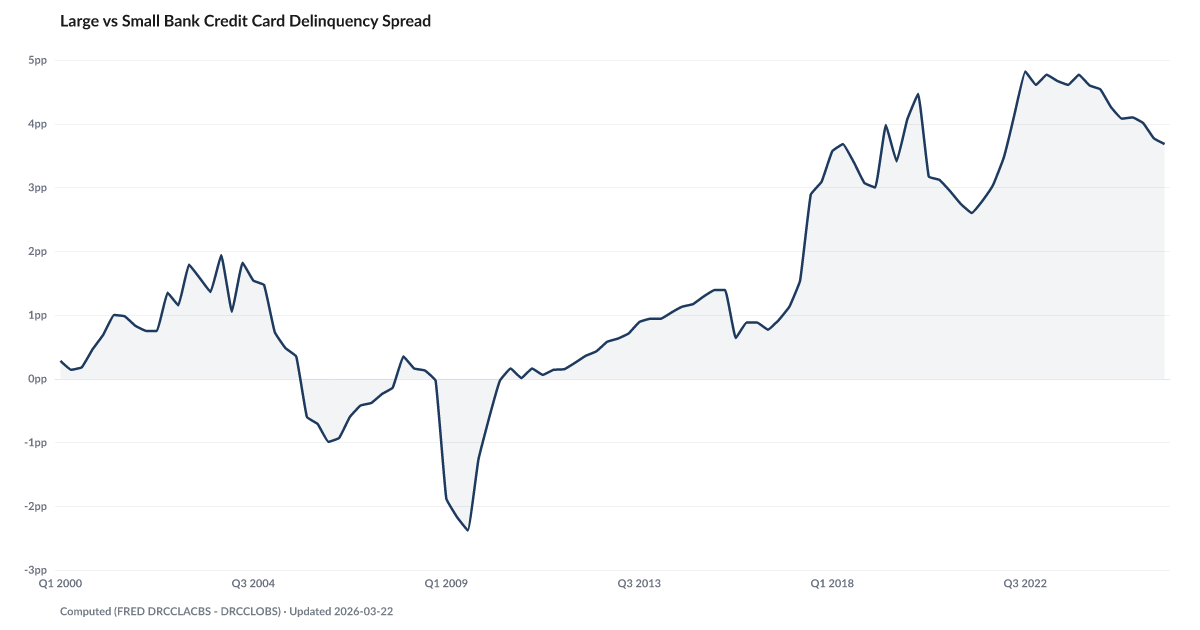
The matched credit card delinquency spread was 3.8 percentage points in Q2 2026. It subtracts the seasonally adjusted, end-of-quarter rate at banks ranked 1st through 100th by assets (DRCCLT100S) from the rate at commercial banks outside that group (DRCCLOBS), using one FRED realtime vintage. A positive value means the outside-top-100 rate was higher; a negative value means the top-100 rate was higher. The spread does not explain the difference. Source: Board of Governors of the Federal Reserve System data retrieved via FRED.
Measurement basis: Seasonally adjusted, end-of-quarter delinquency rate on credit card loans at commercial banks outside the 100 largest by assets minus the corresponding rate at banks ranked 1st through 100th, in percentage points. Both FRED series must be matched to the same realtime vintage and Board Charge-Off and Delinquency Rates release family before subtraction.
The outside-top-100 minus top-100 credit card delinquency spread was 3.8 percentage points in Q2 2026.
The matched spread reached -2.52 percentage points in Q3 2009. A negative value means the outside-top-100 rate was below the top-100 rate in that quarter; a positive value means it was above.
The current spread is 3.8 percentage points in Q2 2026. It is calculated directly from the two population-specific series for that quarter, rather than from the all-commercial-bank aggregate.
The Risk Reset is a separate TransUnion account-holder measure and is not used to explain the bank-size spread. Credit Card Charge-Offs is also a separate series with a different numerator.
The spread reports a difference between two commercial-bank asset-rank populations. It does not identify customer characteristics, lending strategy, institutional resilience, or a reason the difference changed.
Explore Further
Is this happening to you?
How does credit card delinquency differ between commercial banks outside and within the 100 largest by assets?
How has Credit Card Delinquency Spread — Outside Top 100 Minus Top 100 Banks changed over time?

Most affected counties
Counties with the highest delinquency scores in the County Distress Index.
Explore all 3,144 counties →| Period | Value | YoY Change |
|---|---|---|
| Q2 2026 | 3.75 pp | -0.37 pp |
| Q1 2026 | 3.64 pp | -0.61 pp |
| Q4 2025 | 3.78 pp | -0.39 pp |
| Q3 2025 | 3.88 pp | -0.5 pp |
| Q2 2025 | 4.12 pp | -0.54 pp |
| Q1 2025 | 4.25 pp | -0.51 pp |
| Q4 2024 | 4.17 pp | -0.73 pp |
| Q3 2024 | 4.38 pp | -0.36 pp |
| Q2 2024 | 4.66 pp | -0.16 pp |
| Q1 2024 | 4.76 pp | -0.16 pp |
| Q4 2023 | 4.9 pp | +0.13 pp |
| Q3 2023 | 4.74 pp | -0.24 pp |
Frequently Asked Questions
What is the outside-top-100 minus top-100 delinquency spread?
It is DRCCLOBS minus DRCCLT100S at the same quarter and FRED realtime vintage, expressed in percentage points. The two source series represent explicit commercial-bank asset-rank populations.
How should the spread's sign be read?
A positive spread means the reported delinquency rate outside the 100 largest banks was higher in that matched quarter. A negative spread means the reported top-100 rate was higher. The magnitude is the percentage-point difference.
Where does this data come from?
The Federal Reserve Board publishes both seasonally adjusted quarterly series in the Charge-Off and Delinquency Rates on Loans and Leases at Commercial Banks release family. FRED distributes them as DRCCLOBS and DRCCLT100S.
Does the spread identify borrowers or causes?
No. It is arithmetic over two bank-reported balance-rate series. It does not describe customers, lending strategy, institutional finances, or why the rates differ.


Quick poll
Is this affecting you or your household?
Discussion
Get the numbers when they move.
New data drops, indicator updates, and ADI score changes — delivered when it matters. No spam.
or Create an Account for full access
Loading comments…