The Risk Reset
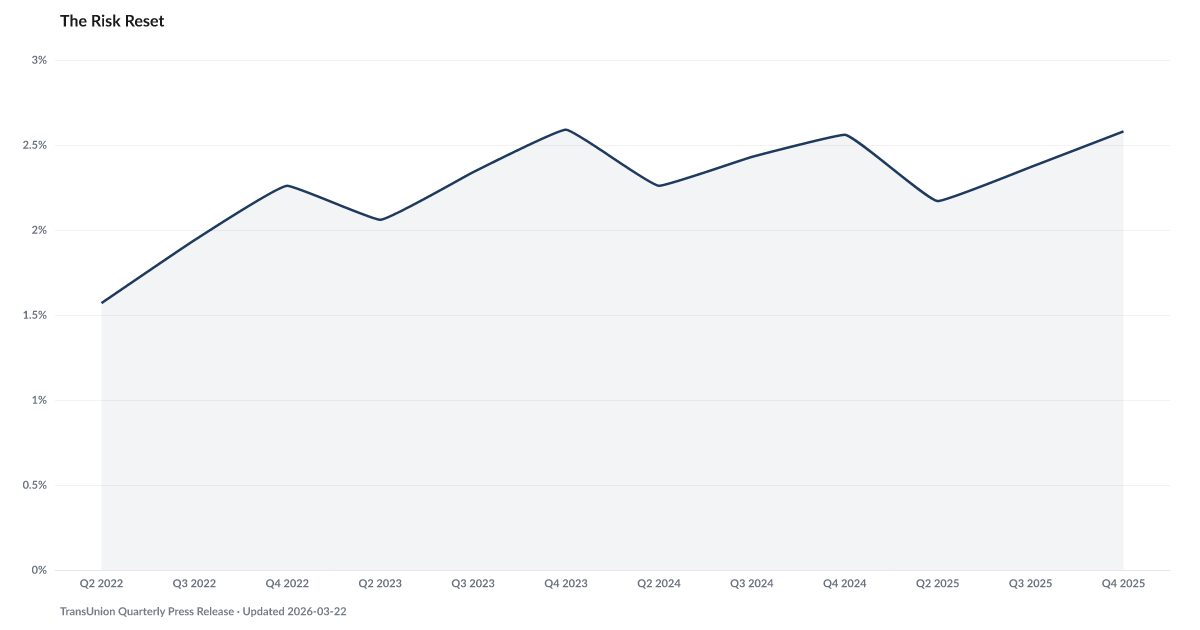
Borrower-level credit card serious delinquency rose year over year
What is the current Risk Reset reading?
TransUnion's Credit Industry Insights Report tracks the share of credit card borrowers who are seriously delinquent. The measure counts consumers rather than the share of balances past due. Source: TransUnion U.S. Consumer Credit Database.
Measurement basis: Borrower-level share of consumers with a bankcard account 90 or more days past due
TransUnion reported 2.26% of credit card borrowers seriously delinquent in Q2 2026.
TransUnion defines this as a borrower-level credit card delinquency rate: the share of consumers with a bankcard account 90 or more days past due.
At 2.26% in Q2 2026, the series describes serious delinquency among credit card borrowers. It does not measure the share of balances past due.
This is an overall credit card borrower measure and does not identify a credit-score tier or lender risk appetite.
Read it alongside Credit Card Delinquency, which uses a different source and a balance-based measure, and Credit Card Charge-Offs, which records losses after delinquency.
Explore Further
Is this happening to you?
Have you fallen behind on a credit card payment?
How has The Risk Reset changed over time?

Most affected counties
Counties with the highest delinquency scores in the County Distress Index.
Explore all 3,144 counties →| Period | Value | YoY Change |
|---|---|---|
| Q2 2026 | 2.26% | +0.09 pp |
| Q1 2026 | 2.53% | +0.1 pp |
| Q4 2025 | 2.58% | +0.02 pp |
| Q3 2025 | 2.37% | -0.06 pp |
| Q2 2025 | 2.17% | -0.09 pp |
| Q1 2025 | 2.43% | -0.12 pp |
| Q4 2024 | 2.56% | -0.03 pp |
| Q3 2024 | 2.43% | +0.09 pp |
| Q2 2024 | 2.26% | +0.2 pp |
| Q1 2024 | 2.55% | +0.29 pp |
| Q4 2023 | 2.59% | +0.33 pp |
| Q3 2023 | 2.34% | +0.4 pp |
Frequently Asked Questions
What does this TransUnion credit card delinquency rate measure?
It is the share of credit card borrowers whose accounts are seriously delinquent. It counts consumers rather than the share of outstanding balances past due.
Why does borrower-level credit card delinquency matter?
It shows how widely serious payment trouble is spread across credit card borrowers. A balance-based rate answers a different question because a small number of large balances can move it.
Where does this credit card delinquency data come from?
TransUnion publishes the borrower-level rate in its quarterly Credit Industry Insights Report using the TransUnion U.S. Consumer Credit Database.


Quick poll
Is this affecting you or your household?
Discussion
Get the numbers when they move.
New data drops, indicator updates, and ADI score changes — delivered when it matters. No spam.
or Create an Account for full access
Loading comments…