Revolving Credit Utilization (75th Percentile)
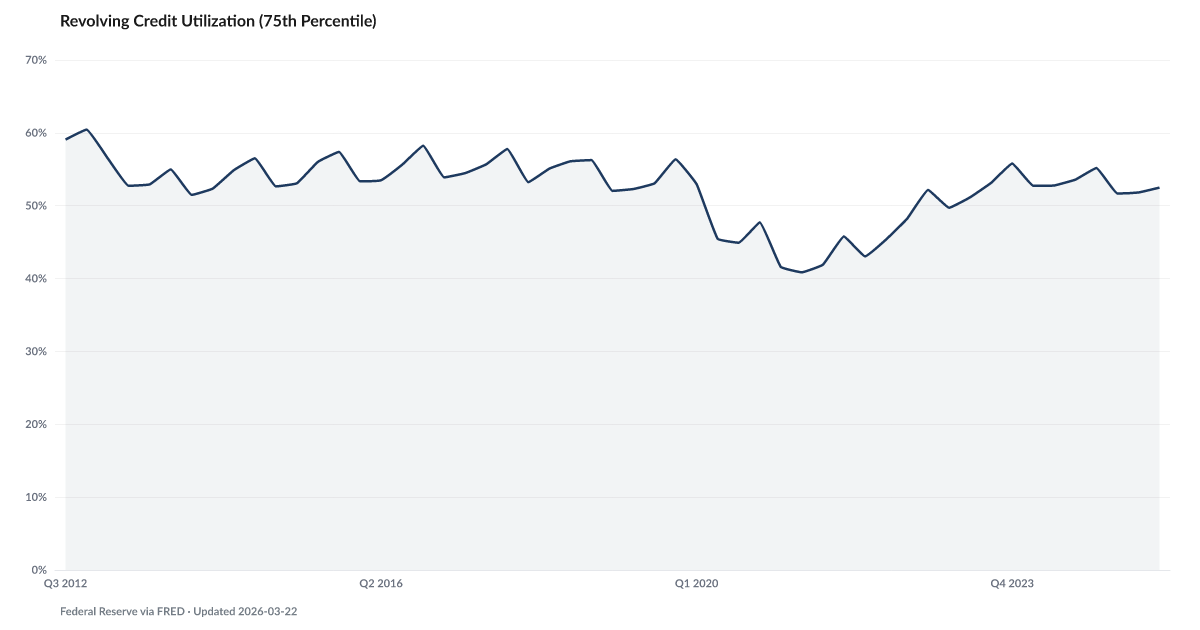
Credit card utilization at the 75th percentile of active borrowers
What is the current Revolving Credit Utilization (75th Percentile) reading?
Borrowers at the 75th percentile of credit card utilization are using 50.47% of their available revolving credit as of Q1 2026, according to Federal Reserve data. High utilization — typically above 30% — signals financial pressure and damages credit scores. Source: Board of Governors of the Federal Reserve System Survey of Consumer Finances data retrieved via FRED.
At the 75th percentile of credit card utilization, active borrowers are using 50.47% of their available credit, far past the level credit scoring models start penalizing.
The Federal Reserve's FRED series RCCCBACTIVEUTILPCT75 tracks credit card utilization at the 75th percentile of active borrowers. As of Q1 2026 the reading is 50.47%, against 40.9% in Q2 2021 and 56.4% in the last quarter before the pandemic.
Credit utilization feeds directly into a FICO score, and scoring models start penalizing borrowers well below where this series sits. At 50.47%, these households are inside the zone where the next card offers stop coming, minimum-payment calculations climb, and the cost of being short on a bill rises sharply.
The 75th percentile is the right place to look. Median utilization numbers blend the stretched with the comfortable in a way that hides the stress. This is a direct read on the households at the edge. Their available credit — the reserve meant to absorb a car repair or an ER bill — is already being used to fund everyday life.
Read utilization alongside The Safety Net and Falling Behind as separate measures. The Safety Net records one survey payment-method response; it does not show what other respondents used or predict what happens when available credit is exhausted.
Explore Further
How has Revolving Credit Utilization (75th Percentile) changed over time?

Most affected counties
Counties with the highest safety net and buffer scores in the County Distress Index.
Explore all 3,144 counties →| Period | Value | YoY Change |
|---|---|---|
| Q1 2026 | 50.47% | -1.2 pp |
| Q4 2025 | 53.99% | -1.19 pp |
| Q3 2025 | 52.49% | -1.08 pp |
| Q2 2025 | 51.82% | -0.96 pp |
| Q1 2025 | 51.67% | -1.06 pp |
| Q4 2024 | 55.18% | -0.62 pp |
| Q3 2024 | 53.57% | +0.42 pp |
| Q2 2024 | 52.78% | +1.63 pp |
| Q1 2024 | 52.73% | +3.02 pp |
| Q4 2023 | 55.8% | +3.63 pp |
| Q3 2023 | 53.15% | +4.96 pp |
| Q2 2023 | 51.15% | +5.8 pp |
Frequently Asked Questions
What does 75th percentile credit utilization mean?
It means that one-quarter of borrowers are using more than 50.47% of their available revolving credit (Q1 2026). Financial advisors generally recommend keeping utilization below 30%. Above 50%, borrowers are more likely to face higher interest rates and credit-score damage.
Why does high utilization matter?
High utilization is both a symptom and a cause of financial distress. It signals that borrowers are relying heavily on available credit, and it damages credit scores, which leads to higher interest rates on any new borrowing.
Where does the data come from?
The Federal Reserve tracks credit card utilization by percentile through survey and administrative data feeding FRED, letting American Default show how the most stretched quarter of borrowers compares with the median.


Quick poll
Is this affecting you or your household?
Discussion
Get the numbers when they move.
New data drops, indicator updates, and ADI score changes — delivered when it matters. No spam.
or Create an Account for full access
Loading comments…