401(k) Loan Outstanding Rate
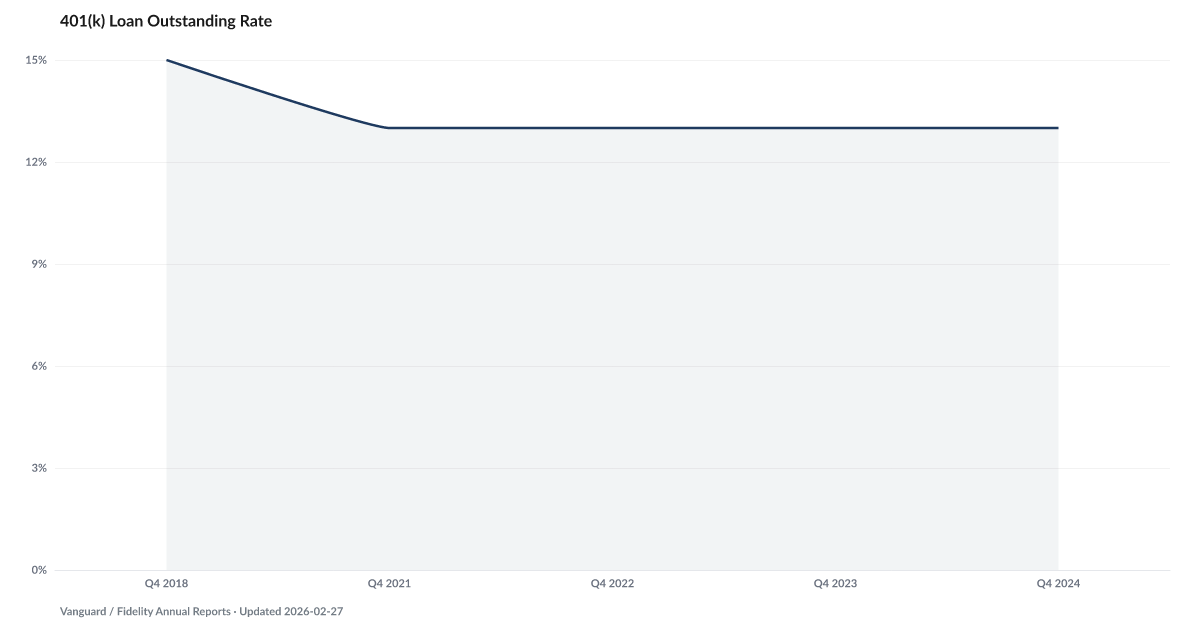
Holding steady; about one in eight Vanguard participants owe money back to their own 401(k)
What is the current 401(k) Loan Outstanding Rate reading?
13% of Vanguard 401(k) plan participants currently have an outstanding loan against their retirement account, according to Vanguard data. Unlike hardship withdrawals, 401(k) loans are scheduled for repayment. After a severance from employment, plan terms may cause an unpaid balance to be offset against the account; qualified plan loan offsets receive an extended rollover deadline tied to the participant's tax return. Sources: Vanguard How America Saves and <a href="https://www.irs.gov/retirement-plans/plan-loan-offsets">IRS plan-loan-offset guidance</a>.
Measurement basis: Share of participants in Vanguard-recordkept defined contribution plans with a loan outstanding against their account at year end, from Vanguard's How America Saves. It covers the plans Vanguard administers, not all U.S. 401(k) participants.
The share of Vanguard 401(k) participants carrying an outstanding loan against their retirement account is 13% as of 2024, and has held between 12% and 13% every year since 2021. A quiet plateau that looks nothing like the emergency it describes.
Vanguard's How America Saves report, built on roughly 5 million retirement plan participants, shows 13% have an outstanding 401(k) loan as of 2024. Every annual reading since 2021 has landed within a point of that. The rate has not budged.
A 401(k) loan is money borrowed from a retirement account and repaid under the plan's terms. After a severance from employment, those terms may cause an unpaid balance to be offset against the account. Under IRS plan-loan-offset guidance, a participant may roll over a qualified plan loan offset by the tax return due date for that year, including extensions. An amount not rolled over is generally taxable, and an additional 10% tax may apply unless an exception applies.
One in eight workers is running that math. And has been, every year, since the pandemic savings surge drained out. This is steady-state behavior now. A plateau, not a spike.
The flatness is the story. The Cannibalization Rate — 401(k) hardship withdrawals — has risen sharply from pre-pandemic levels. Loans have held at their elevated plateau. Together they describe the same pattern: households eating retirement to fund today. The Buffer was supposed to absorb this kind of shock. The 401(k) is absorbing it instead.
Explore Further
Is this happening to you?
Have you borrowed against your 401(k) or thought about it?
How has 401(k) Loan Outstanding Rate changed over time?

Most affected counties
Counties with the highest safety net and buffer scores in the County Distress Index.
Explore all 3,144 counties →| Period | Value | YoY Change |
|---|---|---|
| 2024 | 13% | 0 pp |
| 2023 | 13% | +1 pp |
| 2022 | 12% | -1 pp |
| 2021 | 13% | 0 pp |
| 2020 | 13% | — |
| 2018 | 15% | — |
Frequently Asked Questions
What share of workers have outstanding 401(k) loans?
13% of Vanguard 401(k) plan participants currently have an outstanding loan against their retirement account, according to Vanguard. This is separate from hardship withdrawals — loans must be repaid with interest.
What happens to a 401(k) loan if you lose your job?
After a severance from employment, plan terms may cause an unpaid balance to be offset against the retirement account. Under IRS guidance, a participant may roll over a qualified plan loan offset by the tax return due date for that year, including extensions. An amount not rolled over is generally taxable, and an additional 10% tax may apply unless an exception applies.
Where does the data come from?
Vanguard's annual How America Saves report tracks 401(k) loan outstanding rates across approximately 5 million participant accounts.


Quick poll
Is this affecting you or your household?
Discussion
Get the numbers when they move.
New data drops, indicator updates, and ADI score changes — delivered when it matters. No spam.
or Create an Account for full access
Loading comments…