The Cannibalization Rate
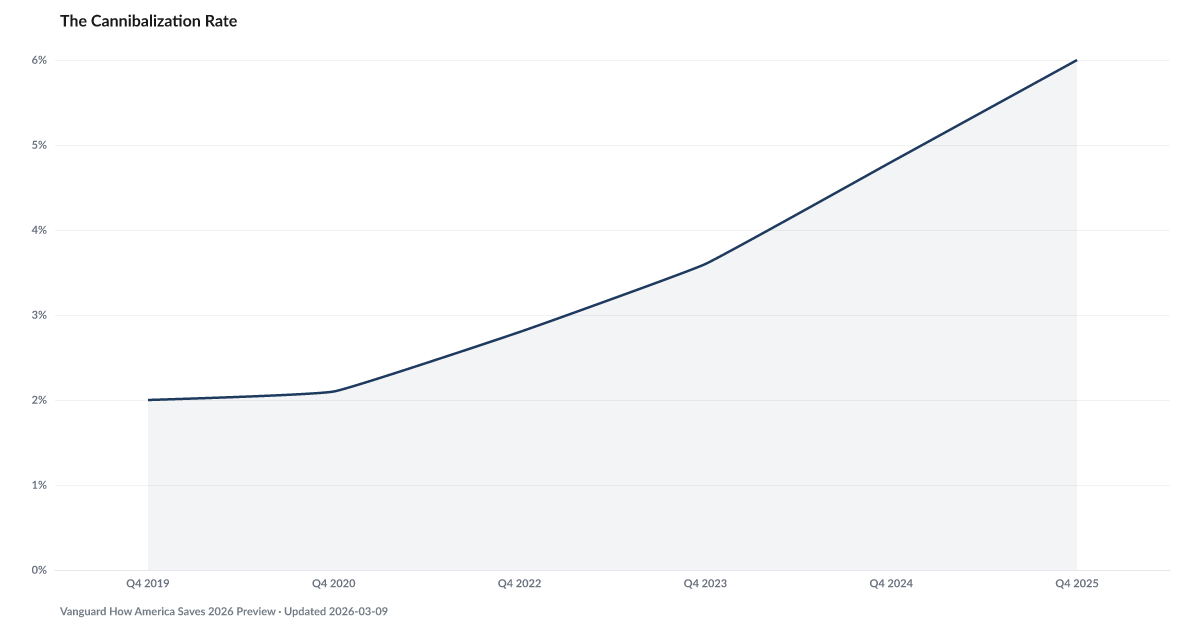
6% in 2025, compared with 4.8% in December 2024 and 2.3% in 2019
What is the current Cannibalization Rate reading?
6% of participants offered a hardship-withdrawal option used it in 2025, according to Vanguard How America Saves 2026. The annual series is supporting evidence of households drawing on retirement savings for current expenses. Source: Vanguard How America Saves 2026.
Measurement basis: Share of participants eligible for a hardship withdrawal who took at least one during the year, in Vanguard-recordkept defined contribution plans, from Vanguard's How America Saves. It counts participants who took a withdrawal rather than the number of withdrawals, and covers the plans Vanguard administers rather than all U.S. retirement savers.
The line between retirement security and day-to-day survival has become the most heavily crossed financial boundary in America.
Vanguard's How America Saves report shows 6% of eligible Vanguard participants took hardship withdrawals in 2025 — roughly triple the 2019 rate and the highest reading in the site series. Separately, the IRS hardship-distribution FAQs explain that the Bipartisan Budget Act of 2018 and final hardship regulations relaxed the federal safe-harbor rules: plans may choose whether to require a plan loan first, and plans may not suspend employee contributions after hardship distributions made after December 31, 2019. The Vanguard series does not establish that those rule changes caused the increase.
The Safety Net reports how adults said they would pay a $1,000 emergency, while The Buffer tracks the national personal savings rate. These separate measures provide household-finance context, but neither identifies what caused the change in hardship withdrawals.
This is a one-way door. Previously untaxed hardship distributions are generally included in income, and an additional 10% tax may apply before age 59½ unless an exception applies. The net amount depends on the participant's circumstances, so there is no universal take-home illustration. The Squeeze shows a growing share of households spending nearly every dollar of income on necessities — the kind of margin-free existence in which retirement savings may become a source of current cash.
The money being consumed today was supposed to fund retirements 20 to 30 years from now. It won't be there.
Explore Further
Is this happening to you?
Have you taken money out of your retirement account to cover a current expense?
How has The Cannibalization Rate changed over time?

Most affected counties
Counties with the highest safety net and buffer scores in the County Distress Index.
Explore all 3,144 counties →| Period | Value | YoY Change |
|---|---|---|
| 2025 | 6% | +1.2 pp |
| 2024 | 4.8% | +1.2 pp |
| 2023 | 3.6% | +0.8 pp |
| 2022 | 2.8% | +0.7 pp |
| 2021 | 2.1% | +0.4 pp |
| 2020 | 1.7% | -0.6 pp |
| 2019 | 2.3% | — |
Frequently Asked Questions
What is the current 401(k) hardship withdrawal rate?
6% of participants offered a hardship-withdrawal option used it in 2025, according to Vanguard How America Saves 2026. The indicator page publishes the full annual series and current source links.
Why are 401(k) hardship withdrawals increasing?
Vanguard's series records an increase in hardship withdrawals, but it does not by itself identify one fixed cause. The IRS hardship-distribution FAQs explain that the Bipartisan Budget Act of 2018 and final hardship regulations changed the federal access rules, while household-buffer measures provide separate context; this page does not treat either as a demonstrated cause of the observed increase.
What are the penalties for a 401(k) hardship withdrawal?
Previously untaxed hardship withdrawals are generally included in income. An additional 10% tax may apply before age 59½ unless an exception applies, and the net amount depends on the participant's circumstances. Unlike 401(k) loans, hardship withdrawals cannot be repaid to the account.
What does the cannibalization rate signal about household distress?
Rising hardship withdrawals indicate that households have exhausted their primary financial buffers — emergency savings, available credit — and are consuming long-term retirement assets to cover current expenses. This is a one-way door: the money withdrawn today was meant to fund retirements 20–30 years from now and will not be replaced.
Where does the 401(k) hardship withdrawal data come from?
Vanguard's annual How America Saves report tracks hardship withdrawal rates across its participant base of approximately 5 million 401(k) accounts. It is one of the largest and most widely cited sources of retirement plan behavior data in the United States.


Quick poll
Is this affecting you or your household?
Discussion
Get the numbers when they move.
New data drops, indicator updates, and ADI score changes — delivered when it matters. No spam.
or Create an Account for full access
Loading comments…