The Safety Net
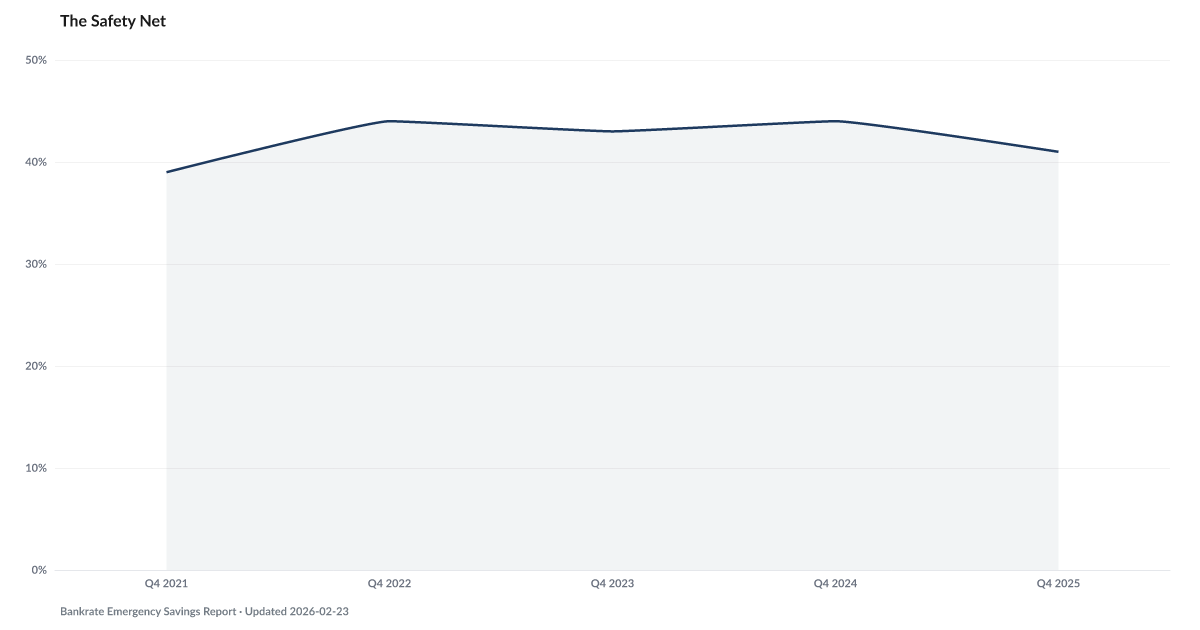
How U.S. adults say they would pay a $1,000 emergency
What is the current Safety Net reading?
Bankrate Emergency Savings Survey: 30% as of 2026. Source: Bankrate Emergency Savings Report.
30% of U.S. adults said they would use savings to pay a $1,000 emergency in 2026.
Bankrate's annual Emergency Savings Report found that 30% of U.S. adults said they would use savings to pay a $1,000 emergency in 2026. The survey records a reported payment method; it does not measure account balances or what every other respondent would do.
Read this survey alongside The Cannibalization Rate, The Buffer, and The Squeeze as separate household-finance measures. They use different populations and methods, and their movement does not establish that one measure caused or predicts another.
Explore Further
How has The Safety Net changed over time?

Most affected counties
Counties with the highest safety net and buffer scores in the County Distress Index.
Explore all 3,144 counties →| Period | Value | YoY Change |
|---|---|---|
| 2026 | 30% | — |
| 2025 | 41% | -3 pp |
| 2024 | 44% | +1 pp |
| 2023 | 43% | -1 pp |
| 2022 | 44% | +5 pp |
| 2021 | 39% | — |
How to read this series
The source changed how it measures this in 2026. Bankrate’s 2026 report added a separate “regular income or cash flow” answer that earlier years did not offer, so respondents who would previously have answered “savings” now split across two answers. Bankrate reports the comparable share who could cover the expense as 47 percent — 30 percent from savings plus 17 percent from income or cash flow. Readings on either side are not directly comparable, so the year-over-year column stays blank where a comparison would cross that date. Source documentation.
Frequently Asked Questions
What is Bankrate Emergency Savings Survey?
How U.S. adults say they would pay a $1,000 emergency
Why does Bankrate Emergency Savings Survey matter for financial distress?
Bankrate Emergency Savings Survey is one of the indicators tracked by the American Distress Index (ADI), which measures five dimensions of U.S. household financial distress: Delinquency, Default & Legal, Debt Burden, Labor, and Safety Net & Buffer. Changes in this indicator contribute to the overall distress picture.
Where does the Bankrate Emergency Savings Survey data come from?
This data comes from Bankrate Emergency Savings Report. More information: https://www.bankrate.com/banking/savings/emergency-savings-report/. The American Distress Index updates this indicator annually.


Quick poll
Is this affecting you or your household?
Discussion
Get the numbers when they move.
New data drops, indicator updates, and ADI score changes — delivered when it matters. No spam.
or Create an Account for full access
Loading comments…