Student Loan Borrowers Behind on Payments or in Collections
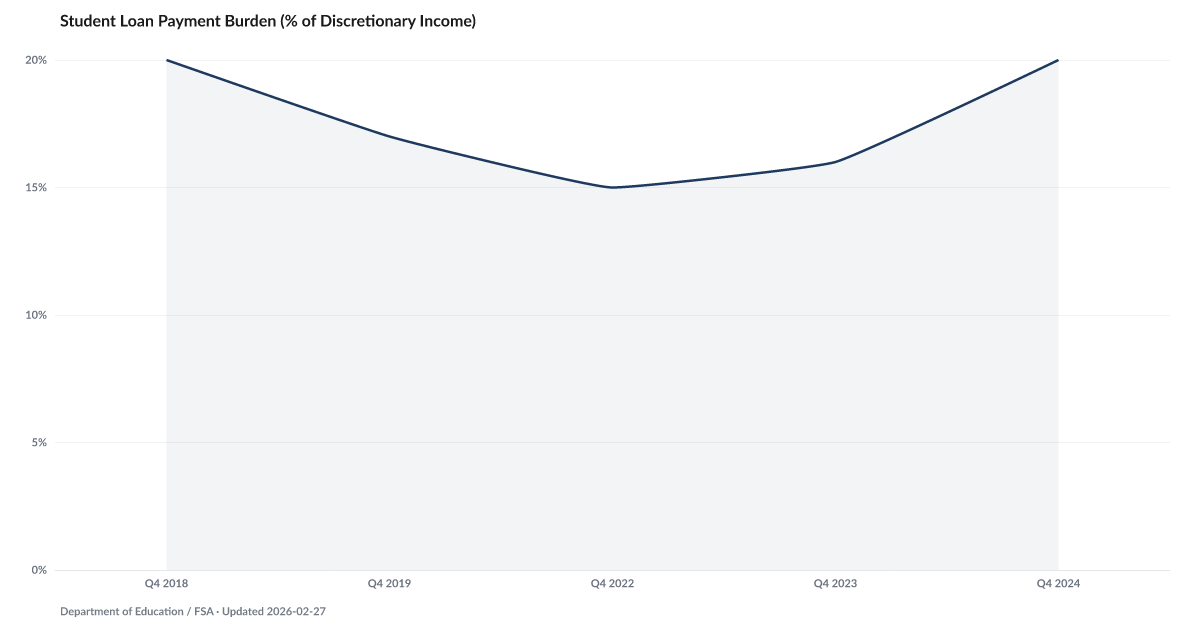
20% of adults with outstanding student loans for their own education were behind on payments or in collections in 2024, compared with 16% in December 2023
What is the current Student Loan Borrowers Behind on Payments or in Collections reading?
In 2024, 20% of adults with outstanding student loans for their own education were behind on payments or in collections, according to the Board of Governors of the Federal Reserve System's Survey of Household Economics and Decisionmaking (SHED).
The Board of Governors of the Federal Reserve System reported in its Survey of Household Economics and Decisionmaking (SHED) that 20% of adults with outstanding student loans for their own education were behind on payments or in collections in 2024.
The Board of Governors of the Federal Reserve System reports in the Survey of Household Economics and Decisionmaking (SHED) that 20% of adults with outstanding student loans for their own education were behind on payments or in collections in 2024.
This is a borrower-status share. It does not measure required payments, loan balances, or payments as a share of income.
This annual series tracks whether adults with outstanding loans for their own education reported being behind on payments or in collections.
SHED later changed to questions about recent payment difficulty. Those results are not appended to this chart because the measure is not comparable with the borrower-status series through 2024.
Explore Further
How has Student Loan Borrowers Behind on Payments or in Collections changed over time?

Most affected counties
Counties with the highest debt burden scores in the County Distress Index.
Explore all 3,144 counties →| Period | Value | YoY Change |
|---|---|---|
| 2024 | 20% | +4 pp |
| 2023 | 16% | +1 pp |
| 2022 | 15% | — |
| 2019 | 17% | -3 pp |
| 2018 | 20% | — |
Frequently Asked Questions
What does the SHED student loan measure track?
The annual SHED measure is the share of adults with outstanding student loans for their own education who reported being behind on payments or in collections. The latest comparable reading was 20% in 2024.
How does this differ from the New York Fed student loan delinquency rate?
SHED reports the share of borrowers who say they are behind on payments or in collections. The Federal Reserve Bank of New York reports the share of outstanding student loan balances that are seriously delinquent. The denominators are different and should not be treated as interchangeable.
Where does this data come from?
The Federal Reserve Board publishes the Survey of Household Economics and Decisionmaking (SHED) annually, surveying a nationally representative sample of U.S. adults about their financial lives.


Quick poll
Is this affecting you or your household?
Discussion
Get the numbers when they move.
New data drops, indicator updates, and ADI score changes — delivered when it matters. No spam.
or Create an Account for full access
Loading comments…