Shelter CPI
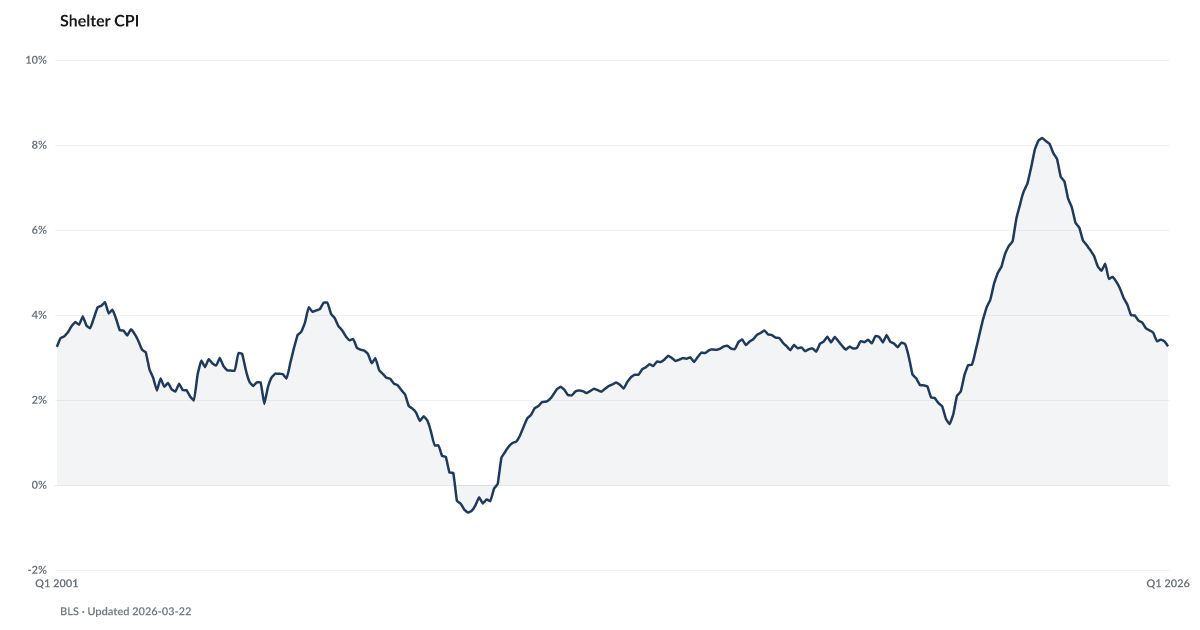
Year-over-year change in the shelter component of the CPI
What is the current Shelter CPI reading?
Shelter CPI: 3.16% as of 2026-07. Source: U.S. Bureau of Labor Statistics (CUSR0000SAH1).
Measurement basis: Year-over-year percent change computed from the seasonally adjusted BLS Shelter CPI (CUSR0000SAH1); seasonally adjusted values may be revised
Shelter inflation is running at 3.16%. The annual pace is back in ordinary territory. The price level it applies to is not.
Shelter is the largest line in the Consumer Price Index and the largest line in most household budgets. BLS data shows it at 3.16% year-over-year as of July 2026. A reading at this level reads like normalization.
The issue is the base. Shelter inflation reached 8.2% in March 2023, and spent the years either side of it well above where it had been. The cumulative result is a shelter cost level meaningfully higher than at the start of 2020, compressed into a few years of back-to-back increases.
A modest annual rate sitting on top of a large accumulated increase is the new normal pricing in. The old baseline is gone. A lower annual rate from here means slower growth, not rollback.
The affordability side is visible in Median Sales Price of Houses Sold and in The Pinch, where Census reports the share of households having difficulty paying usual expenses. Whether the cause is rent, ownership, or utilities, shelter is where the gap between the annual rate and the accumulated level hits households hardest.
Explore Further
How has Shelter CPI changed over time?

Most affected counties
Counties with the highest debt burden scores in the County Distress Index.
Explore all 3,144 counties →| Period | Value | YoY Change |
|---|---|---|
| Jul 2026 | 3.16% | -0.52 pp |
| Jun 2026 | 3.26% | -0.57 pp |
| May 2026 | 3.35% | -0.51 pp |
| Apr 2026 | 3.29% | -0.7 pp |
| Mar 2026 | 3.02% | -0.98 pp |
| Feb 2026 | 2.96% | -1.28 pp |
| Jan 2026 | 3.02% | -1.37 pp |
| Dec 2025 | 3.15% | -1.47 pp |
| Nov 2025 | 3.03% | -1.76 pp |
| Sep 2025 | 3.58% | -1.26 pp |
| Aug 2025 | 3.64% | -1.57 pp |
| Jul 2025 | 3.69% | -1.35 pp |
Frequently Asked Questions
What is Shelter CPI?
Year-over-year change in the shelter component of the CPI
Why does Shelter CPI matter for financial distress?
Shelter CPI is one of the indicators tracked by the American Distress Index (ADI), which measures five dimensions of U.S. household financial distress: Delinquency, Default & Legal, Debt Burden, Labor, and Safety Net & Buffer. Changes in this indicator contribute to the overall distress picture.
Where does the Shelter CPI data come from?
This data comes from U.S. Bureau of Labor Statistics (CUSR0000SAH1). More information: https://data.bls.gov/timeseries/CUSR0000SAH1. The American Distress Index updates this indicator monthly.


Quick poll
Is this affecting you or your household?
Discussion
Get the numbers when they move.
New data drops, indicator updates, and ADI score changes — delivered when it matters. No spam.
or Create an Account for full access
Loading comments…