The Pinch
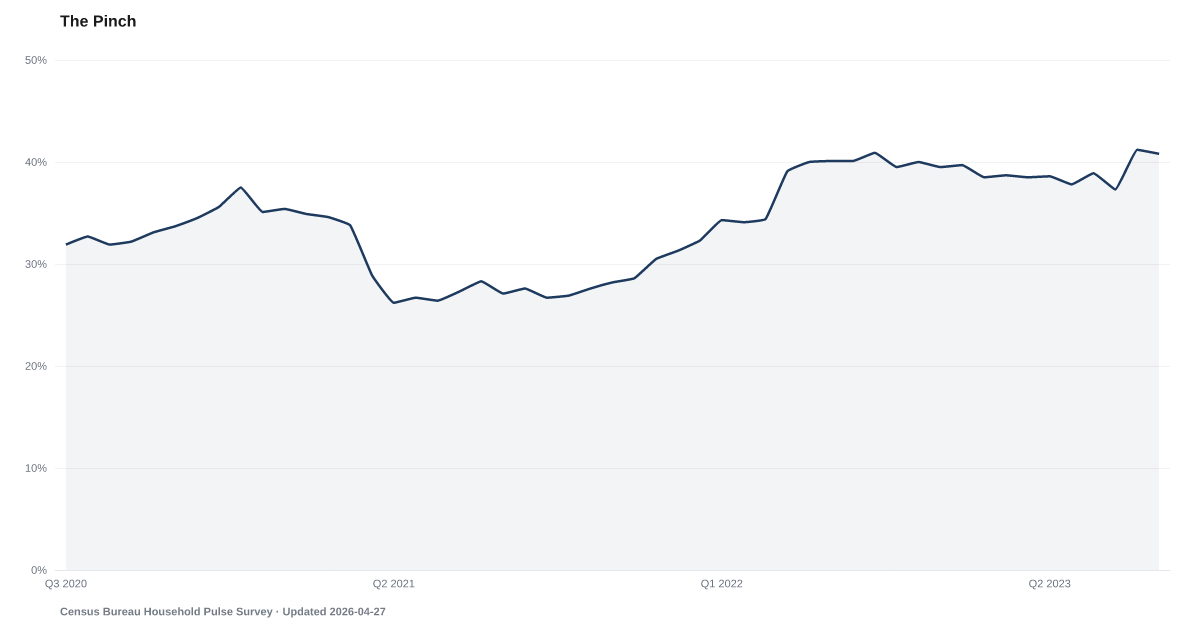
Share of U.S. adults reporting difficulty paying usual household expenses
What is the current Pinch reading?
Difficulty Paying Usual Household Expenses: 22.8% as of 2026-03-30. Source: U.S. Census Bureau Household Pulse Survey.
Census has rebuilt this survey twice since 2024, so the current reading has no comparable number behind it.
The Census Bureau asks adults whether their household has had difficulty paying its usual expenses. In March 2026, 22.8% said yes. That question now asks about the last two months. Through 2025 it asked about the last seven days.
The rewrite matters more than the number. A two-month window counts a household that fell behind once and recovered. A seven-day window does not. Widen the window and the share rises on the wording alone, with nothing changing in anyone's finances. So the current reading cannot be subtracted from the one before it, and the year-over-year column on this page stays empty on purpose.
The history behind it is not one series either. Through September 2024 the Household Pulse Survey ran as a cross-sectional survey and read between 35.7% and 41.2% across 2023 and 2024. Census then moved the question into a longitudinal panel, which reported 19.8% in June 2025 on identical wording. Neither figure is wrong. They were asked of different people, drawn different ways.
Wages have been rising, nominally, while The Squeeze shows a sizeable share of households spending nearly all of their income on necessities. The paycheck grows. The bills grow faster. What's left is the pinch.
Difficulty covering usual expenses is a direct report of current household strain. The Safety Net reports one emergency-payment response, while The Buffer reports the personal savings rate. They add separate context, but this page does not label expense difficulty a validated leading indicator of later delinquency or default.
Explore Further
How has The Pinch changed over time?

Most affected counties
Counties with the highest safety net and buffer scores in the County Distress Index.
Explore all 3,144 counties →| Period | Value | YoY Change |
|---|---|---|
| Mar 2026 | 22.8% | — |
| Jun 2025 | 19.8% | — |
| Sep 2024 | 37.1% | -0.2 pp |
| Aug 2024 | 37.4% | -1.5 pp |
| Jul 2024 | 37.4% | -0.4 pp |
| Jun 2024 | 37% | -1.6 pp |
| May 2024 | 36.5% | -2 pp |
| Apr 2024 | 36.4% | -2.1 pp |
| Apr 2024 | 35.7% | -3 pp |
| Mar 2024 | 36.2% | -2.3 pp |
| Feb 2024 | 36% | -3.7 pp |
| Oct 2023 | 40.8% | -0.1 pp |
How to read this series
The source changed how it measures this in Jun 2025. The Household Pulse Survey ended cross-sectional collection in September 2024 and relaunched inside the Household Trends and Outlook Pulse Survey as a longitudinal panel. Readings before and after sit on different samples. Readings on either side are not directly comparable, so the year-over-year column stays blank where a comparison would cross that date. Source documentation.
The source changed how it measures this in Mar 2026. Census widened the question's recall window from the last 7 days to the last two months, and returned the survey to a cross-sectional design. A longer window counts more households, so the level steps up on the wording alone. Readings on either side are not directly comparable, so the year-over-year column stays blank where a comparison would cross that date. Source documentation.
Frequently Asked Questions
What is Difficulty Paying Usual Household Expenses?
Share of U.S. adults reporting difficulty paying usual household expenses
Why does Difficulty Paying Usual Household Expenses matter for financial distress?
Difficulty Paying Usual Household Expenses is one of the indicators tracked by the American Distress Index (ADI), which measures five dimensions of U.S. household financial distress: Delinquency, Default & Legal, Debt Burden, Labor, and Safety Net & Buffer. Changes in this indicator contribute to the overall distress picture.
Where does the Difficulty Paying Usual Household Expenses data come from?
This data comes from U.S. Census Bureau Household Pulse Survey. More information: https://www.census.gov/data/experimental-data-products/household-pulse-survey.html. The American Distress Index updates this indicator every two weeks.

Quick poll
Is this affecting you or your household?
Discussion
Get the numbers when they move.
New data drops, indicator updates, and ADI score changes — delivered when it matters. No spam.
or Create an Account for full access
Loading comments…