Financial Health Score (FHN FinHealth Survey)
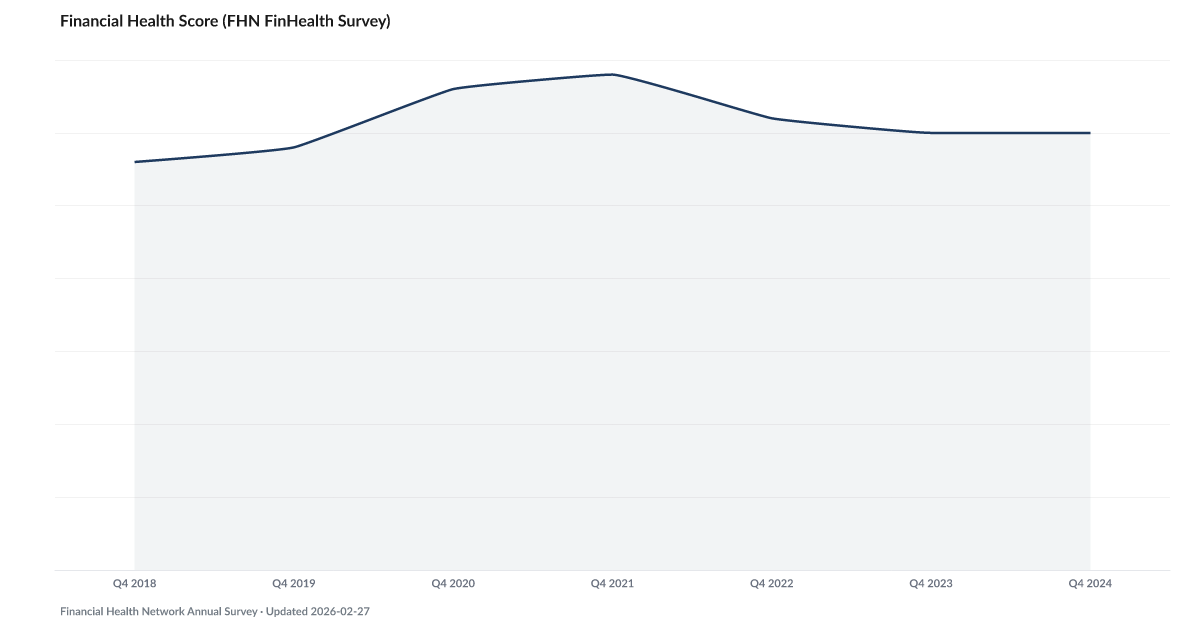
Unchanged from a year ago; nearly 1 in 3 in 'poor' financial health
What is the current Financial Health Score (FHN FinHealth Survey) reading?
Roughly 30% of American households scored in the 'Financially Healthy' tier of the Financial Health Network's annual Pulse assessment in 2024, which measures eight dimensions of financial well-being: spending, saving, borrowing, and planning. The remaining households scored as Coping (managing day-to-day but not resilient to shocks) or Vulnerable (struggling across multiple dimensions). Source: Financial Health Network FinHealth Pulse.
Measurement basis: Share of adults the Financial Health Network classifies as Financially Healthy on its FinHealth Score, which combines eight measures of spending, saving, borrowing and planning. The Pulse survey is fielded on the University of Southern California's Understanding America Study, a probability-based internet panel recruited by address-based sampling and weighted to population benchmarks for the noninstitutionalized U.S. adult population. Respondents are scored from their answers; they are not asked to rate their own financial health.
The Financial Health Network classifies 30 of Americans as financially healthy in 2024. Down from 34% in 2021.
The Financial Health Network's FinHealth Pulse Survey, a nationally representative annual study, sorts Americans into three tiers: Financially Healthy, Coping, and Vulnerable. The 2024 survey finds 30 in the healthy tier. The majority fall into Coping or Vulnerable — unable to cover all their obligations without strain, or failing to cover them outright.
The 2021 reading was 34%. That reflected a moment of stimulus checks, paused student loan payments, and a personal savings rate that briefly hit two digits. Every one of those supports has since rolled off.
The decline came from every support layer being pulled at once. No single shock. A coordinated rollback. The stimulus ended. The child tax credit expansion expired. SNAP emergency allotments sunset. The student loan pause closed. Each rollback, on its own, was manageable. Stacked, they moved the national financial health score multiple percentage points in the wrong direction and held it there.
This survey adds a household-level view to the structural measures. The Buffer reports the personal savings rate, while The Safety Net reports the share who said they would use savings to pay a $1,000 emergency. These measures can be read together as separate context; this page does not claim a validated lag from one to later debt stress.
Explore Further
How has Financial Health Score (FHN FinHealth Survey) changed over time?

Most affected counties
Counties with the highest safety net and buffer scores in the County Distress Index.
Explore all 3,144 counties →| Period | Value | YoY Change |
|---|---|---|
| 2024 | 30 | 0 |
| 2023 | 30 | — |
| 2022 | 31 | -3 |
| 2021 | 34 | +1 |
| 2020 | 33 | +4 |
| 2019 | 29 | +1 |
| 2018 | 28 | — |
How to read this series
The source changed how it measures this in 2023. The Financial Health Network sampled and weighted at the individual level through 2022 and at the household level from 2023, sampling one self-identified financial decision-maker per household. Readings on either side of this boundary describe different units. Readings on either side are not directly comparable, so the year-over-year column stays blank where a comparison would cross that date. Source documentation.
Frequently Asked Questions
What share of Americans are financially healthy?
30% of U.S. households scored in the Financially Healthy tier of the 2024 FinHealth Pulse. The rest scored Coping or Vulnerable — able to get by day-to-day, or struggling, but not resilient to a financial shock.
What does the FinHealth Pulse measure?
The Financial Health Network's annual Pulse survey scores households across eight dimensions spanning spend, save, borrow, and plan — for example whether income reliably covers expenses, whether savings could absorb an emergency, and whether debt is manageable relative to income.
Where does this data come from?
The Financial Health Network publishes the FinHealth Pulse survey annually, drawing on a nationally representative sample of U.S. adults.


Quick poll
Is this affecting you or your household?
Discussion
Get the numbers when they move.
New data drops, indicator updates, and ADI score changes — delivered when it matters. No spam.
or Create an Account for full access
Loading comments…