Unbanked / Underbanked Household Rate
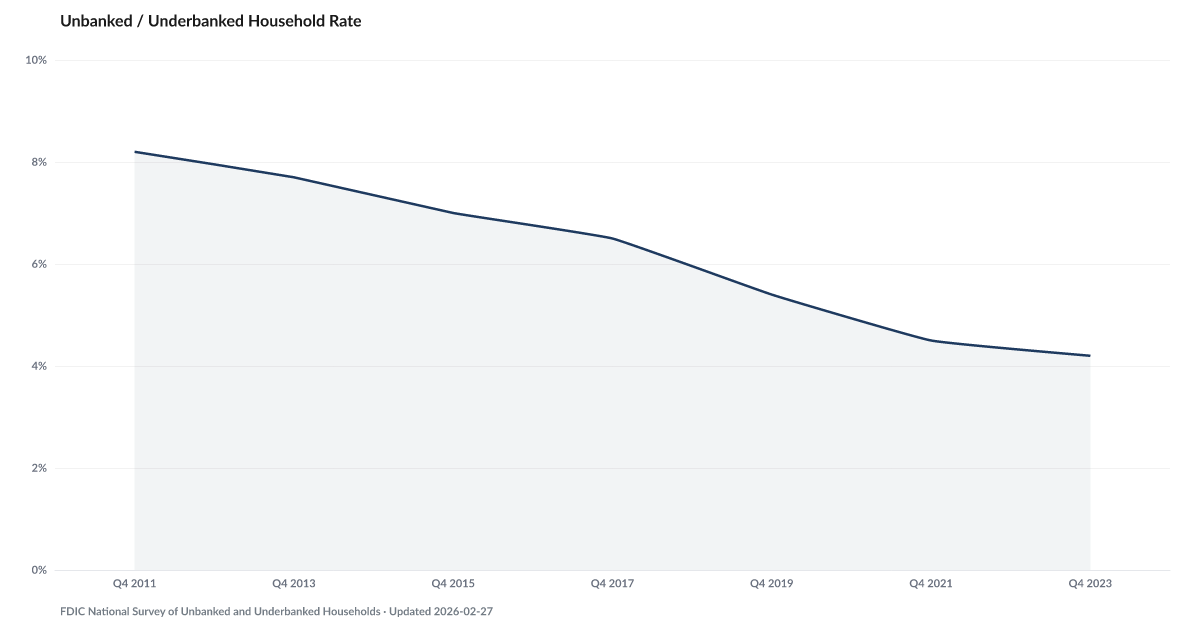
Down from 4.5% two years ago and roughly half its 8.2% level in 2011
What is the current Unbanked / Underbanked Household Rate reading?
4.2% of American households have no bank account at all (unbanked) as of the 2023 Federal Deposit Insurance Corporation survey, and millions more are underbanked — relying on check cashers, payday lenders, and other alternative financial services instead of traditional banks. Source: FDIC National Survey of Unbanked and Underbanked Households.
The share of U.S. households without a bank account has fallen to 4.2%. The current reading is the lowest in the site series.
The FDIC's National Survey of Unbanked and Underbanked Households, conducted every two years, measured the unbanked rate at 4.2% in 2023. That is down from 8.2% in 2011 — a halving over a dozen years. The trend is one of the cleaner pieces of good news in American household finance.
Having a bank account matters. Without one, routine life runs through check cashers, prepaid cards, and payday lenders — each skimming fees that a checking account would absorb for free. The FDIC estimates unbanked households pay hundreds of dollars a year in fees for services a bank would provide at no cost.
The improvement is real. It is also partial. A bank account is the entry point of financial participation, not the ceiling. Millions of households now have accounts but still rely on alternative financial services for credit — the underbanked layer that this survey tracks separately.
Account access, The Safety Net, and The Buffer are separate measures. The Safety Net records how adults said they would pay one hypothetical emergency; it does not report account balances or emergency-fund adequacy.
Explore Further
Is this happening to you?
Do you or someone you know rely on check-cashing or prepaid cards instead of a bank account?
How has Unbanked / Underbanked Household Rate changed over time?

Most affected counties
Counties with the highest safety net and buffer scores in the County Distress Index.
Explore all 3,144 counties →| Period | Value | YoY Change |
|---|---|---|
| 2023 | 4.2% | — |
| 2021 | 4.5% | — |
| 2019 | 5.4% | — |
| 2017 | 6.5% | — |
| 2015 | 7% | — |
| 2013 | 7.7% | — |
| 2011 | 8.2% | — |
Frequently Asked Questions
How many Americans don't have a bank account?
4.2% of U.S. households are unbanked (2023) — they have no checking or savings account at any bank or credit union. This leaves them reliant on check cashers, money orders, and prepaid cards for basic financial transactions.
What does 'underbanked' mean?
Underbanked households have a bank account but still rely on alternative financial services — payday lenders, check cashers, pawn shops, rent-to-own services — for some financial needs. These services typically charge much higher fees than a traditional bank account.
Where does this data come from?
The FDIC conducts its National Survey of Unbanked and Underbanked Households every two years, in partnership with the U.S. Census Bureau.


Quick poll
Is this affecting you or your household?
Discussion
Get the numbers when they move.
New data drops, indicator updates, and ADI score changes — delivered when it matters. No spam.
or Create an Account for full access
Loading comments…