Senior Loan Officer Survey: Banks Tightening Standards
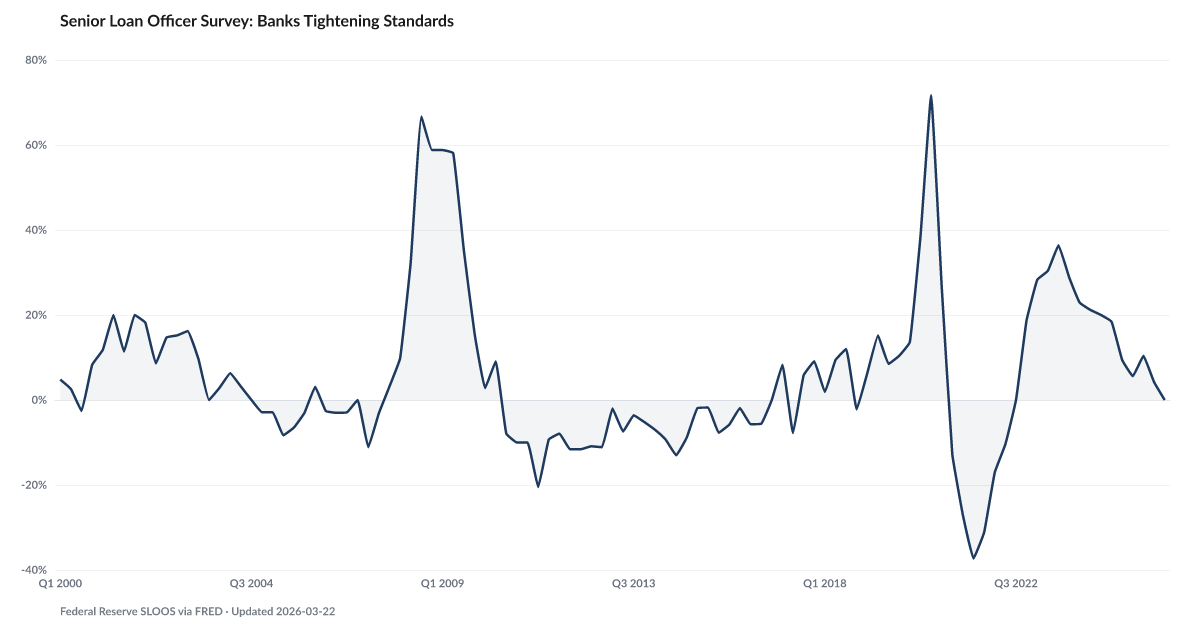
Net percentage of U.S. banks tightening lending standards on consumer loans
What is the current Senior Loan Officer Survey: Banks Tightening Standards reading?
The Senior Loan Officer Opinion Survey (SLOOS) asks bank loan officers whether they are tightening or loosening lending standards. A positive reading means banks are net tightening; a negative reading means they are net loosening. The most recent survey, for Q3 2026, shows a net 6.7% of banks reporting tighter standards. This captures the supply side of credit — even where demand exists, tighter standards can cut off borrowers and deepen financial distress.
The net share of U.S. banks tightening lending standards has returned to zero. That ends the longest tightening cycle in more than a decade.
The Federal Reserve's Senior Loan Officer Survey asks banks a simple question every quarter. Are you making it harder or easier to get a loan than three months ago? The answer is reported as a net percentage, the share tightening minus the share loosening. Positive means credit is harder to get. Negative means easier.
The net reading peaked above 70 percent during COVID and climbed again to roughly 36 percent in mid-2023 as the Fed hiked aggressively. It has since fallen steadily. The Q3 2026 print is zero. Banks as a group are neither tightening nor loosening. That is a meaningful inflection.
The question is what it signals. The conventional read is relief. Credit is becoming available again, which supports spending, borrowing, and the economy at the margin. The less conventional read is timing. The last two cycles, 2006-2007 and 2019, also showed net tightening rolling over to zero in the quarters just before household delinquency rates started climbing hard. Loosening doesn't cause the delinquency. It signals that banks have stopped pricing in the risk that households have already started acting on.
Falling Behind is already moving. The Late Fee confirms credit card delinquency remains elevated. The end of the tightening cycle is arriving into an environment where the underlying borrower is weaker than the headline indicators suggest. That combination has historically been where the next credit problem starts.
Explore Further
Is this happening to you?
Have you been denied credit or offered worse terms than you expected?
How has Senior Loan Officer Survey: Banks Tightening Standards changed over time?

Most affected counties
Counties with the highest debt burden scores in the County Distress Index.
Explore all 3,144 counties →| Period | Value | YoY Change |
|---|---|---|
| Q3 2026 | 6.7% | -3.7 pp |
| Q2 2026 | 2% | -3.6 pp |
| Q1 2026 | 0% | -9.4 pp |
| Q4 2025 | 4.2% | -14.2 pp |
| Q3 2025 | 10.4% | -9.6 pp |
| Q2 2025 | 5.6% | -15.6 pp |
| Q1 2025 | 9.4% | -13.5 pp |
| Q4 2024 | 18.4% | -10.5 pp |
| Q3 2024 | 20% | -16.4 pp |
| Q2 2024 | 21.2% | -9.2 pp |
| Q1 2024 | 22.9% | -5.4 pp |
| Q4 2023 | 28.9% | +10.1 pp |
Frequently Asked Questions
What does the SLOOS measure?
The Senior Loan Officer Opinion Survey asks bank loan officers whether they are tightening or loosening lending standards. It captures the supply side of credit: even when consumers need to borrow, tighter bank standards can cut off access, pushing them toward higher-cost alternatives.
Why does credit tightening matter for households?
When banks tighten standards, marginal borrowers lose access to credit on reasonable terms. That pushes them toward credit cards (currently averaging 20.94% APR), Buy Now Pay Later, or payday lenders — or forces them to cut spending, which can trigger the distress cascade other indicators track.
Where does SLOOS data come from?
The Federal Reserve conducts the Senior Loan Officer Opinion Survey quarterly, polling senior loan officers at large domestic and foreign-owned banks. The Q3 2026 reading is a net 6.7%.


Quick poll
Is this affecting you or your household?
Discussion
Get the numbers when they move.
New data drops, indicator updates, and ADI score changes — delivered when it matters. No spam.
or Create an Account for full access
Loading comments…