Total Nonfarm Payrolls
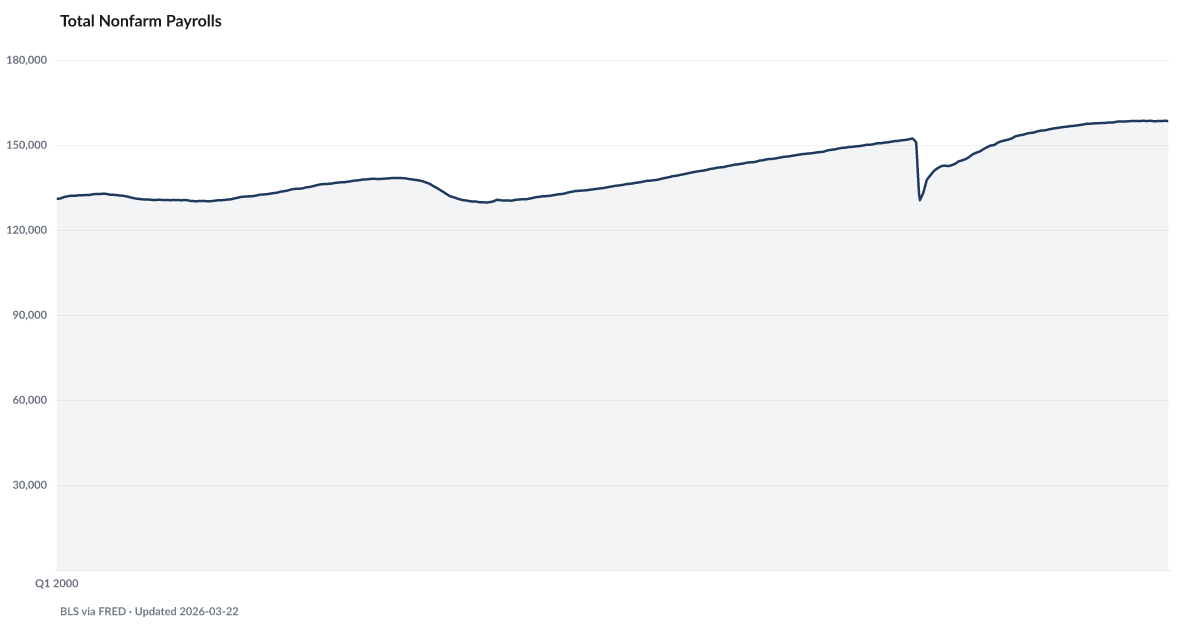
Total employment in the U.S. nonfarm economy
What is the current Total Nonfarm Payrolls reading?
U.S. payrolls fell by 23,000 in July 2026, to 158.86 million jobs. The current June 2026 estimate is 158.88 million. The Current Employment Statistics establishment survey estimates nonfarm payroll jobs, not unique people; someone paid by more than one establishment is counted at each. It excludes farm workers, private-household workers, self-employed people, and unpaid workers. Month-over-month changes show the net change in payroll jobs. Source: U.S. Bureau of Labor Statistics data retrieved via FRED (PAYEMS).
The U.S. Bureau of Labor Statistics estimated 158.86 million nonfarm payroll jobs in July 2026. This is a job-stock estimate, not a count of unique people; recent observations remain subject to revision.
The U.S. Bureau of Labor Statistics estimated nonfarm payroll employment below its all-time high in July 2026. That comparison describes the level only. Monthly revisions can alter recent observations, and the period-to-period change is a separate measure.
PAYEMS counts payroll jobs, not unique workers. A person holding two covered jobs can appear twice. The net monthly change combines hires, separations, business births and deaths, and revisions; the aggregate alone does not identify which flow moved. The Indeed Job Postings Index and JOLTS Quits Rate measure different labor-market activity and are not substitutes for the payroll level.
Industry composition can change without the aggregate revealing it. The detailed payroll tables should be used to identify which industries gained or lost jobs; the headline level cannot establish the sector mix by itself.
A large employment stock can coexist with household distress because PAYEMS does not measure job quality, hours, earnings, unemployment duration, or household buffers. Youth Unemployment and Continued Unemployment Claims are separate measures; read them alongside payrolls without treating one series as proof of another's direction.
Explore Further
How has Total Nonfarm Payrolls changed over time?

Most affected counties
Counties with the highest labor scores in the County Distress Index.
Explore all 3,144 counties →| Period | Value | YoY Change |
|---|---|---|
| Jul 2026 | 158.858M | +316K |
| Jun 2026 | 158.881M | +403K |
| May 2026 | 158.861M | +363K |
| Apr 2026 | 158.798M | +313K |
| Mar 2026 | 158.65M | +273K |
| Feb 2026 | 158.436M | +126K |
| Jan 2026 | 158.592M | +324K |
| Dec 2025 | 158.432M | +116K |
| Nov 2025 | 158.449M | +370K |
| Oct 2025 | 158.408M | +463K |
| Sep 2025 | 158.548M | +636K |
| Aug 2025 | 158.472M | +715K |
Frequently Asked Questions
What are total nonfarm payrolls?
Nonfarm payrolls estimate U.S. wage and salary jobs outside agriculture and private households. The series excludes self-employed and unpaid workers. It counts jobs rather than unique people, so someone paid by two establishments appears twice. At 158.86 million jobs, it is a broad monthly measure of nonfarm payroll employment.
Why do payrolls matter for the distress index?
Monthly payroll changes show the net number of jobs added or lost. Slower growth can signal weaker labor demand, but PAYEMS alone does not measure household income, job quality, or financial distress.
Where does this data come from?
Published monthly by the Bureau of Labor Statistics as part of the Current Employment Statistics establishment survey, available via FRED series PAYEMS.


Quick poll
Is this affecting you or your household?
Discussion
Get the numbers when they move.
New data drops, indicator updates, and ADI score changes — delivered when it matters. No spam.
or Create an Account for full access
Loading comments…