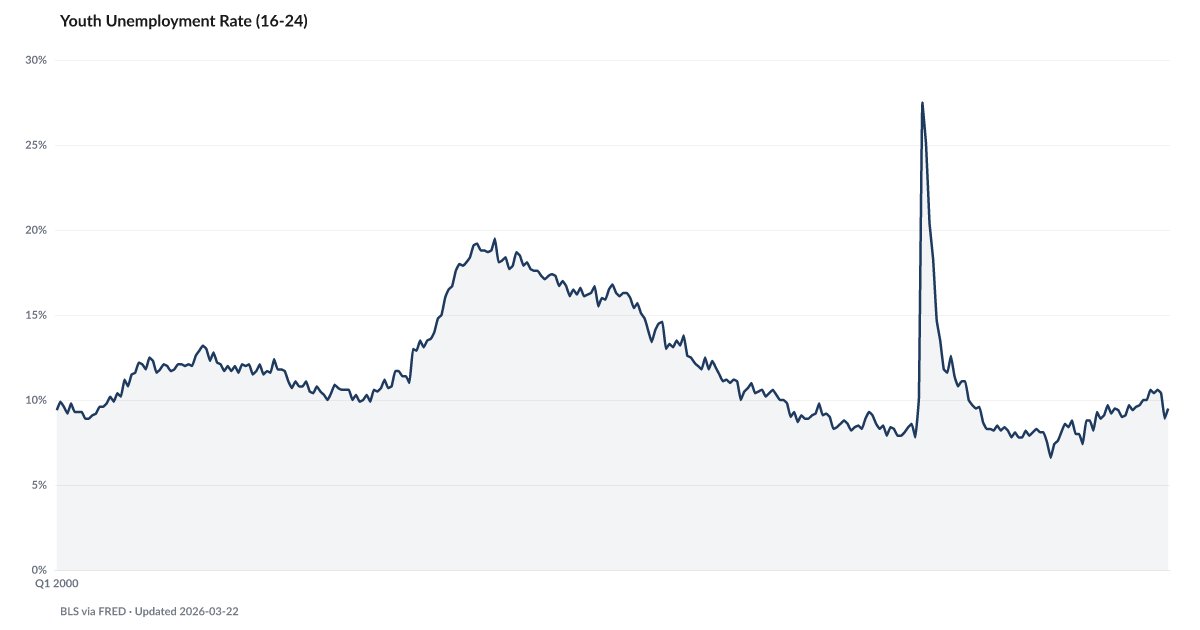
Youth Unemployment Rate (16-24)
Unemployment rate for workers ages 16 to 24
What is the current Youth Unemployment Rate (16-24) reading?
Youth unemployment (ages 16–24) registered 8.5% in July 2026. This cohort tracks the jobless rate for workers entering the labor market — historically the most vulnerable to economic downturns and most at risk from AI displacement of entry-level work. Source: U.S. Bureau of Labor Statistics data retrieved via FRED (LNS14024887).
Young workers — the age group most exposed to entry-level automation — are seeing unemployment drift higher than the headline rate, even as overall labor markets stay near full employment.
The BLS reports unemployment for workers ages 16-24 at 8.5% in July 2026. Young workers cycle through first jobs more often, so a gap above the headline Unemployment Rate is normal — but the shape of this cycle is different from the last one. In 2022, youth unemployment averaged just above 8%. In 2023 it briefly dipped below 7%. The run from 2024 through mid-2025 climbed steadily higher and peaked above 10% before easing.
Entry-level positions are where most younger workers enter the labor force, and entry-level positions are often discussed in automation-exposure research. The Horizon tracks the estimated human task-duration threshold at the benchmark's fitted success-probability point; it does not report elapsed runtime. The Adoption Curve separately reports employer deployment. Neither measure establishes which jobs are being absorbed first.
A softening youth labor market is also a household distress signal even when the younger worker still lives at home. Parents absorbing an unemployed 22-year-old are running their buffers down just as fast as if the distress were their own. The Buffer shows the personal savings rate near historic lows, which means there is less cushion in the household to absorb an adult child's joblessness.
Historically, youth unemployment leads the broader rate by one to two quarters when the labor market turns. The question is whether the current drift in young-worker joblessness is early warning of a broader softening or a standalone, AI-driven structural shift — both interpretations can be true simultaneously.
Explore Further
Is this happening to you?
Do you know a young person struggling to land their first real job?
How has Youth Unemployment Rate (16-24) changed over time?

Most affected counties
Counties with the highest labor scores in the County Distress Index.
Explore all 3,144 counties →| Period | Value | YoY Change |
|---|---|---|
| Jul 2026 | 8.5% | -1.5 pp |
| Jun 2026 | 9.2% | -0.8 pp |
| May 2026 | 9.4% | -0.3 pp |
| Apr 2026 | 9.5% | -0.1 pp |
| Mar 2026 | 8.5% | -0.9 pp |
| Feb 2026 | 9.5% | -0.2 pp |
| Jan 2026 | 8.9% | -0.2 pp |
| Dec 2025 | 10.4% | +1.4 pp |
| Nov 2025 | 10.6% | +1.2 pp |
| Sep 2025 | 10.4% | +1.2 pp |
| Aug 2025 | 10.6% | +0.9 pp |
| Jul 2025 | 10% | +0.9 pp |
Frequently Asked Questions
Why does youth unemployment matter as a distress signal?
Workers aged 16–24 are the first to lose hours and the last to be hired when the economy weakens. They also disproportionately fill the entry-level roles most vulnerable to AI automation. Rising youth unemployment is often a leading signal of broader labor-market deterioration.
How does AI affect youth employment specifically?
Entry-level jobs that traditionally served as career on-ramps — data entry, junior writing, basic coding, customer service — are among the tasks most readily automated by AI. That creates a specific risk for workers building their first work experience.
Where does youth unemployment data come from?
The Bureau of Labor Statistics publishes the 16-24 unemployment rate monthly as part of the Current Population Survey. The July 2026 reading is 8.5%.


Quick poll
Is this affecting you or your household?
Discussion
Get the numbers when they move.
New data drops, indicator updates, and ADI score changes — delivered when it matters. No spam.
or Create an Account for full access
Loading comments…