The Adoption Curve
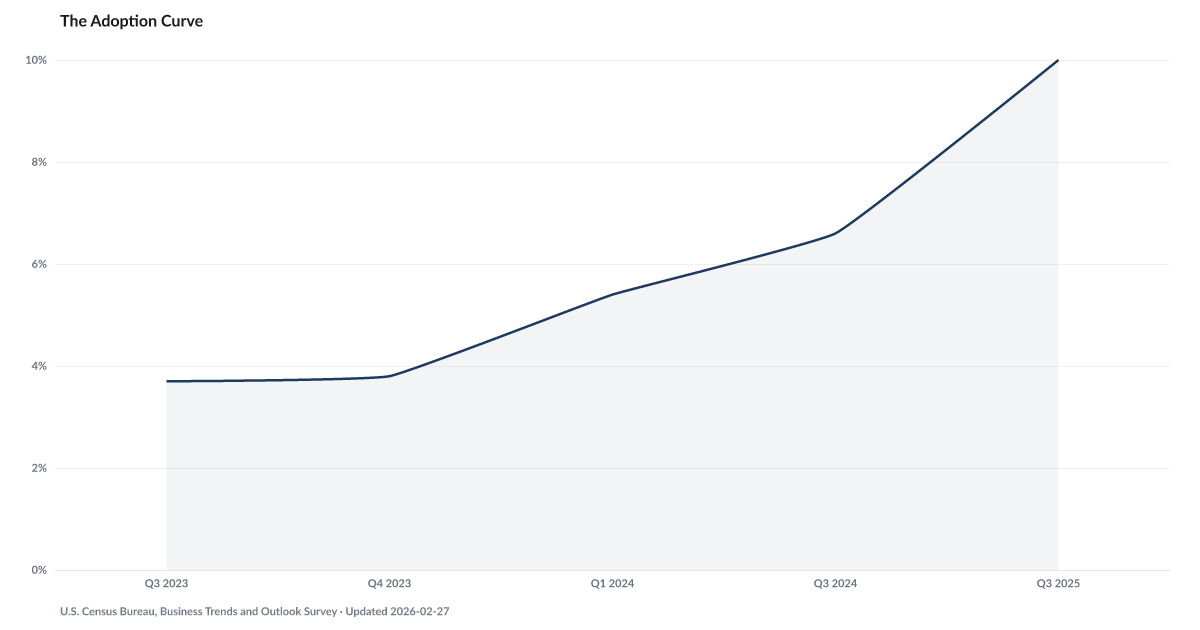
The September 2025 survey wave, up from 6.6% in the August 2024 wave and 3.7% when Census first asked in September 2023
What was the last reported Adoption Curve reading?
10% of U.S. businesses reported using artificial intelligence in any business function as of September 2025, according to the U.S. Census Bureau's Business Trends and Outlook Survey (BTOS). American Default Research tracks adoption alongside hiring and layoff measures; the survey does not establish that adoption caused a particular workforce outcome. Source: Census BTOS.
As of September 2025, 10% of U.S. employer businesses used AI in production — multiples above the share two years earlier, and the adoption curve was still steepening at that reading.
The Census Bureau's Business Trends and Outlook Survey reached 10% in its most recent reading (September 2025) for the share of U.S. employer businesses using AI in their operations. Two years earlier, in September 2023, that share was 3.7%. The line has bent upward in each successive reading.
That level sounds modest until you work through what it represents. The Census BTOS universe is employer firms — roughly 5.8 million businesses that together employ most of the private-sector workforce. A shift of that magnitude in two years is millions of workers whose employer has added AI to production workflows in the last two years.
Adoption is a leading indicator. The workforce consequences show up downstream in series like The AI Cut, where Challenger began tracking AI-attributed layoff announcements as a distinct category its earlier reports did not carry, and The Tech Drought, where information-sector job openings have fallen sharply since 2025. The Horizon tracks the capability side — the estimated human-expert task-duration threshold at which the evaluated agent's fitted success probability is 50 percent, not elapsed agent runtime — and that curve is steeper still.
Adoption sits alongside capability, hiring, and layoff measures on this site. Their movement can motivate questions about a path from adoption to displacement to lost income, but the data do not establish that one stage caused the next.
Is this happening to you?
Is your employer rolling out AI tools that change how you do your job?
How has The Adoption Curve changed over time?

Most affected counties
Counties with the highest labor scores in the County Distress Index.
Explore all 3,144 counties →| Period | Value | YoY Change |
|---|---|---|
| Sep 2025 | 10% | +3.4 pp |
| Sep 2024 | 6.6% | +2.9 pp |
| Aug 2024 | 6.6% | +2.9 pp |
| Mar 2024 | 5.4% | — |
| Feb 2024 | 5.4% | — |
| Dec 2023 | 3.8% | — |
| Nov 2023 | 3.8% | — |
| Sep 2023 | 3.7% | — |
Frequently Asked Questions
What percentage of U.S. businesses use AI?
10% of U.S. businesses reported using AI in any business function as of September 2025, according to the Census Bureau's Business Trends and Outlook Survey. The rate varies significantly by industry, with technology and finance leading.
Why does AI adoption matter for household financial distress?
American Default Research treats adoption as one concurrent signal alongside hiring and layoff measures. Automation may change demand for some tasks, but the adoption survey alone does not establish that it caused layoffs, longer job searches, or wage changes.
Where does AI adoption data come from?
The Census Bureau's Business Trends and Outlook Survey (BTOS) is a quarterly survey of U.S. businesses covering current and anticipated use of AI technologies. It is one of the few government-sourced measures of AI adoption.


Quick poll
Is this affecting you or your household?
Discussion
Get the numbers when they move.
New data drops, indicator updates, and ADI score changes — delivered when it matters. No spam.
or Create an Account for full access
Loading comments…