The Tech Drought
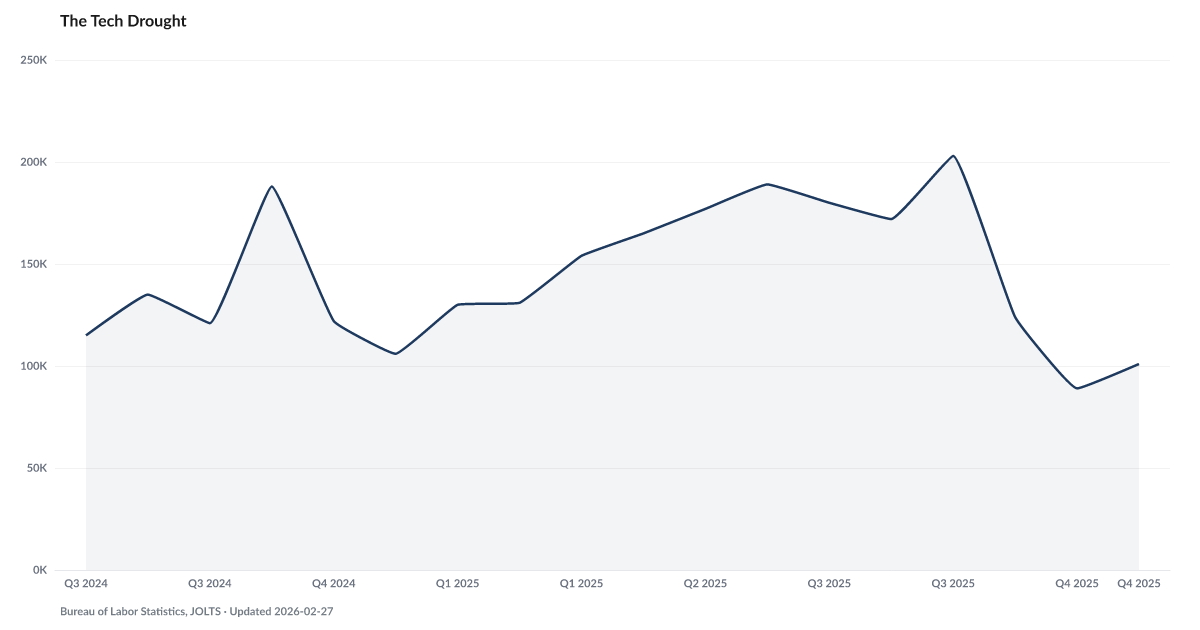
90,000 tech sector job openings — tech hiring has not recovered
What is the current Tech Drought reading?
Information-sector job openings are the U.S. Bureau of Labor Statistics JOLTS estimate for NAICS 51. The series describes monthly vacancy demand in publishing, telecommunications, data processing, and related information industries; it does not cover every technology occupation or establish that changes in this sector predict the broader labor market. Source: Bureau of Labor Statistics, JOLTS.
Information-sector job openings were 90,000 in June 2026 — 56% below the 203,000 reading recorded in September 2025.
The BLS Job Openings and Labor Turnover Survey tracks unfilled positions by industry. For the information sector — NAICS 51, which includes software publishing, data processing, and most of what the press calls tech — openings stood at 203,000 in September 2025. By December, that figure was 101,000. The one-quarter drop was severe.
Tech hiring is one part of the labor market, not a validated leading relationship on this page. Read this series alongside Continued Unemployment Claims and the JOLTS Quits Rate for broader context; their movements do not establish that the tech series caused or predicted them.
The current pullback carries a wrinkle the 2022 reset didn't. That episode was mostly a correction from pandemic over-hiring. The 2025-2026 pullback coincides with longer estimated human task-duration thresholds in The Horizon — not longer elapsed model runtime — and with AI-attributed layoff announcements in The AI Cut. How much of the tech drought is cyclical and how much is structural remains an open question; coincidence alone does not resolve it.
For households whose income depends on tech-sector work, the distinction matters. Cyclical downturns reverse; structural ones don't. The downstream indicator to watch is Youth Unemployment, where early-career workers — the group most exposed to entry-level automation — are already running well above the rate of workers over 35.
Explore Further
Is this happening to you?
Have you noticed tech job postings drying up in your area?
How has The Tech Drought changed over time?

Most affected counties
Counties with the highest labor scores in the County Distress Index.
Explore all 3,144 counties →| Period | Value | YoY Change |
|---|---|---|
| Jun 2026 | 90K | -33K |
| May 2026 | 72K | -37K |
| Apr 2026 | 82K | -52K |
| Mar 2026 | 83K | -32K |
| Feb 2026 | 80K | -45K |
| Jan 2026 | 100K | -1K |
| Dec 2025 | 112K | +7K |
| Nov 2025 | 88K | -31K |
| Oct 2025 | 117K | -61K |
| Sep 2025 | 119K | +5K |
| Aug 2025 | 141K | +36K |
| Jul 2025 | 157K | +52K |
Frequently Asked Questions
What does the tech job-openings indicator measure?
It reports the Bureau of Labor Statistics JOLTS estimate of open positions in the information sector, NAICS 51. That industry classification includes publishing, telecommunications, data processing, and related activities, but it is not a count of every technology job opening in the economy.
Does this series measure the effect of AI on hiring?
No. JOLTS measures job openings by industry and does not attribute changes to artificial intelligence, automation, or any other single cause. Read it as a measure of information-sector vacancy demand, not as a causal estimate of AI displacement.
Where does tech job opening data come from?
The data comes from the Bureau of Labor Statistics Job Openings and Labor Turnover Survey, using the information-sector series for NAICS 51.


Quick poll
Is this affecting you or your household?
Discussion
Get the numbers when they move.
New data drops, indicator updates, and ADI score changes — delivered when it matters. No spam.
or Create an Account for full access
Loading comments…