The Pump Tax
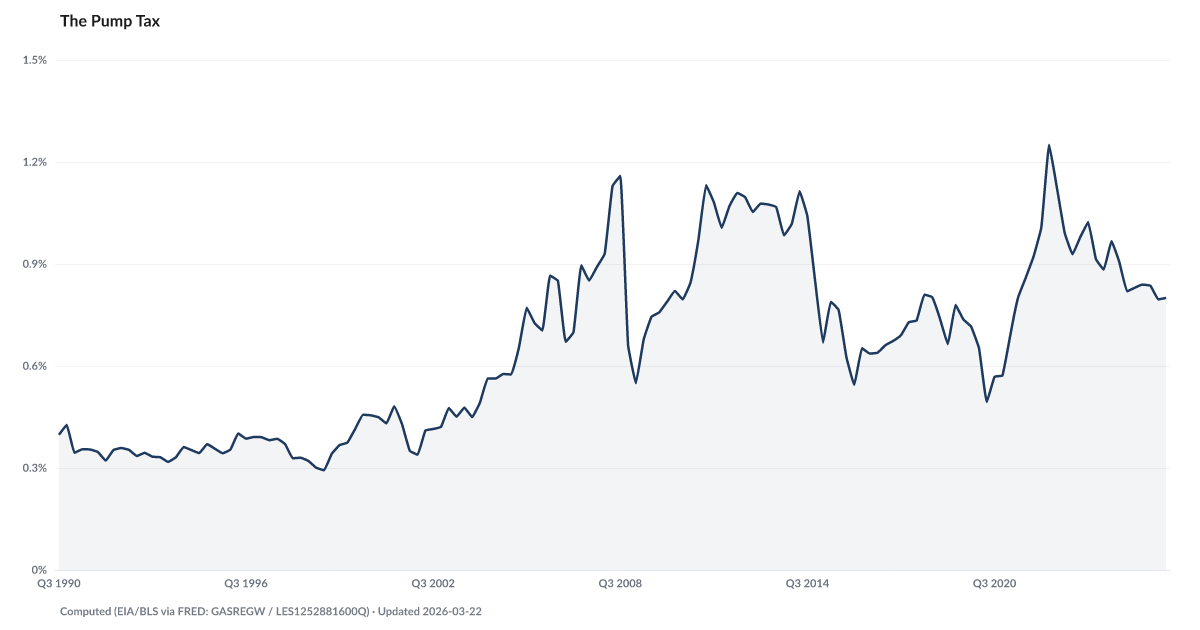
Gas prices relative to median weekly earnings
Productivity-Pay Wedge is currently elevated — historically leads this indicator by 0 quarter. Productivity-Pay Wedge · View projections
What is the current Pump Tax reading?
American households are spending 1.11% of disposable income on gasoline in Q2 2026. The Pump Tax tracks gasoline costs as a share of household income — a direct measure of fuel affordability. Source: Computed from U.S. Energy Information Administration gasoline prices and U.S. Bureau of Economic Analysis disposable personal income.
A gallon of gas now costs 1.11 percent of median weekly earnings, back above the pre-pandemic norm after retreating from the 2022 energy shock.
The gas affordability ratio is a simple piece of math. Take the weekly retail price of regular gas. Divide by median full-time weekly earnings. The result is the share of one week's pay that buys one gallon. EIA and U.S. Bureau of Labor Statistics data retrieved via FRED make the calculation automatic.
The pre-pandemic normal sat near 0.7 percent. The 2022 reading hit 1.25 percent as gas briefly cleared five dollars a gallon. Through 2023 and 2024 the ratio retreated into the 0.8 range. That was the story everyone remembers. Prices came back down.
They came back down, then they started climbing again. The Q2 2026 reading is 1.1 percent — strongest reading since the 2022 shock. The climb happened in spite of the earnings side. Wages kept growing. Gas prices grew faster.
Gasoline is a regressive cost. The bottom income quartile spends a much larger share of income on fuel than the top quartile does. That same quartile is the one showing up in The Divergence, where low-income consumer spending growth now trails high-income spending by nearly 10 points. A rising pump tax is one of the mechanisms pulling the lower-income side of the economy away from the top.
Explore Further
Is this happening to you?
Is filling up the tank taking a bigger bite out of your budget than it used to?
How has The Pump Tax changed over time?

Most affected counties
Counties with the highest debt burden scores in the County Distress Index.
Explore all 3,144 counties →| Period | Value | YoY Change |
|---|---|---|
| Q2 2026 | 1.11% | +0.27 pp |
| Q1 2026 | 0.84% | +0.01 pp |
| Q3 2025 | 0.84% | -0.07 pp |
| Q2 2025 | 0.84% | -0.13 pp |
| Q1 2025 | 0.83% | -0.05 pp |
| Q4 2024 | 0.82% | -0.1 pp |
| Q3 2024 | 0.91% | -0.12 pp |
| Q2 2024 | 0.97% | -0.01 pp |
| Q1 2024 | 0.88% | -0.05 pp |
| Q4 2023 | 0.91% | -0.08 pp |
| Q3 2023 | 1.02% | -0.1 pp |
| Q2 2023 | 0.98% | -0.27 pp |
Frequently Asked Questions
What is The Pump Tax?
The Pump Tax measures gasoline spending as a percentage of household disposable income. The Q2 2026 reading is 1.11%, capturing how much fuel costs burden the average American household.
Why does gas affordability matter for distress?
Gasoline is essential for commuting to work. When fuel costs spike, lower-income households — who already spend a disproportionate share on gas — must cut other spending or take on debt.
Where does this data come from?
Computed from EIA gasoline price data and BEA disposable personal income data.


Quick poll
Is this affecting you or your household?
Discussion
Get the numbers when they move.
New data drops, indicator updates, and ADI score changes — delivered when it matters. No spam.
or Create an Account for full access
Loading comments…