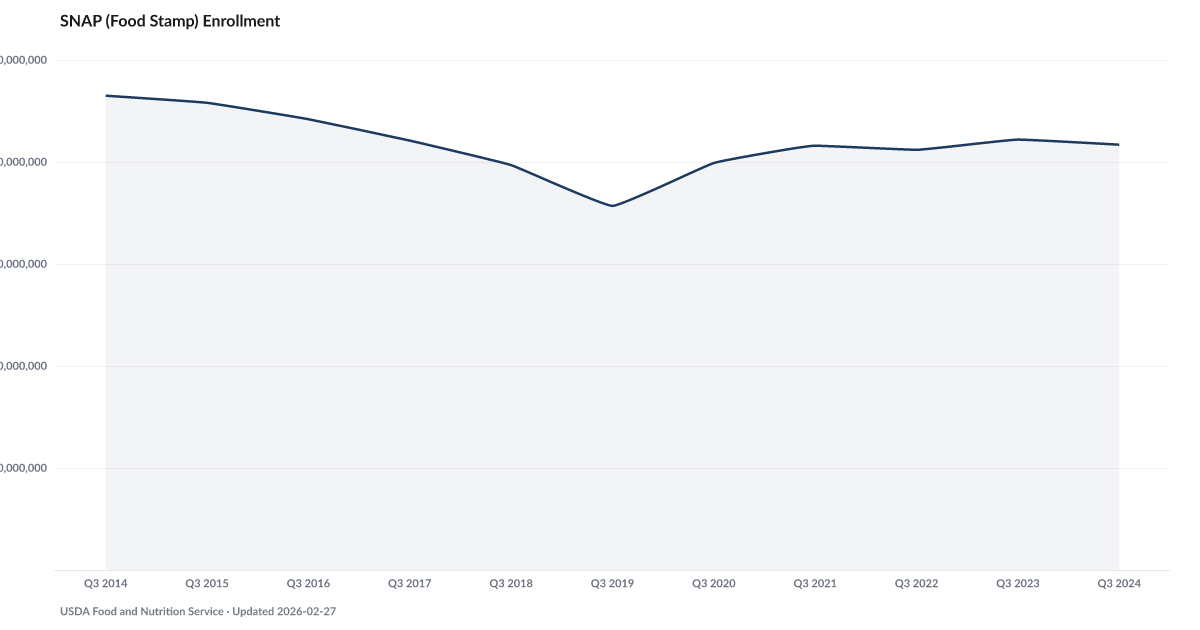
SNAP (Food Stamp) Enrollment
36.56 million people enrolled in SNAP in May 2026
What is the current SNAP (Food Stamp) Enrollment reading?
36.56 million Americans were enrolled in the Supplemental Nutrition Assistance Program (SNAP, formerly food stamps) as of May 2026 — a direct measure of how many households cannot afford groceries without government help. SNAP enrollment responds to changes in income and employment with a lag, so it is both a current-distress signal and a trailing one.
SNAP enrollment remains well above its pre-pandemic baseline, and is holding there while the headline labor market keeps expanding.
The USDA Food and Nutrition Service publishes monthly SNAP enrollment data. The September 2019 reading, just before the pandemic, was 35.7 million. Enrollment surged through 2020 and 2021 and has not returned to pre-pandemic levels. Several million additional Americans are using food assistance today than before the pandemic, and the rolls have stopped falling.
That persistence is the point. SNAP enrollment is means-tested. Eligibility depends on income relative to the federal poverty line. For enrollment to stay well above pre-pandemic levels five years later, the share of households below the income thresholds has to be structurally higher — either because wages have not kept up with costs, or because the cost of qualifying expenses like rent and child care has pushed more households across the eligibility line.
The official unemployment rate has been under 5% for most of this window. The headline economy is not in recession. And yet the number of households qualifying for grocery help keeps climbing.
SNAP enrollment, The Buffer, and The Safety Net use different populations and methods. Read them as separate context; neither buffer measure establishes why a household participates in SNAP or explains the enrollment trend.
Explore Further
How has SNAP (Food Stamp) Enrollment changed over time?

Most affected counties
Counties with the highest debt burden scores in the County Distress Index.
Explore all 3,144 counties →| Period | Value | YoY Change |
|---|---|---|
| May 2026 | 36.562M | -5.686M |
| Apr 2026 | 37.079M | -5.275M |
| Mar 2026 | 37.531M | -4.663M |
| Feb 2026 | 37.947M | -4.233M |
| Jan 2026 | 38.552M | -4.267M |
| Dec 2025 | 39.208M | -3.749M |
| Nov 2025 | 40M | -3.015M |
| Oct 2025 | 41.097M | -2.157M |
| Sep 2025 | 41.633M | -683.496K |
| Aug 2025 | 41.837M | -437.529K |
| Jul 2025 | 42.013M | -14.702K |
| Jun 2025 | 42.085M | +219.302K |
How to read this series
The source changed how it measures this in Oct 2022. Readings through September 2022 are annual fiscal-year figures dated to the September 30 fiscal-year end. From October 2022 the series carries USDA's individual monthly participation counts, so a reading before this date summarises a whole year and a reading after it counts one month. Readings on either side are not directly comparable, so the year-over-year column stays blank where a comparison would cross that date. Source documentation.
Frequently Asked Questions
How many Americans receive SNAP benefits?
36.56 million Americans are enrolled in SNAP as of May 2026, according to U.S. Department of Agriculture data. Enrollment is a direct count of individuals and families who qualify based on income and household size.
Why does SNAP enrollment matter as a distress indicator?
SNAP enrollment is one of the more direct measures of financial distress available — it counts people who cannot afford to feed themselves without government help. Unlike a survey-based measure, enrollment reflects circumstances verified through an actual application process.
Where does SNAP enrollment data come from?
The USDA Food and Nutrition Service publishes SNAP participation data monthly. The May 2026 reading is 36.56 million participants nationwide.


Quick poll
Is this affecting you or your household?
Discussion
Get the numbers when they move.
New data drops, indicator updates, and ADI score changes — delivered when it matters. No spam.
or Create an Account for full access
Loading comments…