Prescription Drug CPI
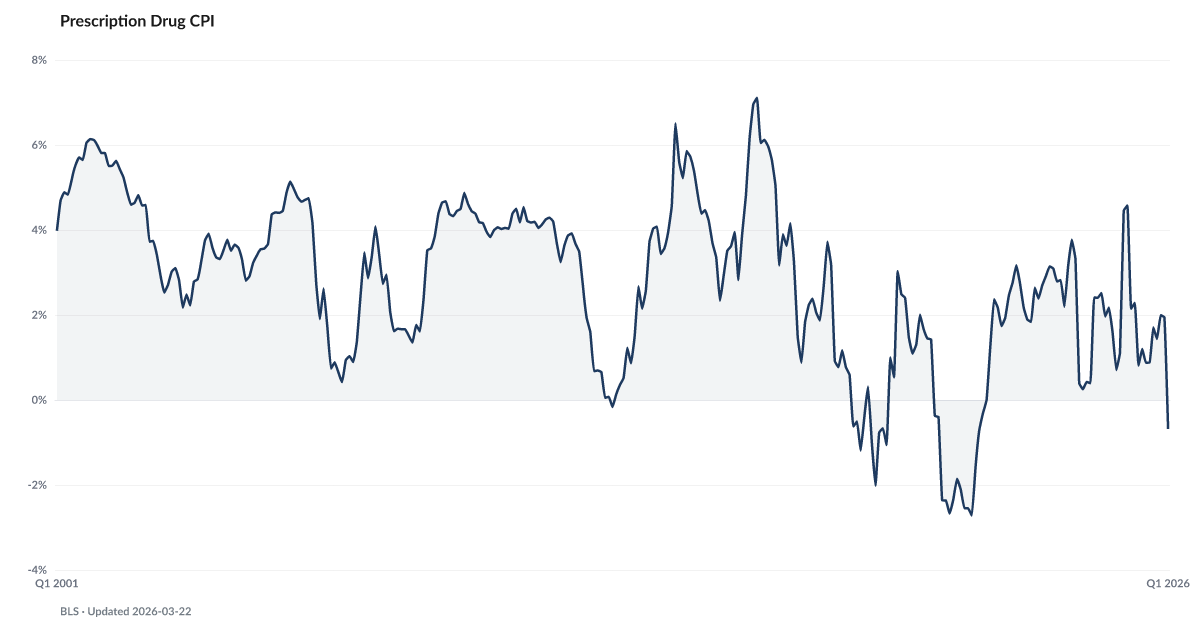
Year-over-year change in prescription drug prices
What is the current Prescription Drug CPI reading?
Prescription Drug CPI: -3.06% as of 2026-07. Source: U.S. Bureau of Labor Statistics (CUSR0000SEMF01).
Measurement basis: Year-over-year percent change computed from the seasonally adjusted BLS Prescription Drug CPI (CUSR0000SEMF01); seasonally adjusted values may be revised
Prescription drug prices are running at -3.06% year-over-year — a CPI category where Medicare negotiation and generic substitution both show up in the index.
Drug prices rarely fall. Over thirty years of this series the year-over-year change has been positive far more often than not, peaking at 7.1% in October 2016. A negative print is the exception, not the pattern.
BLS data shows the year-over-year change at -3.06% as of July 2026. The print reflects two regulatory levers running at the same time. Medicare negotiation on a widening list of drugs is feeding through to the price indexes. Generic substitution on several high-volume brand franchises is arriving in parallel.
Where the index is falling, the relief is concentrated in drugs coming off patent and in the categories Medicare is negotiating. Patients on novel biologics, weight-loss drugs, or specialty cancer therapies face price curves that look nothing like the headline number.
The broader context is sobering. Medical Care CPI covers the whole medical basket, and doctor visits, hospital services and insurance premiums are the lines that dominate it. Drugs are the smallest part of the medical budget for most households who are not on a specialty therapy.
Explore Further
How has Prescription Drug CPI changed over time?

Most affected counties
Counties with the highest debt burden scores in the County Distress Index.
Explore all 3,144 counties →| Period | Value | YoY Change |
|---|---|---|
| Jul 2026 | -3.06% | -3.94 pp |
| Jun 2026 | -2.5% | -3.7 pp |
| May 2026 | -2.02% | -2.83 pp |
| Apr 2026 | -0.52% | -2.8 pp |
| Mar 2026 | -0.18% | -2.33 pp |
| Feb 2026 | -0.7% | -5.28 pp |
| Jan 2026 | -0.53% | -4.98 pp |
| Dec 2025 | 1.95% | +0.85 pp |
| Nov 2025 | 1.86% | +1.16 pp |
| Sep 2025 | 1.71% | -0.47 pp |
| Aug 2025 | 0.88% | -1.09 pp |
| Jul 2025 | 0.88% | -1.64 pp |
Frequently Asked Questions
What is Prescription Drug CPI?
Year-over-year change in prescription drug prices
Why does Prescription Drug CPI matter for financial distress?
Prescription Drug CPI is one of the indicators tracked by the American Distress Index (ADI), which measures five dimensions of U.S. household financial distress: Delinquency, Default & Legal, Debt Burden, Labor, and Safety Net & Buffer. Changes in this indicator contribute to the overall distress picture.
Where does the Prescription Drug CPI data come from?
This data comes from U.S. Bureau of Labor Statistics (CUSR0000SEMF01). More information: https://data.bls.gov/timeseries/CUSR0000SEMF01. The American Distress Index updates this indicator monthly.


Quick poll
Is this affecting you or your household?
Discussion
Get the numbers when they move.
New data drops, indicator updates, and ADI score changes — delivered when it matters. No spam.
or Create an Account for full access
Loading comments…