Medical Care CPI
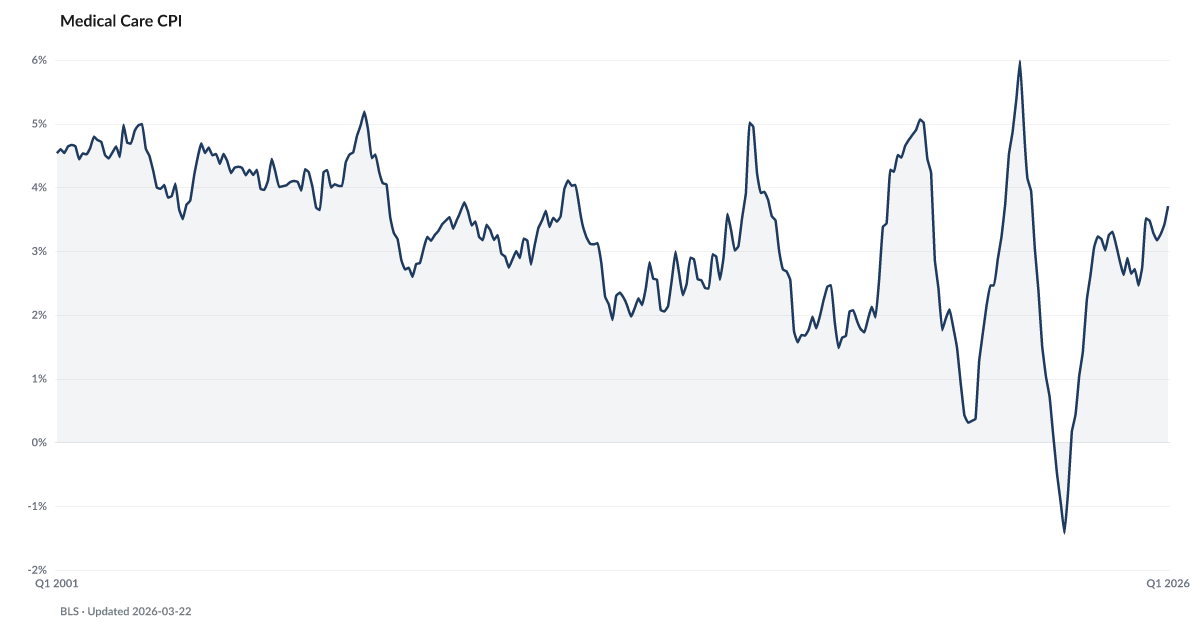
Year-over-year change in medical care costs
What is the current Medical Care CPI reading?
Medical Care CPI: 1.7% as of 2026-07. Source: U.S. Bureau of Labor Statistics (CUSR0000SAM).
Measurement basis: Year-over-year percent change computed from the seasonally adjusted BLS Medical Care CPI (CUSR0000SAM); seasonally adjusted values may be revised
Medical care inflation is running at 1.7% as of July 2026. The annual print swings. The compounding underneath it does not.
Medical inflation went negative for a stretch in 2023, bottoming at -1.4% in September 2023. The print was unusual. It reflected a change in how the BLS measures health insurance prices, combined with Medicare drug negotiation effects feeding through to the pharmaceutical component. Both factors were temporary.
BLS data puts medical care CPI at 1.7% year over year as of July 2026. Where that sits against the Federal Reserve's 2 percent inflation objective moves from print to print. What has defined healthcare costs for four decades is not any single year's rate but what a run of them compounds to.
The driver is the services side: doctor visits, hospital services, outpatient procedures, and especially insurance premiums. These categories compound year after year, and a rate in the low single digits sustained across a working lifetime doubles a cost without any single year looking alarming. Prescription Drug CPI tracks the drug component separately; the two move on different regulatory clocks.
Separate household-finance context is available from The Safety Net and Bankruptcy Filings. Medical Care CPI measures price change; it does not identify whether a particular price change produced an emergency expense or a later court filing.
Explore Further
How has Medical Care CPI changed over time?

Most affected counties
Counties with the highest debt burden scores in the County Distress Index.
Explore all 3,144 counties →| Period | Value | YoY Change |
|---|---|---|
| Jul 2026 | 1.7% | -1.82 pp |
| Jun 2026 | 2.03% | -0.72 pp |
| May 2026 | 2.59% | +0.13 pp |
| Apr 2026 | 2.54% | -0.18 pp |
| Mar 2026 | 3.05% | +0.41 pp |
| Feb 2026 | 3.36% | +0.47 pp |
| Jan 2026 | 3.19% | +0.57 pp |
| Dec 2025 | 3.15% | +0.32 pp |
| Nov 2025 | 2.9% | -0.19 pp |
| Sep 2025 | 3.29% | +0.03 pp |
| Aug 2025 | 3.48% | +0.47 pp |
| Jul 2025 | 3.52% | +0.33 pp |
Frequently Asked Questions
What is Medical Care CPI?
Year-over-year change in medical care costs
Why does Medical Care CPI matter for financial distress?
Medical Care CPI is one of the indicators tracked by the American Distress Index (ADI), which measures five dimensions of U.S. household financial distress: Delinquency, Default & Legal, Debt Burden, Labor, and Safety Net & Buffer. Changes in this indicator contribute to the overall distress picture.
Where does the Medical Care CPI data come from?
This data comes from U.S. Bureau of Labor Statistics (CUSR0000SAM). More information: https://data.bls.gov/timeseries/CUSR0000SAM. The American Distress Index updates this indicator monthly.


Quick poll
Is this affecting you or your household?
Discussion
Get the numbers when they move.
New data drops, indicator updates, and ADI score changes — delivered when it matters. No spam.
or Create an Account for full access
Loading comments…