Motor Vehicle Insurance CPI
Year-over-year change in auto insurance premiums
Historically follows CPI Inflation Rate (All Items) by 3 quarters — no active signal. CPI Inflation Rate (All Items) · View projections
What is the current Motor Vehicle Insurance CPI?
Motor vehicle insurance prices rose 5.9% year-over-year as of February 2026, according to BLS CPI data (series CUSR0000SETD). While down from the June 2023 peak of 19.8% YoY, auto insurance inflation continues to outpace headline CPI by a wide margin. The cumulative effect means auto insurance premiums are roughly 50% higher than in 2020. This persistent cost pressure disproportionately affects lower-income households, where auto insurance represents a larger share of disposable income. Source: Bureau of Labor Statistics (CUSR0000SETD).
Motor Vehicle Insurance CPI at 5.5%
Tracking improving relative to recent baseline.
Explore Further
How has Motor Vehicle Insurance CPI changed over time?
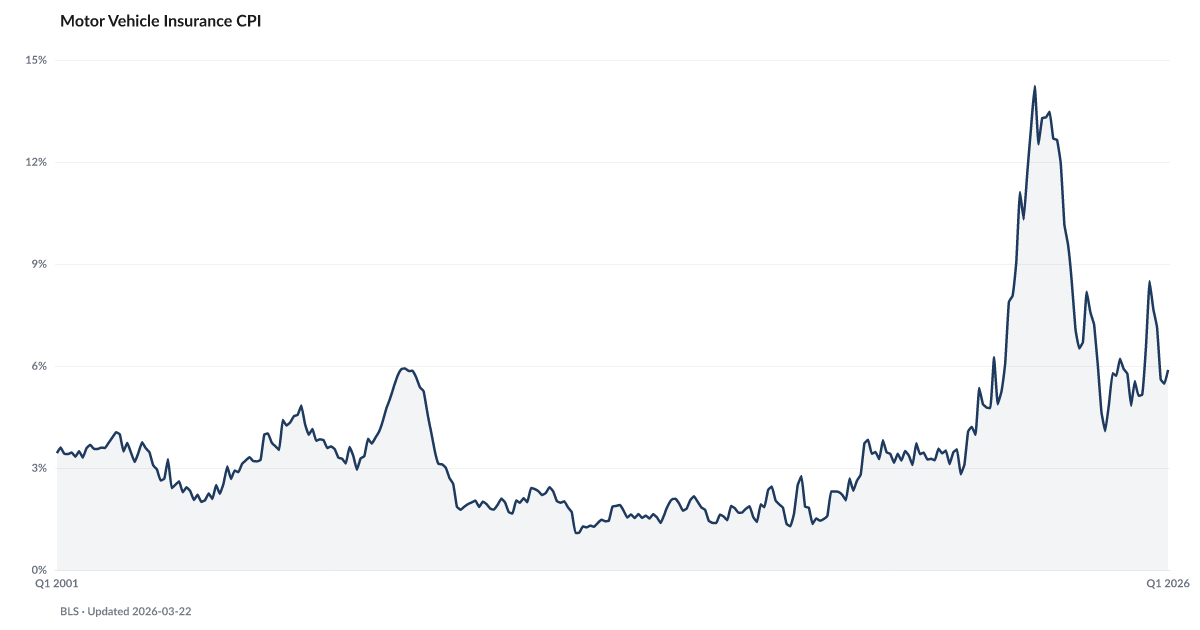
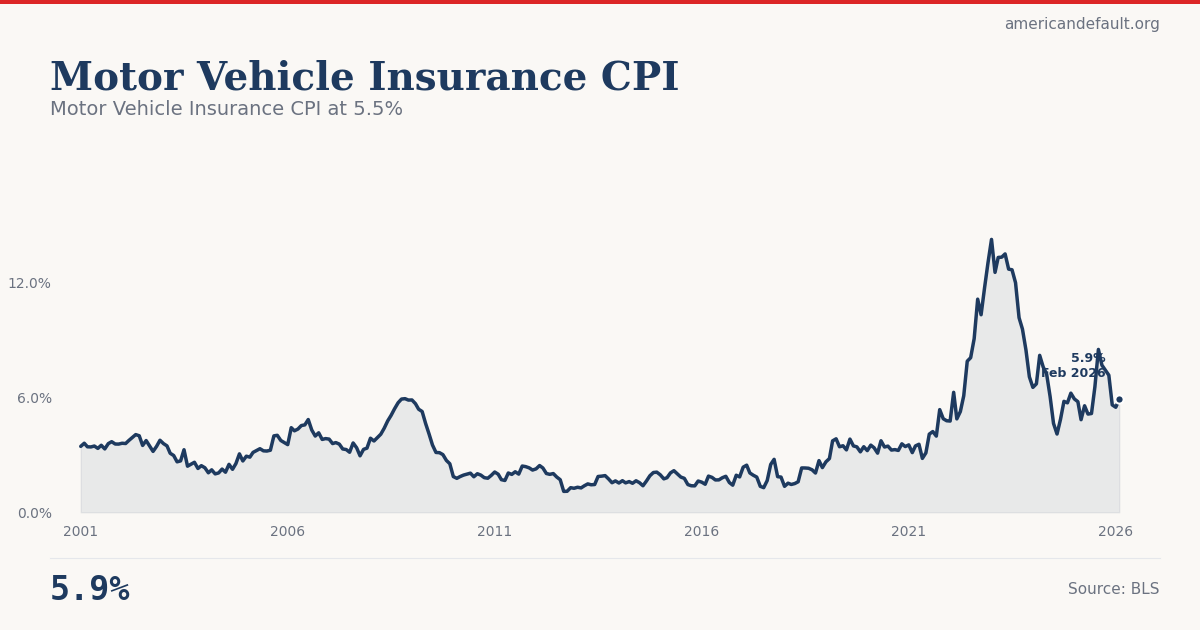

| Period | Value | YoY Change |
|---|---|---|
| Feb 2026 | 5.89% | +0.1 pts |
| Jan 2026 | 5.48% | −0.4 pts |
| Dec 2025 | 5.6% | −0.6 pts |
| Nov 2025 | 7.15% | +1.4 pts |
| Sep 2025 | 7.68% | +2.8 pts |
| Aug 2025 | 8.5% | +4.4 pts |
| Jul 2025 | 6.54% | +1.9 pts |
| Jun 2025 | 5.15% | −0.9 pts |
| May 2025 | 5.12% | −2.1 pts |
| Apr 2025 | 5.56% | −2.0 pts |
| Mar 2025 | 4.83% | −3.4 pts |
| Feb 2025 | 5.77% | −0.9 pts |
Frequently Asked Questions
How much has auto insurance gone up?
Motor vehicle insurance prices rose 5.9% year-over-year as of February 2026 (BLS series CUSR0000SETD). From the June 2023 peak of 19.8% YoY, the rate has declined but remains well above the long-run average of roughly 3-4% annual growth. Cumulatively, auto insurance premiums are approximately 50% higher than early 2020.
Why is auto insurance so expensive?
Three factors drive elevated auto insurance costs: higher vehicle repair costs (parts inflation + labor shortages), increased claim severity (more expensive vehicles, advanced sensors), and higher reinsurance costs passed down from catastrophe losses. Unlike gas prices, insurance costs are sticky — once premiums rise, they rarely decline.
How does auto insurance inflation connect to the American Distress Index?
Auto insurance CPI is tracked as a context indicator for the ADI's Cost Pressure dimension. While not directly in the composite, it illustrates the gap between headline CPI and the costs households actually face — a dynamic the ADI captures through its healthcare and shelter inflation spreads.
Quick poll
Is this affecting you or your household?
Discussion
Get the numbers when they move.
New data drops, indicator updates, and ADI score changes — delivered when it matters. No spam.
or Create an Account for full access
Loading comments…