The Card Tax
Average interest rate on credit card plans
What is the current The Card Tax?
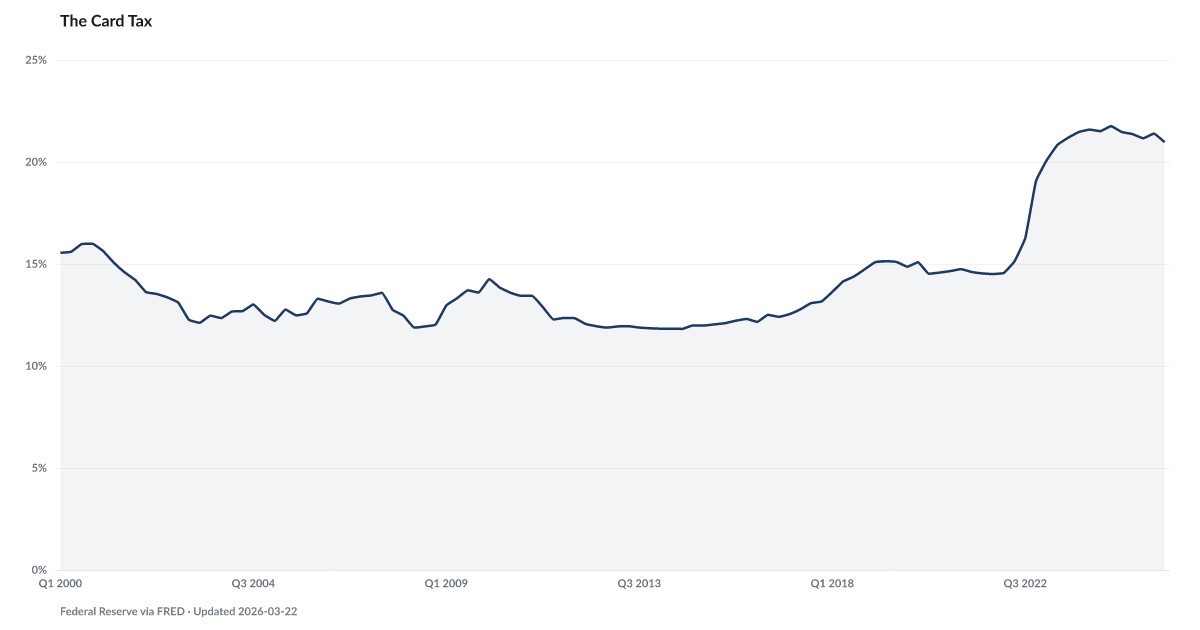
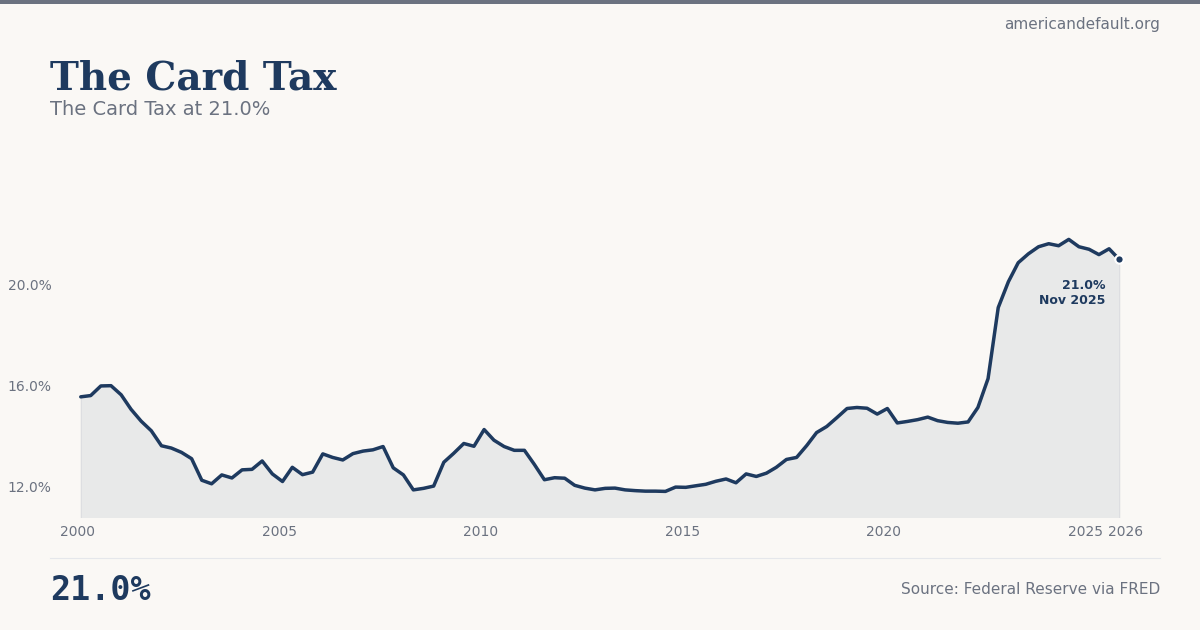
The average commercial bank credit card interest rate stood at 20.97% in Q4 2025, according to the Federal Reserve's quarterly survey — the highest in the history of the series. For context, the average APR was around 12% as recently as 2015 and 14.5% before the Fed's 2022–2023 rate-hiking cycle. At this rate, Americans collectively pay hundreds of billions per year in credit card interest on $1.28 trillion in outstanding balances. Source: Federal Reserve G.19 Statistical Release.
The interest rate Americans pay on revolving debt has reached a level that no borrower alive has ever experienced.
The average commercial bank credit card interest rate stood at 20.97% in Q4 2025, according to the Federal Reserve's quarterly survey — the highest in the series' history. For context, the average APR was around 12% as recently as 2015 and 14.5% before the Fed's 2022–2023 rate-hiking cycle. The rate has remained elevated even as the Fed has paused, because credit card pricing has become structurally disconnected from the federal funds rate.
The impact is mechanical: higher rates mean more of each payment goes to interest and less to principal. Plastic Ceiling shows total credit card debt at a record $1.28 trillion. At nearly 21%, Americans are collectively paying hundreds of billions per year in credit card interest — a transfer of wealth from borrowers to lenders that dwarfs most federal programs in scale.
For households already stretched thin, the compounding effect is devastating. Falling Behind tracks the result: total delinquency climbing to 4.8%. And Debt Service shows that 11.3% of disposable income now goes to debt payments — up sharply from pandemic lows, with credit card interest rates as one of the primary drivers.
Explore Further
Is this happening to you?
Do you know what interest rate you're paying on your credit card balance?
How has The Card Tax changed over time?

| Period | Value | YoY Change |
|---|---|---|
| Q4 2025 | 20.97% | −0.5 pts |
| Q3 2025 | 21.39% | −0.4 pts |
| Q2 2025 | 21.16% | −0.4 pts |
| Q1 2025 | 21.37% | −0.2 pts |
| Q4 2024 | 21.47% | +0.0 pts |
| Q3 2024 | 21.76% | +0.6 pts |
| Q2 2024 | 21.51% | +0.7 pts |
| Q1 2024 | 21.59% | +1.5 pts |
| Q4 2023 | 21.47% | +2.4 pts |
| Q3 2023 | 21.19% | +4.9 pts |
| Q2 2023 | 20.84% | +5.7 pts |
| Q1 2023 | 20.09% | +5.5 pts |
Frequently Asked Questions
What is the current average credit card interest rate?
The average commercial bank credit card interest rate was 20.97% in Q4 2025, according to the Federal Reserve — the highest in the history of the series. The rate was approximately 12% as recently as 2015 and 14.5% before the 2022–2023 rate-hiking cycle.
Why haven't credit card rates come down with Fed rate cuts?
Credit card pricing has become structurally disconnected from the federal funds rate. Even as the Fed has paused rate increases, credit card APRs have remained at record levels. Card issuers have widened the spread between their cost of funds and what they charge consumers.
How much do Americans pay in credit card interest?
With $1.28 trillion in credit card debt outstanding at an average 20.97% APR, Americans collectively pay hundreds of billions of dollars per year in credit card interest alone. For a household carrying the average balance, this amounts to over $1,000 per year in interest — money that services debt rather than covering expenses or building savings.
How do high APRs affect debt repayment?
Higher rates mean more of each monthly payment goes to interest and less to principal reduction. At 20.97%, a borrower making minimum payments on a $5,000 balance would pay approximately $7,000 in interest over the life of the debt and take over 20 years to pay it off.
Where does the credit card APR data come from?
The Federal Reserve publishes average credit card interest rates quarterly in its G.19 Statistical Release on Consumer Credit. The data covers interest rates charged by all U.S. commercial banks on credit card plans.
Quick poll
Is this affecting you or your household?
Discussion
Get the numbers when they move.
New data drops, indicator updates, and ADI score changes — delivered when it matters. No spam.
or Create an Account for full access
Loading comments…