Healthcare Inflation Premium (Medical CPI minus Overall CPI)
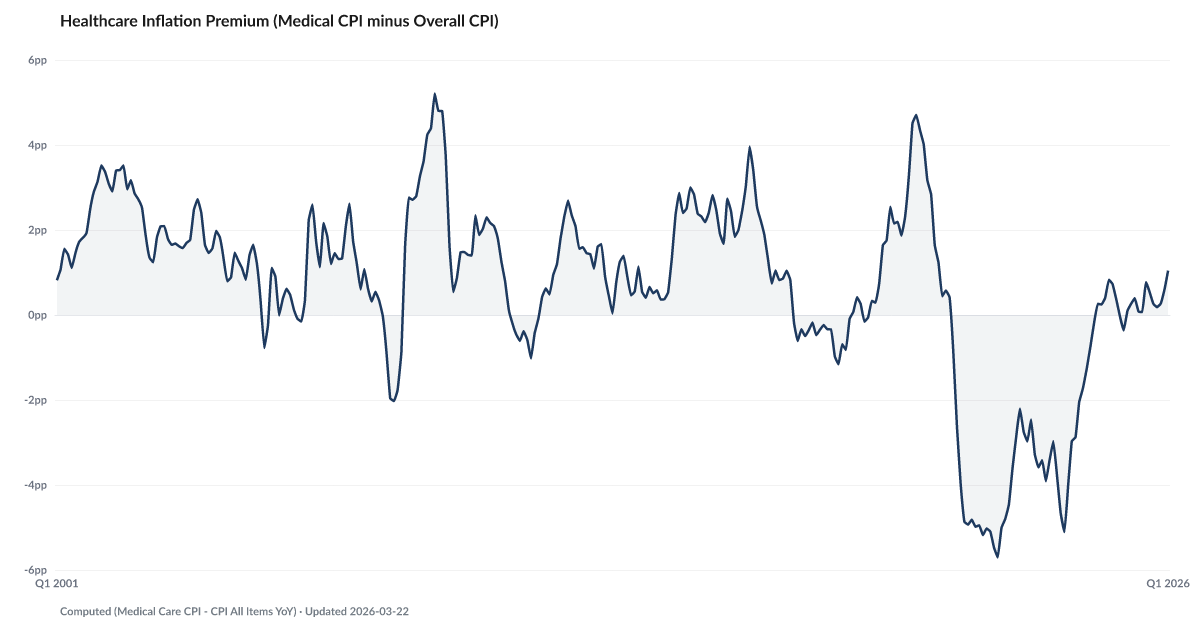
Gap between medical care inflation and the overall Consumer Price Index
Currently elevated — historically leads Auto Insurance Inflation Premium (Auto CPI minus Overall CPI) by 7 quarters. Auto Insurance Inflation Premium (Auto CPI minus Overall CPI) · View projections
What is the current Healthcare Inflation Premium (Medical CPI minus Overall CPI) reading?
The healthcare inflation premium — seasonally adjusted medical care CPI minus seasonally adjusted all-items CPI — is -1.6 percentage points in July 2026. A positive reading means medical costs are rising faster than general prices. A negative reading means they are rising more slowly. Either way the spread compounds: a gap held for years changes how much of a household budget healthcare consumes. Source: U.S. Bureau of Labor Statistics (CUSR0000SAM minus CPIAUCSL).
Measurement basis: Percentage-point difference between year-over-year changes in the seasonally adjusted Medical Care CPI (CUSR0000SAM) and seasonally adjusted all-items CPI-U (CPIAUCSL); seasonally adjusted values may be revised
The gap between medical inflation and the overall CPI has flipped negative. The gap has flipped negative again — the premium ran negative throughout 2022-2024 as well, hitting -5.7 points in 2022.
For most of the past forty years, medical care inflation outran the overall Consumer Price Index by a point or more. That premium compounds. A one-point annual gap, held for a decade, means medical costs grow roughly 10 percent faster than everything else over the period.
The relationship has inverted. BLS data shows the July 2026 reading at -1.6 percentage points. A negative premium means medical care inflation is running below the headline rate rather than above it. This is unusual. It reflects a mix of health insurance methodology changes at the BLS, Medicare drug negotiation effects feeding through to the price indexes, and a period when overall inflation has itself been running above trend.
None of that makes healthcare affordable. The cumulative gap from the last decade has not reversed. Medical Care CPI is still up roughly 30 percent since 2020 in absolute terms. A brief negative premium is a statistical moment, not a trend change. When the insurance-methodology adjustments work through the index, the historical pattern typically reasserts.
The measure compares medical-care inflation with the overall Consumer Price Index. A reading of -1.6 percentage points describes that price-growth gap for the period; it does not establish how any household financed care or whether medical costs led to a bankruptcy filing.
Explore Further
How has Healthcare Inflation Premium (Medical CPI minus Overall CPI) changed over time?

Most affected counties
Counties with the highest debt burden scores in the County Distress Index.
Explore all 3,144 counties →| Period | Value | YoY Change |
|---|---|---|
| Jul 2026 | -1.6 pp | -2.38 pp |
| Jun 2026 | -1.44 pp | -1.51 pp |
| May 2026 | -1.57 pp | -1.66 pp |
| Apr 2026 | -1.24 pp | -1.63 pp |
| Mar 2026 | -0.23 pp | -0.5 pp |
| Feb 2026 | 0.93 pp | +0.84 pp |
| Jan 2026 | 0.8 pp | +1.17 pp |
| Dec 2025 | 0.5 pp | +0.54 pp |
| Nov 2025 | 0.2 pp | -0.17 pp |
| Sep 2025 | 0.27 pp | -0.56 pp |
| Aug 2025 | 0.54 pp | +0.14 pp |
| Jul 2025 | 0.77 pp | +0.53 pp |
Frequently Asked Questions
What is the healthcare inflation premium?
It measures the gap between medical care CPI inflation and overall CPI inflation. The latest reading is -1.6 percentage points (July 2026). A positive premium means healthcare costs are rising faster than general prices. A negative one means they are rising more slowly.
Why does this gap matter?
When healthcare costs consistently outpace overall inflation, they consume an ever-larger share of household budgets. The premium is a derived spread, so it is not an input to the American Distress Index — the index's written membership rule admits only direct household-distress rates and shares. American Default Research tracks it alongside the index as cost-of-living context.
Where does this data come from?
Computed from two seasonally adjusted BLS series: medical care CPI (CUSR0000SAM) minus all-items CPI (CPIAUCSL).


Discussion
Get the numbers when they move.
New data drops, indicator updates, and ADI score changes — delivered when it matters. No spam.
or Create an Account for full access
Loading comments…