Delinquency Rate on Single-Family Residential Mortgages, All Commercial Banks
Mortgage loans 30+ days past due or in nonaccrual
What is the current Delinquency Rate on Single-Family Residential Mortgages, All Commercial Banks reading?
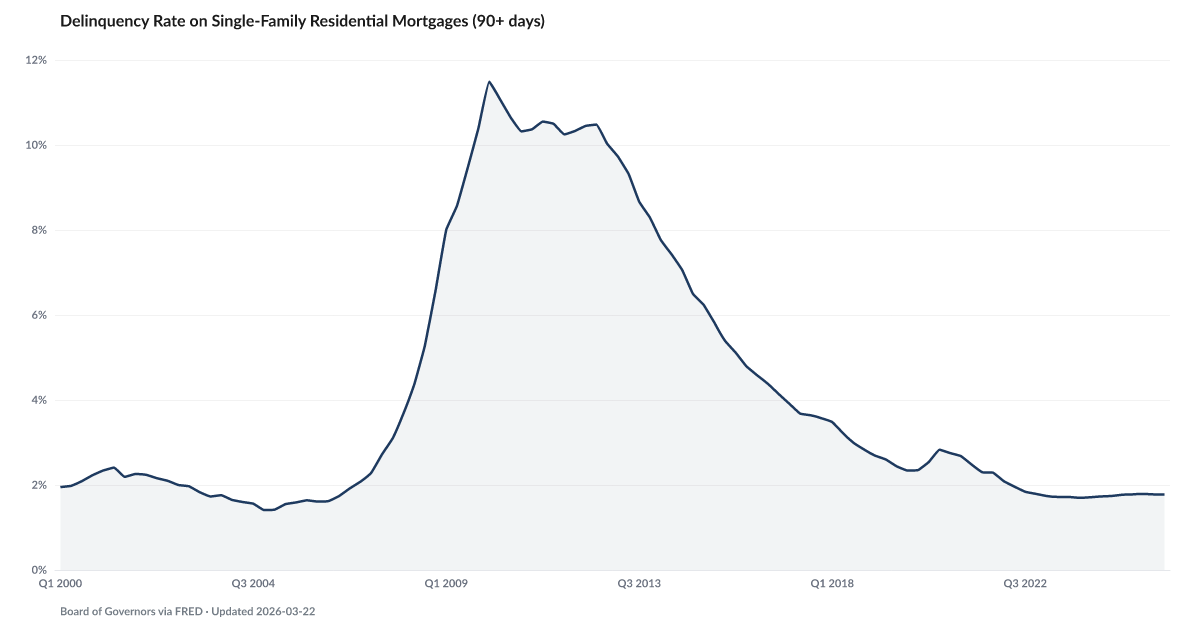
The delinquency rate on single-family residential mortgages was 1.86% in Q2 2026, according to the Board of Governors of the Federal Reserve System (FRED series DRSFRMACBS). This counts loans thirty days or more past due plus loans in nonaccrual status, at all commercial banks. The current rate is stable and well below the 11.48% crisis peak in Q1 2010, but represents the bank-booked single-family universe only. FHA-insured loans, tracked separately, show 11.79% delinquency — a 6.3 times multiplier that the blended national rate obscures. Source: Board of Governors data retrieved via FRED (DRSFRMACBS).
Measurement basis: 30+ days past due or in nonaccrual status, per the Federal Reserve Board Charge-Off and Delinquency Rates release
Mortgage delinquency sits at 1.86% in Q2 2026 — historically low, and the quietest data point in the distress picture.
This cycle's distress is showing up almost everywhere except the mortgage book. That's the headline of the data, and it's the point.
The Board of Governors' bank-booked mortgage delinquency rate reads 1.86% in Q2 2026, and has held in a narrow band since Q1 2023. That is a historically quiet range. Today's reading is roughly one-sixth of the GFC-era high set in Q1 2010.
The explanation is vintage, not household health. The mortgage book is mostly old. Mortgage Originations are running well below the 2021 pace. Homeowners locked in at 3% rates are not selling, not refinancing, and not defaulting — the payment is manageable because it was underwritten in a different universe. The distress that would otherwise show up here is landing in Credit Card Delinquency, in Auto Loan Serious Delinquency, and in Credit Card Charge-Offs.
A rate-locked mortgage book is unusually stable. It is also blind to what's happening to the newer borrowers — the FHA buyers, the recent originations — who do not have the 3% buffer protecting them. First Missed is the series to watch. It has ticked back up recently.
Explore Further
How has Delinquency Rate on Single-Family Residential Mortgages, All Commercial Banks changed over time?

Most affected counties
Counties with the highest delinquency scores in the County Distress Index.
Explore all 3,144 counties →| Period | Value | YoY Change |
|---|---|---|
| Q2 2026 | 1.86% | +0.08 pp |
| Q1 2026 | 1.88% | +0.11 pp |
| Q4 2025 | 1.79% | +0.02 pp |
| Q3 2025 | 1.78% | +0.04 pp |
| Q2 2025 | 1.78% | +0.05 pp |
| Q1 2025 | 1.77% | +0.06 pp |
| Q4 2024 | 1.77% | +0.07 pp |
| Q3 2024 | 1.74% | +0.02 pp |
| Q2 2024 | 1.73% | +0.01 pp |
| Q1 2024 | 1.71% | -0.03 pp |
| Q4 2023 | 1.7% | -0.09 pp |
| Q3 2023 | 1.72% | -0.12 pp |
Frequently Asked Questions
What is the current mortgage delinquency rate?
The delinquency rate on single-family residential mortgages at commercial banks was 1.86% in Q2 2026, per the Federal Reserve Board (FRED DRSFRMACBS). It counts loans thirty days or more past due plus loans in nonaccrual status, and covers single-family mortgages held on commercial-bank balance sheets. The FHA rate tracked separately comes from a servicer survey covering a different book of business, not a different insurance category within this one.
Why does FHA delinquency matter more than the headline rate?
FHA-insured mortgage delinquency was 11.79% in Q2 2026 — 6.3 times the bank-booked single-family rate of 1.86%. FHA borrowers are predominantly first-time buyers with lower incomes and smaller down payments. Their delinquency rate is a leading indicator of broader default trends because they are the first to feel economic pressure.
How does mortgage delinquency connect to the American Distress Index?
Mortgage delinquency is one of four inputs to the American Distress Index's Delinquency domain, alongside credit card, consumer loan, and auto loan delinquency. Each input is scored against its own quarterly history. The current conventional rate sits low in that record, and the domain score states exactly how low.


Quick poll
Is this affecting you or your household?
Discussion
Get the numbers when they move.
New data drops, indicator updates, and ADI score changes — delivered when it matters. No spam.
or Create an Account for full access
Loading comments…