Mortgage Origination Volume
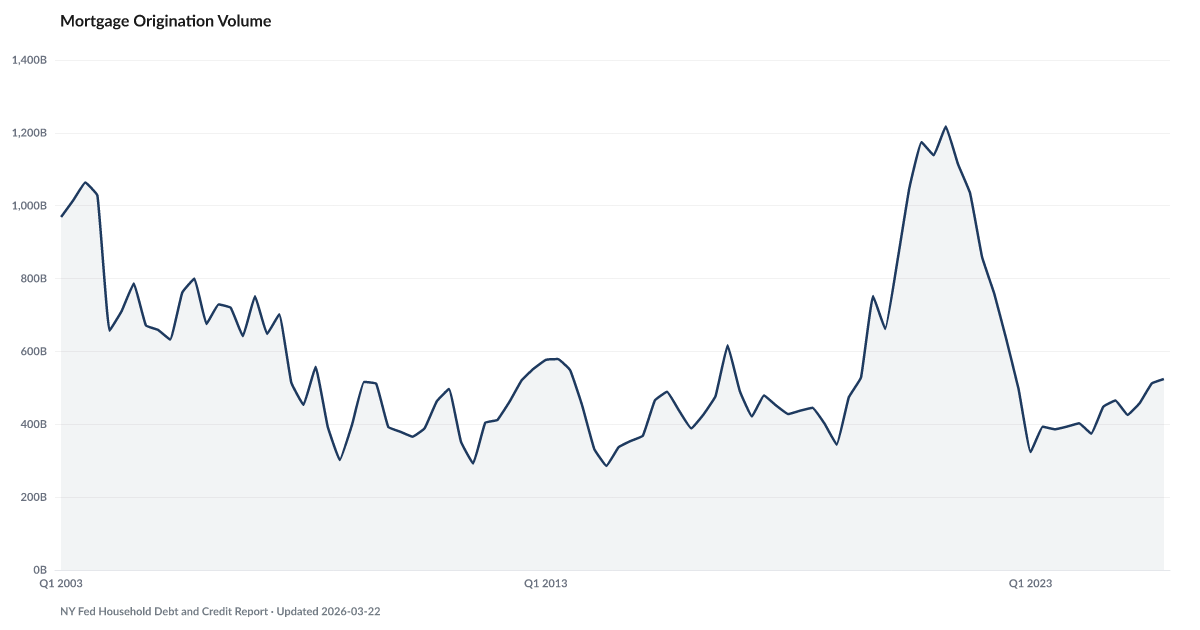
Quarterly dollar volume of new mortgage originations
What is the current Mortgage Origination Volume reading?
Mortgage origination volume was $504.64 billion in Q4 2024, according to the Federal Reserve Bank of New York Quarterly Report on Household Debt and Credit. Origination volume reflects both demand for housing and banks' willingness to lend — declines signal tightening credit conditions. Source: NY Fed Consumer Credit Panel / Equifax.
Mortgage origination volume sits at $504.64 billion a quarter as of Q2 2026, 59% below the $1.2 trillion reading of Q2 2021.
The housing market has two populations now. The people who got their mortgage before rates rose, and the people who want one.
Origination volume is the size of the second group. In Q2 2026, NY Fed data show $504.64 billion in new mortgages originated. That's up from the $323.5 billion low in Q1 2023, but well below the $1.2 trillion mid-2021 reading, when sub-3% rates pulled forward years of future refinancing and purchase activity into a single 18-month window.
The composition is what ages. Every quarter that origination volume runs depressed, the national mortgage book gets older, more rate-locked, and less transactional. Sellers stay in the cheap mortgages they locked in before rates rose, because they can't carry the payment on the next house. Buyers delay. The borrowers moving in are overwhelmingly FHA and first-time, which is why First Missed has started ticking up even while overall Mortgage Delinquency stays near pre-pandemic levels.
Low origination volume also blinds parts of the data. Delinquency rates are computed against the existing book. A book full of vintage 2020-2021 paper written at rates near 3% is structurally safer than a book full of 2024-2025 paper written at today's rates. The calm in bank-booked mortgage delinquency is partly the calm of a book that mostly predates this rate environment.
Explore Further
Is this happening to you?
Have high rates made buying or refinancing feel impossible?
How has Mortgage Origination Volume changed over time?

Most affected counties
Counties with the highest delinquency scores in the County Distress Index.
Explore all 3,144 counties →| Period | Value | YoY Change |
|---|---|---|
| Q2 2026 | $504.64B | +$46.36B |
| Q1 2026 | $529.8B | +$104.17B |
| Q4 2025 | $524.42B | +$59.07B |
| Q3 2025 | $512.15B | +$63.84B |
| Q2 2025 | $458.28B | +$84.17B |
| Q1 2025 | $425.63B | +$22.98B |
| Q4 2024 | $465.35B | +$71.58B |
| Q3 2024 | $448.31B | +$61.94B |
| Q2 2024 | $374.11B | -$19.25B |
| Q1 2024 | $402.65B | +$79.12B |
| Q4 2023 | $393.77B | -$103.8B |
| Q3 2023 | $386.37B | -$246.13B |
Frequently Asked Questions
What is current mortgage origination volume?
U.S. mortgage originations totaled $504.64 billion in Q4 2024. This includes new purchases, refinances, and home equity originations.
Why does mortgage origination volume matter?
Falling origination volume signals tightening credit conditions and reduced housing demand. The American Distress Index tracks it as a financial conditions indicator.
Where does this data come from?
This data comes from the NY Fed Consumer Credit Panel, published quarterly as part of the Quarterly Report on Household Debt and Credit.


Quick poll
Is this affecting you or your household?
Discussion
Get the numbers when they move.
New data drops, indicator updates, and ADI score changes — delivered when it matters. No spam.
or Create an Account for full access
Loading comments…