First Missed
Back down after a brief uptick; early-stage mortgage trouble remains low by historical standards
What is the current First Missed reading?
Cotality's Loan Performance Insights report tracks the share of mortgages that move from current status to 30 days past due during the reported month. This is a transition flow of mortgages or loans, not the stock already 30–59 days past due and not a share of borrowers. Source: Cotality.
Measurement basis: Share of mortgages that transitioned from current status to 30 days past due during the reported month. This is a flow of mortgages or loans, not the stock already 30–59 days past due and not a share of borrowers.
Cotality reports the share of mortgages that move from current status to 30 days past due during the reported month.
Every foreclosure begins as a single missed payment.
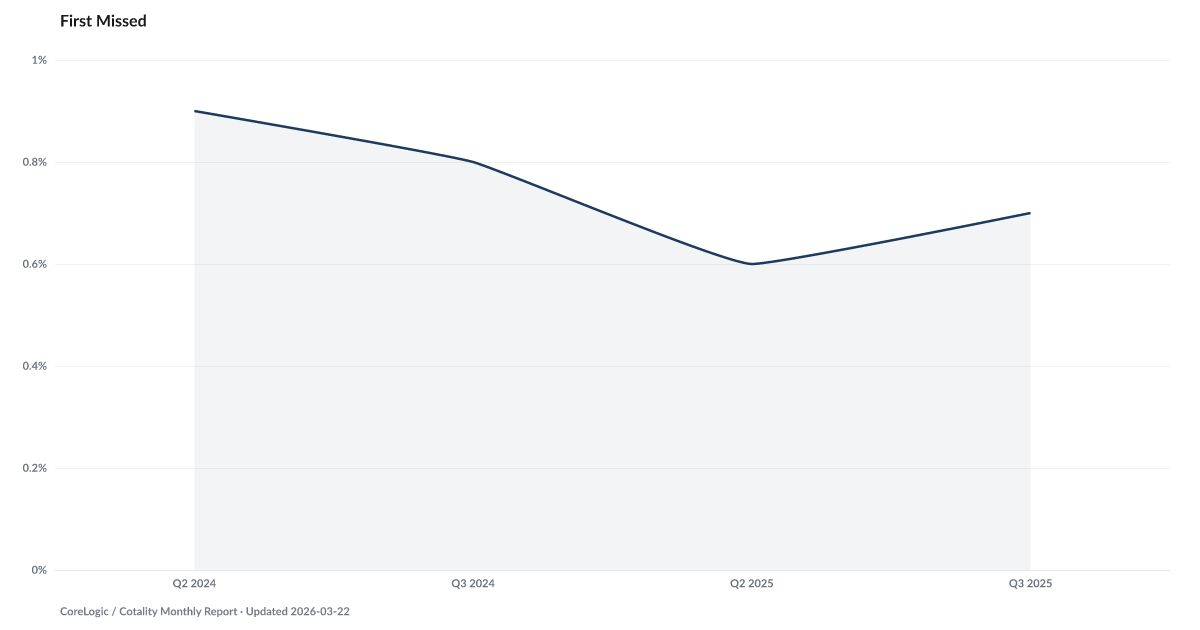
Cotality tracks that flow directly — the share of mortgages that were current and moved to 30 days past due during the reported month. It is a transition flow, not the stock of mortgages already 30–59 days past due. In Q1 2026 the rate was 0.6%.
That movement is small. It also matters. Mortgage Delinquency has been historically quiet and looks reassuringly calm. But that figure is the output of whatever happened in the first-missed series three quarters ago. The pipeline runs in one direction.
This series follows mortgage transitions, not unique borrowers. Read it alongside the stock measures in Mortgage Delinquency and the separate foreclosure flows in Foreclosure Starts without substituting one measure for another.
Explore Further
Is this happening to you?
Did you miss your first mortgage payment recently?
How has First Missed changed over time?

Most affected counties
Counties with the highest default and legal scores in the County Distress Index.
Explore all 3,144 counties →| Period | Value | YoY Change |
|---|---|---|
| Q1 2026 | 0.6% | 0 pp |
| Q4 2025 | 0.7% | — |
| Q3 2025 | 0.7% | -0.1 pp |
| Q2 2025 | 0.6% | -0.3 pp |
| Q1 2025 | 0.6% | — |
| Q3 2024 | 0.8% | — |
| Q2 2024 | 0.9% | — |
Frequently Asked Questions
What does the early-stage transition rate measure?
It measures the share of mortgages that transition from current status to 30 days past due during the reported month.
Why is this an early warning indicator?
A transition flow counts movement from current to 30 days past due. The separately reported 30–59-day delinquency rate is a stock of loans already in that status and cannot substitute for this series.
Where does this data come from?
Cotality publishes the measure in its Loan Performance Insights reports using loan-level mortgage-performance data.


Quick poll
Is this affecting you or your household?
Discussion
Get the numbers when they move.
New data drops, indicator updates, and ADI score changes — delivered when it matters. No spam.
or Create an Account for full access
Loading comments…