The K-Shape
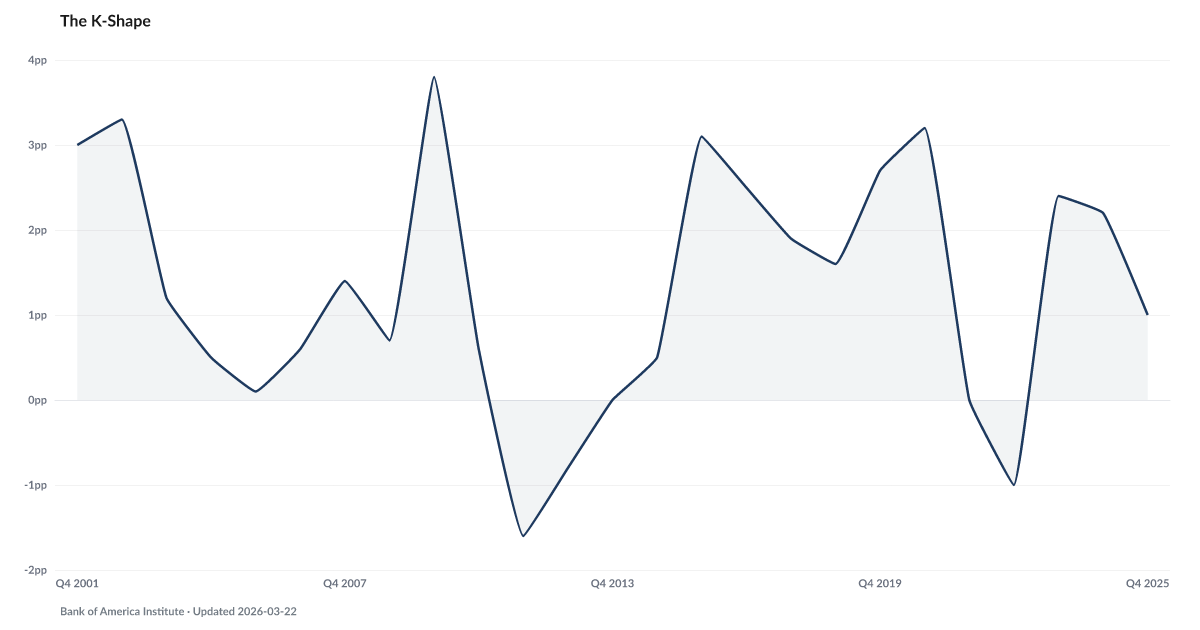
Gap between lower-income wage growth and inflation
Historically follows Energy CPI (All Items) by 1 quarter — no active signal. Energy CPI (All Items) · View projections
What is the current The K-Shape?
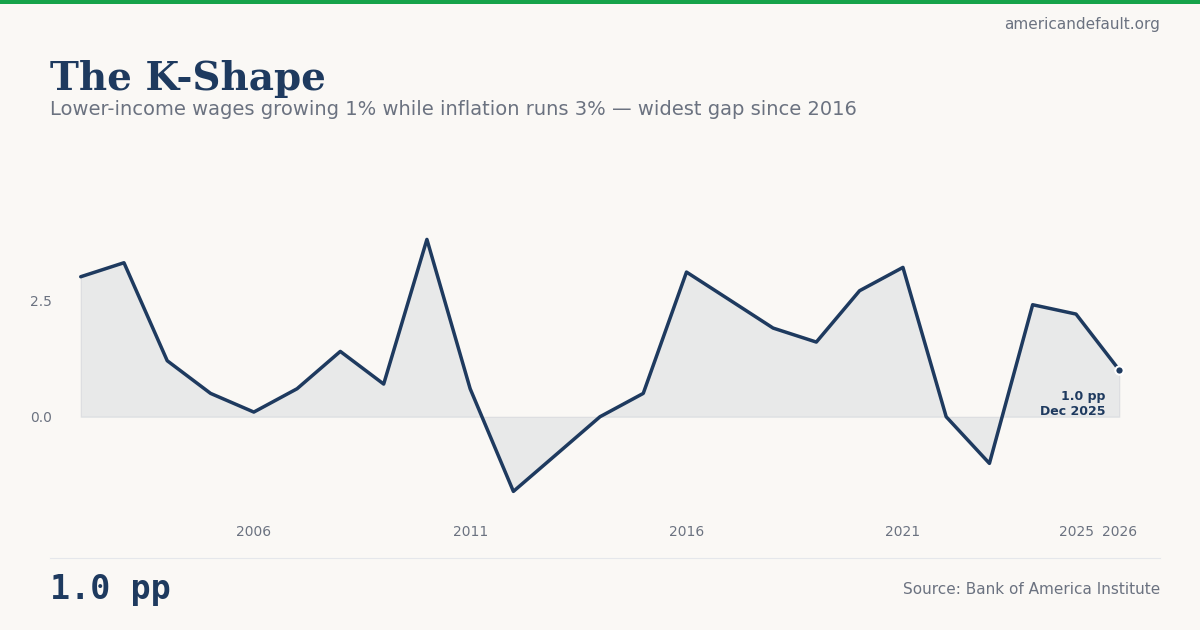
Lower-income households saw after-tax wage growth of just 1% year-over-year in late 2025, while CPI inflation ran at approximately 3% — creating a negative 2 percentage point real wage gap, according to Bank of America Institute data. Higher-income workers saw 4% wage growth, comfortably ahead of inflation. The gap between the two groups is the widest since 2016. Source: Bank of America Institute (2025).
The gap between what higher-income and lower-income workers earn has widened to levels not seen since 2016, and the lower end is falling behind prices.
Lower-income households saw after-tax wage growth of just 1% year-over-year in late 2025, according to Bank of America Institute analysis of internal depositor data. With CPI inflation running at approximately 3%, lower-income workers experienced a real wage decline of roughly 2 percentage points. Higher-income workers, by contrast, saw 4% wage growth — comfortably ahead of inflation. The gap between the two groups is the widest since 2016.
This divergence is the mechanism behind what shows up in other indicators as household distress. The Squeeze reports that 29% of lower-income households now spend 95% or more of income on necessities — up from 27.1% in 2023. When wages grow at 1% and essential costs grow at 3%, the shortfall doesn't appear as a recession. It appears as slowly deepening pressure on the bottom half of the income distribution.
The economic recovery from 2020 onward was initially described as K-shaped — a temporary phenomenon expected to resolve as the labor market tightened. Five years later, the K has become structural. Pink Slips shows 108,400 layoffs announced in January 2026, disproportionately affecting lower-wage workers in government and support functions. And The Warning Light — below the recession threshold for 13 months — suggests the pressure is more likely to increase than ease.
Explore Further
Is this happening to you?
Has your raise kept up with what you're actually paying for rent, food, and insurance?
How has The K-Shape changed over time?

| Period | Value | YoY Change |
|---|---|---|
| 2025 | 1 pts | −1.2 pts |
| 2024 | 2.2 pts | −0.2 pts |
| 2023 | 2.4 pts | +3.4 pts |
| 2022 | -1 pts | −1.0 pts |
| 2021 | 0 pts | −3.2 pts |
| 2020 | 3.2 pts | +0.5 pts |
| 2019 | 2.7 pts | +1.1 pts |
| 2018 | 1.6 pts | −0.3 pts |
| 2017 | 1.9 pts | −0.6 pts |
| 2016 | 2.5 pts | −0.6 pts |
| 2015 | 3.1 pts | +2.6 pts |
| 2014 | 0.5 pts | +0.5 pts |
Frequently Asked Questions
Are wages keeping up with inflation for lower-income workers?
No. Lower-income households saw wage growth of just 1% year-over-year in late 2025 while CPI inflation ran at approximately 3%, resulting in a real wage decline of about 2 percentage points. Their purchasing power is shrinking.
Is the wage-inflation gap the same across income levels?
No. Higher-income workers saw 4% wage growth, comfortably ahead of 3% inflation, while lower-income workers experienced a negative real wage gap. This K-shaped divergence means economic averages mask worsening conditions for the bottom half of the income distribution.
How long has the K-shaped recovery lasted?
The K-shaped pattern was initially described as a temporary post-pandemic phenomenon expected to resolve as the labor market tightened. Five years later, the divergence has become structural, with the gap widening to levels not seen since 2016.
How does the wage gap affect household financial distress?
When wages grow at 1% and essential costs grow at 3%, the shortfall directly drives the squeeze visible in other indicators: 29% of lower-income households spend 95%+ of income on necessities, the savings rate has fallen to 3.6%, and 37% of adults cannot cover a $400 emergency.
Where does the wage-inflation gap data come from?
Bank of America Institute analyzes aggregated internal depositor data to track wage growth by income quartile. The American Distress Index combines this with BLS CPI data and the Atlanta Fed Wage Growth Tracker to compute the real wage gap for lower-income households.
Quick poll
Is this affecting you or your household?
Discussion
Get the numbers when they move.
New data drops, indicator updates, and ADI score changes — delivered when it matters. No spam.
or Create an Account for full access
Loading comments…