The Import Tax
The 2025 Liberation Day tariff escalation hit consumer goods directly, with t...
What is the current The Import Tax?
Import prices rose 1.72% year-over-year in the latest reading. The Import Tax tracks how trade costs — tariffs, shipping, and foreign exchange — flow through to consumer prices. Rising import costs are effectively a hidden tax on consumers, particularly for goods-heavy categories like electronics, clothing, and building materials. Source: BLS.
Tariff burden on U.S. households spiked to ~1.7% of income in 2025 — more than double the pre-trade-war level
The 2025 Liberation Day tariff escalation hit consumer goods directly, with the bottom income quintile bearing a disproportionate ~3% burden.
Explore Further
Is this happening to you?
Have your grocery or household costs gone up in ways that feel disconnected from inflation headlines?
How has The Import Tax changed over time?
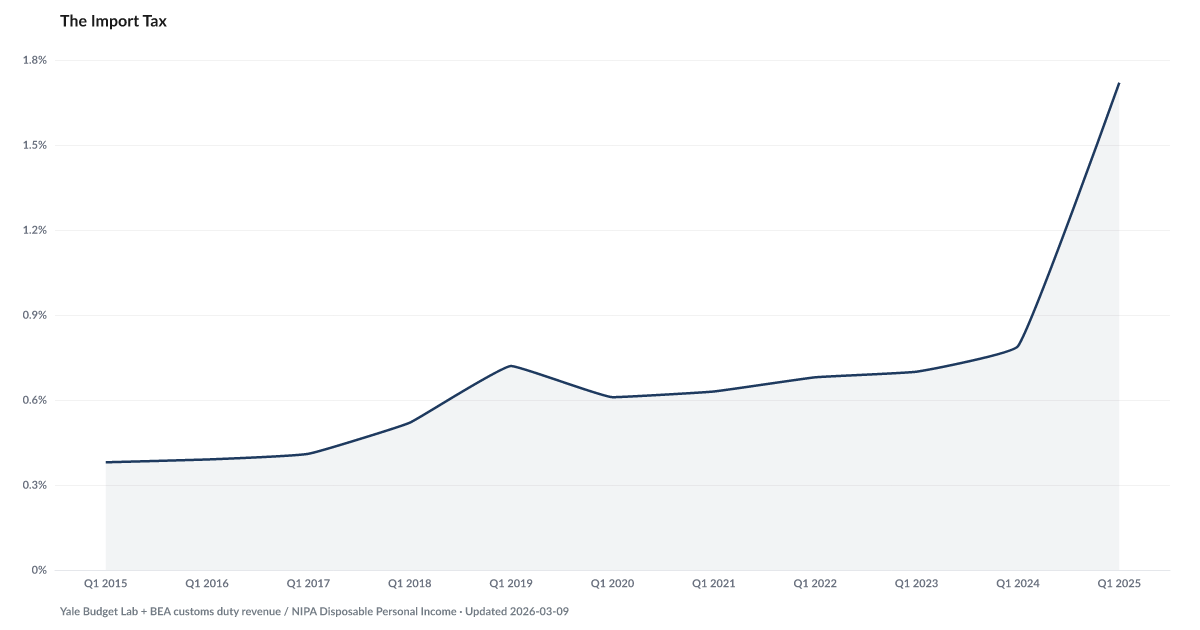
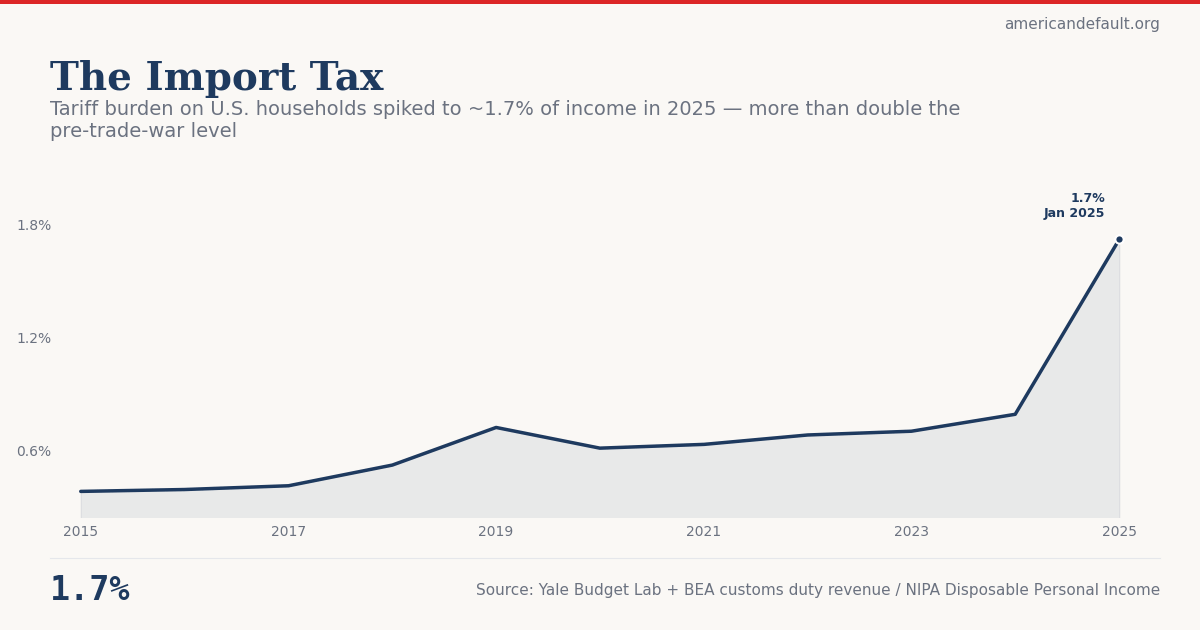

| Period | Value | YoY Change |
|---|---|---|
| 2025 | 1.72% | +0.9 pts |
| 2024 | 0.79% | +0.1 pts |
| 2023 | 0.7% | +0.0 pts |
| 2022 | 0.68% | +0.1 pts |
| 2021 | 0.63% | +0.0 pts |
| 2020 | 0.61% | −0.1 pts |
| 2019 | 0.72% | +0.2 pts |
| 2018 | 0.52% | +0.1 pts |
| 2017 | 0.41% | +0.0 pts |
| 2016 | 0.39% | +0.0 pts |
| 2015 | 0.38% | — |
Frequently Asked Questions
What is The Import Tax?
The Import Tax tracks year-over-year changes in import prices. At 1.72%, it measures how much trade costs are increasing for goods entering the U.S.
Why do import prices matter for distress?
Rising import prices flow through to consumer goods, effectively acting as a hidden tax. Tariff increases amplify this effect, raising costs for everyday products.
Where does this data come from?
Published monthly by the Bureau of Labor Statistics as part of the Import/Export Price Indexes.
Quick poll
Is this affecting you or your household?
Discussion
Get the numbers when they move.
New data drops, indicator updates, and ADI score changes — delivered when it matters. No spam.
or Create an Account for full access
Loading comments…