U-6 Underemployment Rate
Broadest measure of labor underutilization
What is the current U-6 Underemployment Rate reading?
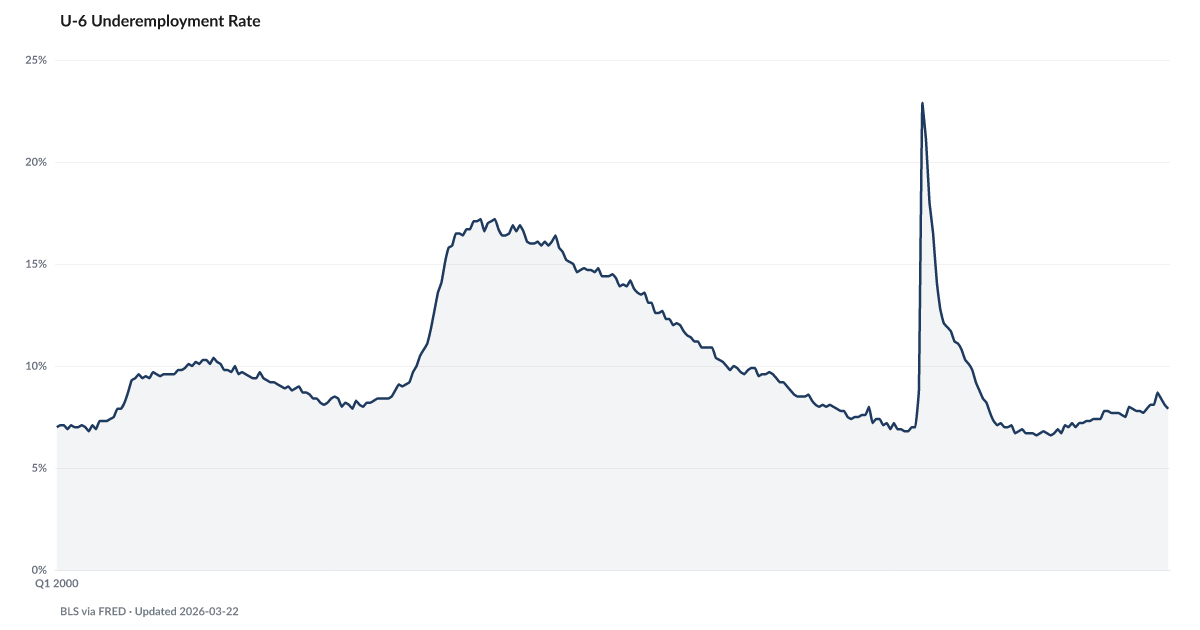
The U-6 underemployment rate — the broadest official measure of labor underutilization — includes unemployed workers, discouraged workers who have stopped looking, and people working part-time for economic reasons. It registered 7.9% in July 2026, according to the U.S. Bureau of Labor Statistics, capturing a significantly larger share of labor-market slack than the headline U-3 unemployment rate.
The broader measure of U.S. labor-market slack stands at 7.9% — far above the headline unemployment rate — and captures the part-time, marginally attached, and discouraged workers the official figure leaves out.
The BLS publishes six different measures of unemployment, labeled U-1 through U-6. The headline Unemployment Rate, U-3, counts only those who are actively looking for work. The broadest measure, U-6, adds workers who want a job but haven't searched recently, workers only marginally attached to the labor force, and workers part-time for economic reasons. The July 2026 reading is 7.9%.
The gap between U-3 and U-6 is a rough index of hidden slack. The current spread sits well above the 2022 reading of roughly 3.1 points and well below the 2009 crisis gap that exceeded 7 points. That gap rises when underemployment climbs faster than unemployment, which is what labor distress typically looks like in its early stages.
U-6 broadens the labor-market view beyond outright job loss. The refreshed leading-indicator scanner keeps Initial Unemployment Claims tied to the headline unemployment rate; U-6 remains the wider slack measure for workers who are underemployed or only marginally attached.
For households, U-6 is often the more honest number. A worker who has stopped looking because the market is dead or who is stuck in 25 hours a week isn't counted in the headline figure. They are counted here. If the question is how many Americans are not getting the work they need, 7.9% is closer to the truth than the headline U-3 print.
Explore Further
How has U-6 Underemployment Rate changed over time?

Most affected counties
Counties with the highest labor scores in the County Distress Index.
Explore all 3,144 counties →| Period | Value | YoY Change |
|---|---|---|
| Jul 2026 | 7.9% | 0 pp |
| Jun 2026 | 7.9% | +0.2 pp |
| May 2026 | 8.1% | +0.3 pp |
| Apr 2026 | 8.2% | +0.4 pp |
| Mar 2026 | 8% | +0.1 pp |
| Feb 2026 | 7.9% | -0.1 pp |
| Jan 2026 | 8.1% | +0.6 pp |
| Dec 2025 | 8.4% | +0.8 pp |
| Nov 2025 | 8.7% | +1 pp |
| Sep 2025 | 8.1% | +0.4 pp |
| Aug 2025 | 8.1% | +0.3 pp |
| Jul 2025 | 7.9% | +0.1 pp |
Frequently Asked Questions
What is the U-6 underemployment rate?
The U-6 rate is the broadest official measure of labor underutilization. It includes the officially unemployed (U-3), plus discouraged workers who have stopped looking for work, plus people working part-time because they cannot find full-time positions.
Why track U-6 instead of the headline unemployment rate?
The headline U-3 rate misses real labor-market distress. Someone working a few hours a week because they cannot find full-time work counts as employed in U-3, but shows up as underemployed in U-6. For measuring household financial distress, the broader measure carries more information.
Where does U-6 data come from?
The Bureau of Labor Statistics publishes the U-6 rate monthly as part of its Alternative Measures of Labor Underutilization. The July 2026 reading is 7.9%.


Quick poll
Is this affecting you or your household?
Discussion
Get the numbers when they move.
New data drops, indicator updates, and ADI score changes — delivered when it matters. No spam.
or Create an Account for full access
Loading comments…