Total Revolving Credit Outstanding
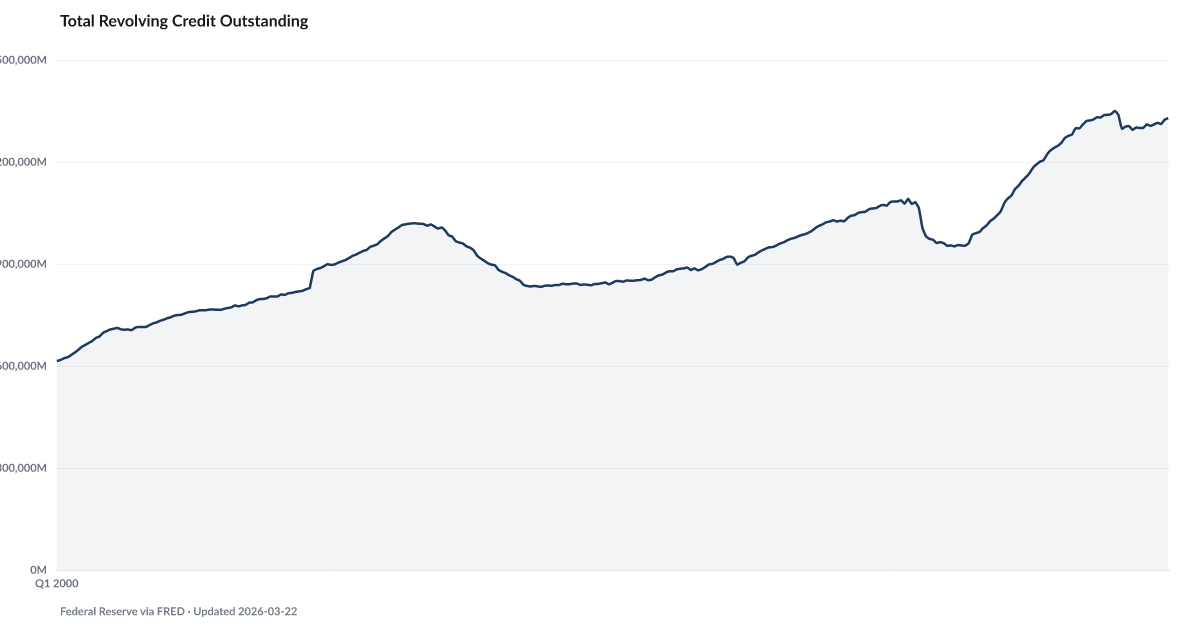
Total revolving credit (primarily credit cards) outstanding
What is the current Total Revolving Credit Outstanding?
Total revolving credit outstanding — primarily credit card balances — tracks the aggregate stock of revolving consumer debt. Growth in revolving credit, combined with record-high APRs and depleted savings, indicates that households are increasingly relying on high-cost borrowing to cover expenses. Source: Federal Reserve G.19 Statistical Release.
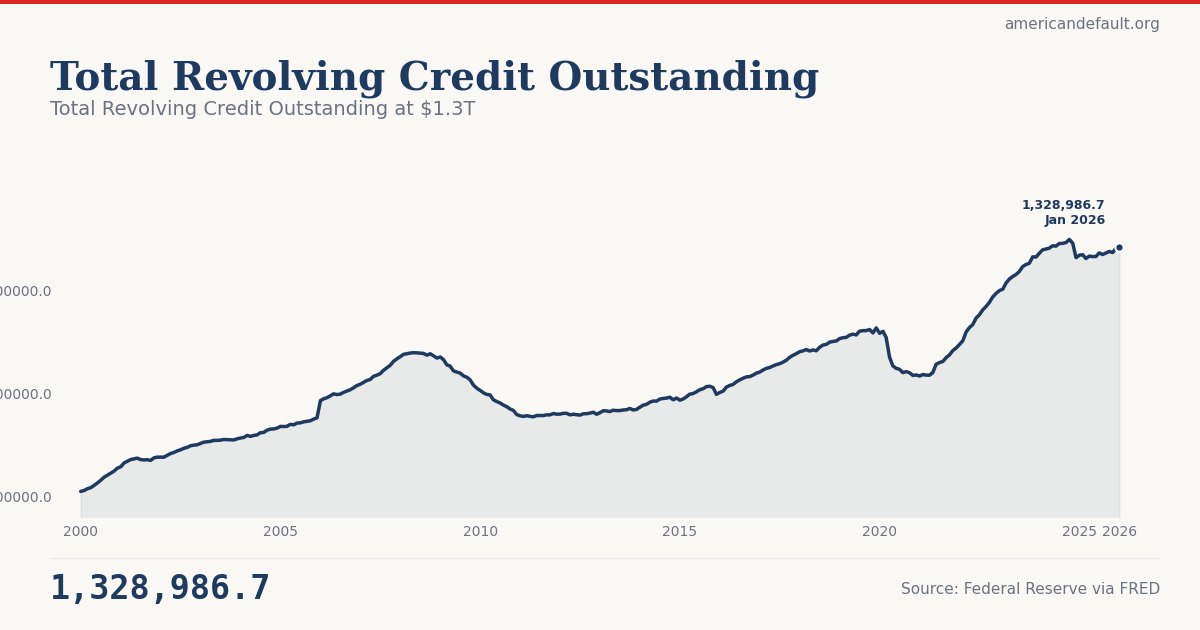
Total Revolving Credit Outstanding at $1.3T
Tracking stable relative to recent baseline.
Explore Further
How has Total Revolving Credit Outstanding changed over time?

| Period | Value | YoY Change |
|---|---|---|
| Jan 2026 | $1.3T | +$24.7B |
| Dec 2025 | $1.3T | +$27.3B |
| Nov 2025 | $1.3T | −$27.2B |
| Oct 2025 | $1.3T | −$35.3B |
| Sep 2025 | $1.3T | −$30.6B |
| Aug 2025 | $1.3T | −$32.6B |
| Jul 2025 | $1.3T | −$27.4B |
| Jun 2025 | $1.3T | −$30.3B |
| May 2025 | $1.3T | −$31.4B |
| Apr 2025 | $1.3T | −$23.4B |
| Mar 2025 | $1.3T | −$27.7B |
| Feb 2025 | $1.3T | −$14.7B |
Frequently Asked Questions
What is revolving credit?
Revolving credit is debt that can be repeatedly borrowed against up to a credit limit, primarily credit cards and home equity lines of credit. Unlike installment loans with fixed payments, revolving credit balances fluctuate based on spending and repayment patterns.
Why does revolving credit growth matter?
When revolving credit grows during a period of depleted savings and record-high interest rates (average APR at 20.97%), it signals that households are borrowing to cover expenses they cannot pay from income or savings. This is distress-driven borrowing rather than discretionary spending.
Where does the data come from?
The Federal Reserve publishes revolving credit data monthly in its G.19 Statistical Release. The American Distress Index tracks both the total outstanding balance and the rate of growth.
Quick poll
Is this affecting you or your household?
Discussion
Get the numbers when they move.
New data drops, indicator updates, and ADI score changes — delivered when it matters. No spam.
or Create an Account for full access
Loading comments…