The Skip Rate
Down from 18.3% a year ago; respondents reported using the strategy at least once in the prior 12 months
What is the current Skip Rate reading?
The Federal Reserve Bank of Philadelphia LIFE Survey reports the share of adults who paid less or skipped other debts or monthly bills at least once in the prior 12 months to help afford monthly bill payments. Respondents could select one or more listed coping strategies. This is not a monthly or quarterly missed-payment rate. Source: Philadelphia Fed Consumer Finance Institute.
Measurement basis: Share of adult respondents who reported paying less or skipping other debts or monthly bills at least once in the prior 12 months to help afford monthly bill payments. Respondents could select one or more listed coping strategies; this is not a quarterly or monthly missed-payment rate.
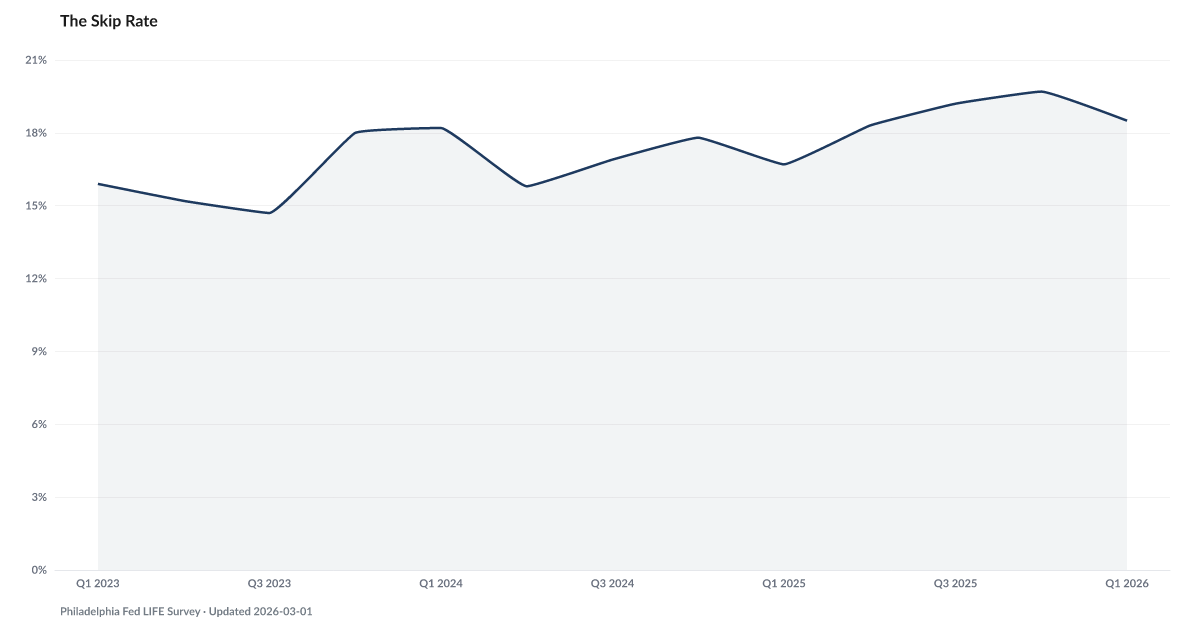
The share of adults reporting that they paid less or skipped other debts or monthly bills at least once in the prior twelve months has sat above 14% across every Philadelphia Fed LIFE reading since 2023. The Q2 2026 reading is 17.4%.
The Philadelphia Fed's LIFE Survey is fielded quarterly, but each reading asks whether respondents used this coping strategy at least once in the prior twelve months. The series has never recorded a reading below 14.7%. The Q2 2026 reading is 17.4%.
The exact response option is “paying less or skipping other debts or monthly bills” to help afford monthly bill payments. Respondents could select one or more listed coping strategies, so the measure does not identify which bill was reduced or skipped and is not a count of missed payments.
Roughly one in five adults reported using that strategy at least once during the prior twelve months. The survey quarter identifies when the response was collected; it does not shorten the recall window to that quarter.
The Skip Rate, Falling Behind, The Buffer, and The Safety Net use different populations and measure different behavior. Their movement does not establish one sequence from a survey response to a missed payment or foreclosure.
Explore Further
How has The Skip Rate changed over time?

Most affected counties
Counties with the highest safety net and buffer scores in the County Distress Index.
Explore all 3,144 counties →| Period | Value | YoY Change |
|---|---|---|
| Q2 2026 | 17.4% | -0.9 pp |
| Q1 2026 | 18.5% | +1.8 pp |
| Q4 2025 | 19.7% | +1.9 pp |
| Q3 2025 | 19.2% | +2.3 pp |
| Q2 2025 | 18.3% | +2.5 pp |
| Q1 2025 | 16.7% | -1.5 pp |
| Q4 2024 | 17.8% | -0.2 pp |
| Q3 2024 | 16.9% | +2.2 pp |
| Q2 2024 | 15.8% | +0.6 pp |
| Q1 2024 | 18.2% | +2.3 pp |
| Q4 2023 | 18% | — |
| Q3 2023 | 14.7% | — |
Frequently Asked Questions
What does the skip rate measure?
It measures the share of adults who reported paying less or skipping other debts or monthly bills at least once in the prior 12 months to help afford monthly bill payments. Respondents could select one or more listed coping strategies.
Why is skipping bills significant?
The measure identifies use of one listed coping strategy. It does not identify which bill was reduced or skipped, count missed payments, or shorten the prior-12-month recall window to the survey quarter.
Where does the skip rate data come from?
The Philadelphia Fed's Consumer Finance Institute fields the LIFE Survey quarterly. Each reading for this item retains the question's prior-12-month recall window.


Quick poll
Is this affecting you or your household?
Discussion
Get the numbers when they move.
New data drops, indicator updates, and ADI score changes — delivered when it matters. No spam.
or Create an Account for full access
Loading comments…