The Mood Ring
University of Michigan consumer sentiment survey
What is the current The Mood Ring?
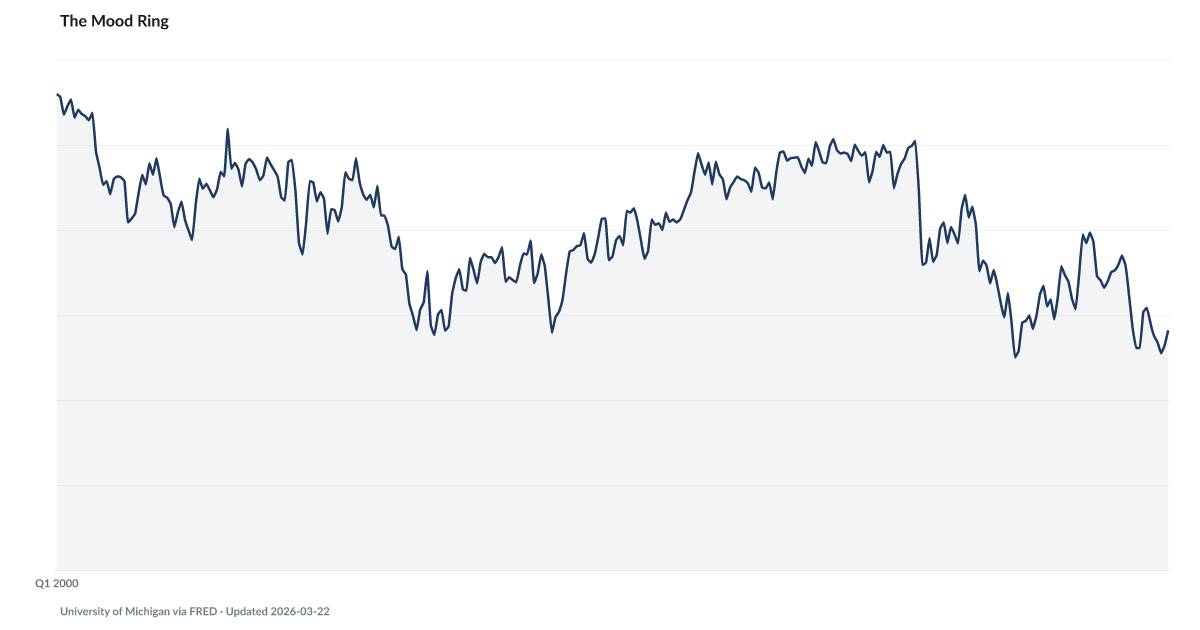
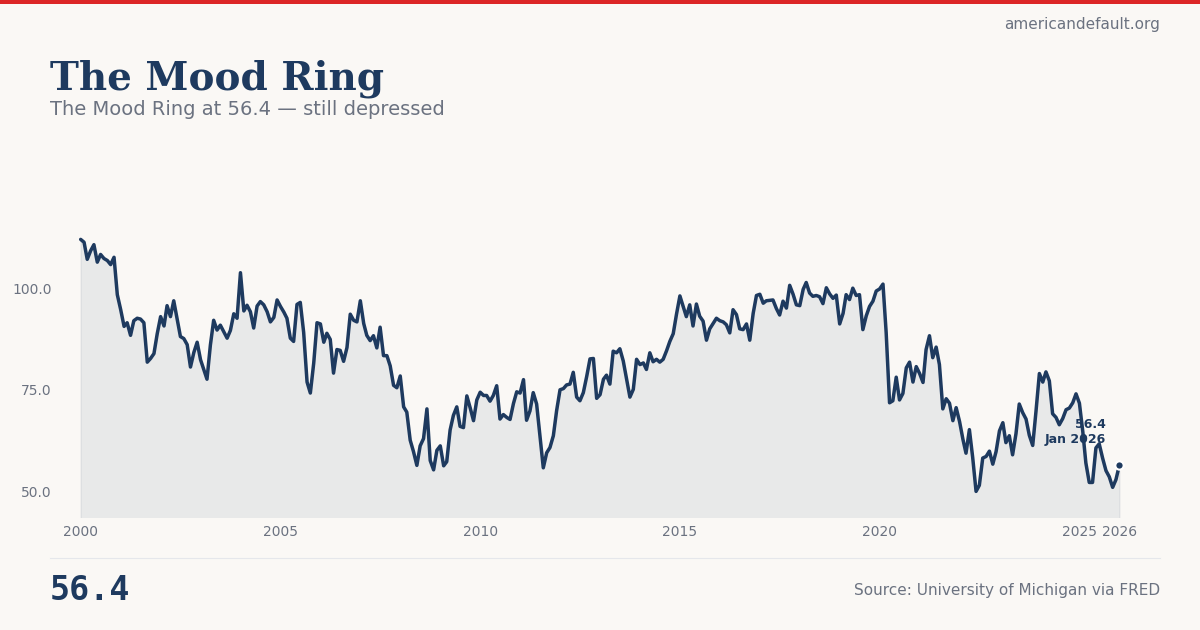
The University of Michigan Consumer Sentiment Index stood at 56.4 in January 2026, down 44% from the 101.0 pre-pandemic reading in February 2020. At current levels, sentiment is lower than during most of the 2008–2009 financial crisis, which bottomed at 55.3. The index briefly rallied to the mid-70s in late 2024 before deteriorating again. Source: University of Michigan Surveys of Consumers (January 2026).
Consumer sentiment crashed during the pandemic, never fully recovered, and is now deteriorating again.
The University of Michigan Consumer Sentiment Index stood at 56.4 in January 2026, down 44% from the 101.0 reading in February 2020 — the last pre-pandemic measurement. The index briefly rallied to the mid-70s in late 2024 before declining again. At current levels, sentiment is lower than during most of the 2008–2009 financial crisis, which bottomed at 55.3 in November 2008.
The Michigan survey measures something different from economic statistics. It captures how people feel about their own financial situation and the economy's direction — a combination of lived experience and forward-looking anxiety. The Warning Light — the Conference Board's expectations index at 72.0 — confirms the pattern from a different survey with a different methodology. When two independent sentiment measures both register sustained distress, it reflects something beyond noise.
Low sentiment becomes self-reinforcing because consumer spending accounts for roughly 70% of GDP. When households feel pessimistic, they pull back on discretionary purchases, which weakens business revenue, which contributes to the kind of tightening tracked by The Tightening — where leverage conditions are moving toward stress territory at the fastest pace in years. And The Squeeze confirms that for 24% of households, the pessimism isn't just a feeling — it's a mathematical reality.
Explore Further
Is this happening to you?
Do you feel more pessimistic about your financial future than you did a year ago?
How has The Mood Ring changed over time?

| Period | Value | YoY Change |
|---|---|---|
| Jan 2026 | 56.4 | −15.30 |
| Dec 2025 | 52.9 | −21.10 |
| Nov 2025 | 51 | −20.80 |
| Oct 2025 | 53.6 | −16.90 |
| Sep 2025 | 55.1 | −15.00 |
| Aug 2025 | 58.2 | −9.70 |
| Jul 2025 | 61.7 | −4.70 |
| Jun 2025 | 60.7 | −7.50 |
| May 2025 | 52.2 | −16.90 |
| Apr 2025 | 52.2 | −25.00 |
| Mar 2025 | 57 | −22.40 |
| Feb 2025 | 64.7 | −12.20 |
Frequently Asked Questions
What is the current consumer sentiment reading?
The University of Michigan Consumer Sentiment Index was 56.4 in January 2026, down 44% from the 101.0 pre-pandemic level. This is lower than most readings during the 2008–2009 financial crisis.
Has consumer sentiment recovered from the pandemic?
No. Sentiment crashed during the pandemic, briefly rallied to the mid-70s in late 2024, and is now deteriorating again. It has not returned to the 90-100 range that characterized the pre-pandemic economy, suggesting a structural shift in how Americans feel about their financial situation.
Why does consumer sentiment matter for the economy?
Consumer spending accounts for roughly 70% of U.S. GDP. When households feel pessimistic, they pull back on discretionary purchases, which weakens business revenue and can become a self-reinforcing cycle of declining spending and tightening financial conditions.
How does Michigan sentiment compare to other measures?
Both the Michigan sentiment index (56.4) and the Conference Board expectations index (72.0, below the 80-point recession threshold for 13 months) signal sustained distress. When two independent surveys with different methodologies agree, it reflects something beyond statistical noise.
Where does consumer sentiment data come from?
The University of Michigan Surveys of Consumers is a monthly telephone survey of approximately 600 households, measuring attitudes about personal finances, business conditions, and buying conditions. It has been published continuously since 1952.
Quick poll
Is this affecting you or your household?
Discussion
Get the numbers when they move.
New data drops, indicator updates, and ADI score changes — delivered when it matters. No spam.
or Create an Account for full access
Loading comments…