Mortgages With Less Than 10 Percent Equity
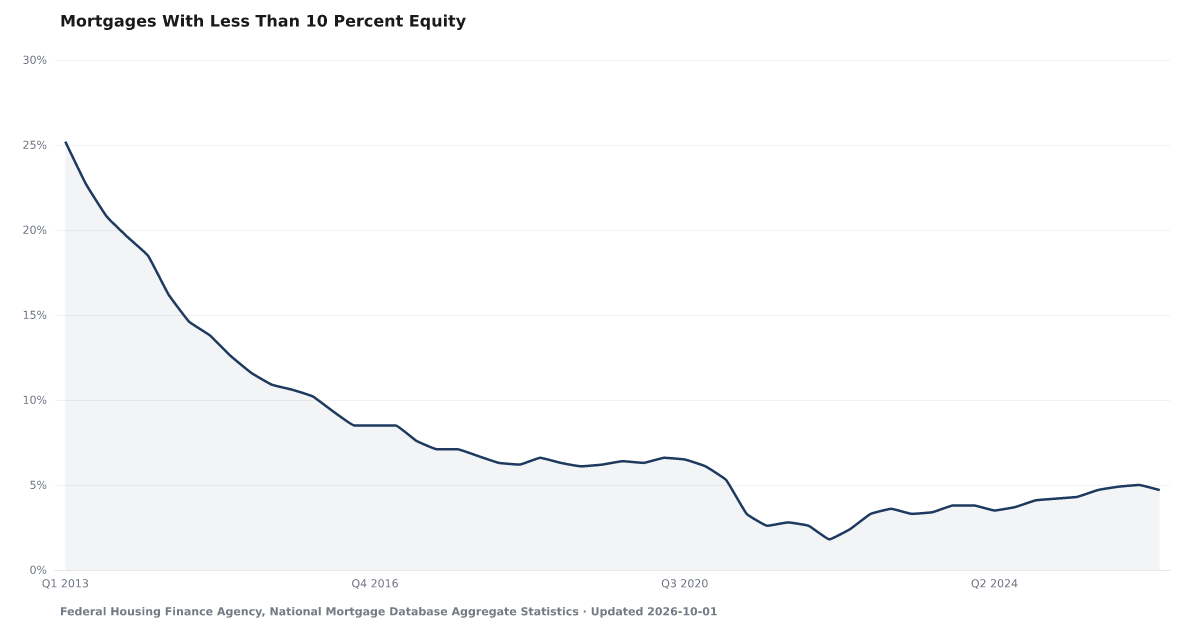
Share of outstanding first mortgages with less than 10 percent equity, by quarter
What is the current Mortgages With Less Than 10 Percent Equity reading?
4.7% of outstanding first mortgages had less than 10 percent equity at the end of Q2 2026, up from 4.3% a year earlier. That means the loan was more than 90 percent of the home's estimated value. The share counts first mortgages only and uses the Federal Housing Finance Agency's estimate of home values. Source: Federal Housing Finance Agency, National Mortgage Database Aggregate Statistics.
Measurement basis: Share of outstanding first mortgages, by number of loans, whose estimated current loan-to-value ratio is above 90 percent, so the owner's equity is under 10 percent of the home's estimated value or below zero. It is the sum of two shares FHFA publishes for the same mortgages in the same table of its Outstanding Residential Mortgage Statistics (All Mortgages, national): loan-to-value above 90 percent up to 100 percent (PCT_MTMLTV_91_100) and above 100 percent (PCT_MTMLTV_GT100), as of each quarter's end. FHFA rounds each share to a tenth of a percentage point, so the sum can differ from an unrounded total by up to a tenth. The home's current value is FHFA's estimate: its value at origination updated with FHFA's house price index for the area. First mortgages only, not second liens or home equity lines. It covers the mortgages in FHFA's National Mortgage Database, a nationally representative 1-in-20 sample of closed-end first mortgages reported to the credit bureaus; mortgages on investor-owned homes and manufactured homes are not as well represented. If FHFA restates a published quarter, we log the new figure for review and keep the published one.
This product uses FHFA data but is neither endorsed nor certified by FHFA.
4.7% of outstanding first mortgages had less than 10 percent equity at the end of Q2 2026, up from 4.3% a year earlier.
Equity is what a home is worth minus what is still owed on the mortgage. The Federal Housing Finance Agency (FHFA), which oversees Fannie Mae and Freddie Mac, estimates it for the mortgages in its National Mortgage Database. At the end of Q2 2026, 4.7% of outstanding first mortgages had less than 10 percent equity, meaning the loan was more than 90 percent of the home's estimated value, up from 4.3% a year earlier.
The share has been higher than in the same quarter a year earlier for 15 quarters in a row.
Less than 10 percent equity is a thin cushion. A 10 percent fall in a home's value would leave every mortgage counted here with a balance larger than the home is worth. The count includes mortgages that already owe more than the home is worth; they are shown on their own in Underwater Mortgages (Owing More Than the Home Is Worth).
FHFA's value for each home is an estimate: the value when the loan was made, updated with FHFA's house price index for the area. The count is of first mortgages only, so a home with a second mortgage or a home equity line owes more than this share shows. It covers the mortgages in FHFA's National Mortgage Database (NMDB®), a random one-in-20 sample of closed-end first mortgages reported to the credit bureaus. Mortgages on investor-owned homes and manufactured homes are not as well represented in that sample.
FHFA publishes these figures once a quarter and gives no release calendar. It publishes two shares for the same mortgages, one for loans of more than 90 percent up to 100 percent of the home's estimated value and one for loans above 100 percent. Each is rounded to a tenth of a percentage point and we add them, so the total can differ from an unrounded sum by up to a tenth. If FHFA restates a quarter we have published, we log the new figure for review and keep the published one.
Explore Further
Mortgages With Less Than 10 Percent Equity over time: what has changed?

Counties with the highest safety net and buffer scores
These are safety net and buffer scores from our County Distress Index, not county readings of Mortgages With Less Than 10 Percent Equity.
Explore all 3,144 counties →| Period | Value | YoY Change |
|---|---|---|
| Q2 2026 | 4.7% | +0.4 pp |
| Q1 2026 | 5% | +0.8 pp |
| Q4 2025 | 4.9% | +0.8 pp |
| Q3 2025 | 4.7% | +1 pp |
| Q2 2025 | 4.3% | +0.8 pp |
| Q1 2025 | 4.2% | +0.4 pp |
| Q4 2024 | 4.1% | +0.3 pp |
| Q3 2024 | 3.7% | +0.3 pp |
| Q2 2024 | 3.5% | +0.2 pp |
| Q1 2024 | 3.8% | +0.2 pp |
| Q4 2023 | 3.8% | +0.5 pp |
| Q3 2023 | 3.4% | +1 pp |
Frequently Asked Questions
What does less than 10 percent equity mean?
Equity is what a home is worth minus what is still owed on the mortgage. Less than 10 percent equity means the mortgage balance is more than 90 percent of the home's estimated value. The count includes mortgages that owe more than the home is worth.
Does this count second mortgages or home equity lines?
No. It counts first mortgages only. A home with a second mortgage or a home equity line owes more than this share shows.
How does FHFA know what a home is worth?
FHFA does not appraise each home. It takes the home's value when the loan was made and updates it with its house price index for the area, so each value is an estimate.
Does this cover every mortgage?
It covers the mortgages in FHFA's National Mortgage Database, a random one-in-20 sample of closed-end first mortgages reported to the credit bureaus. FHFA describes the sample as representative of the mortgage market as a whole. Mortgages on investor-owned homes and manufactured homes are not as well represented.
Where does this data come from?
The Federal Housing Finance Agency's National Mortgage Database Aggregate Statistics, in its Outstanding Residential Mortgage Statistics file, which FHFA publishes once a quarter. We read the file directly and add the two shares FHFA publishes for loans above 90 percent of the home's estimated value. FHFA rounds each to a tenth of a percentage point, so the total can differ from an unrounded sum by up to a tenth.

Quick poll
Is this affecting you or your household?
Discussion
Get the numbers when they move.
New data drops, indicator updates, and American Distress Index changes — delivered when it matters. No spam.
or Create an Account for full access
Loading comments…