Initial Unemployment Claims (SA)
Weekly new filings for unemployment insurance
Validated leading indicator for Continued Unemployment Claims (SA) (1q lag) — currently dormant. Continued Unemployment Claims (SA) · View projections
What is the current Initial Unemployment Claims (SA)?
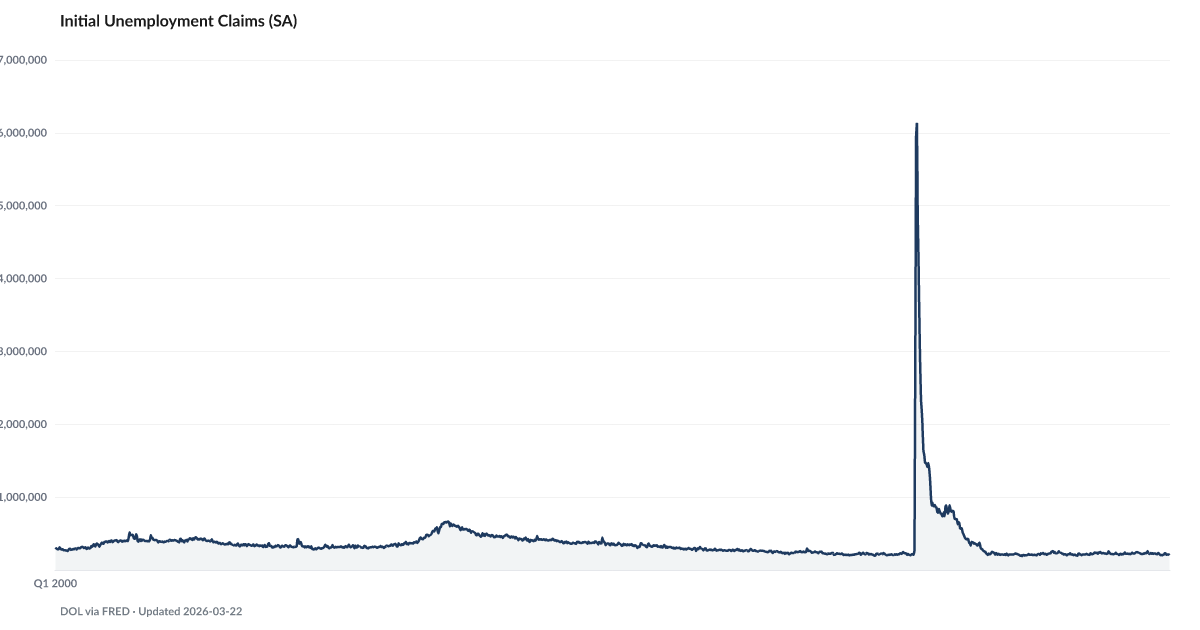
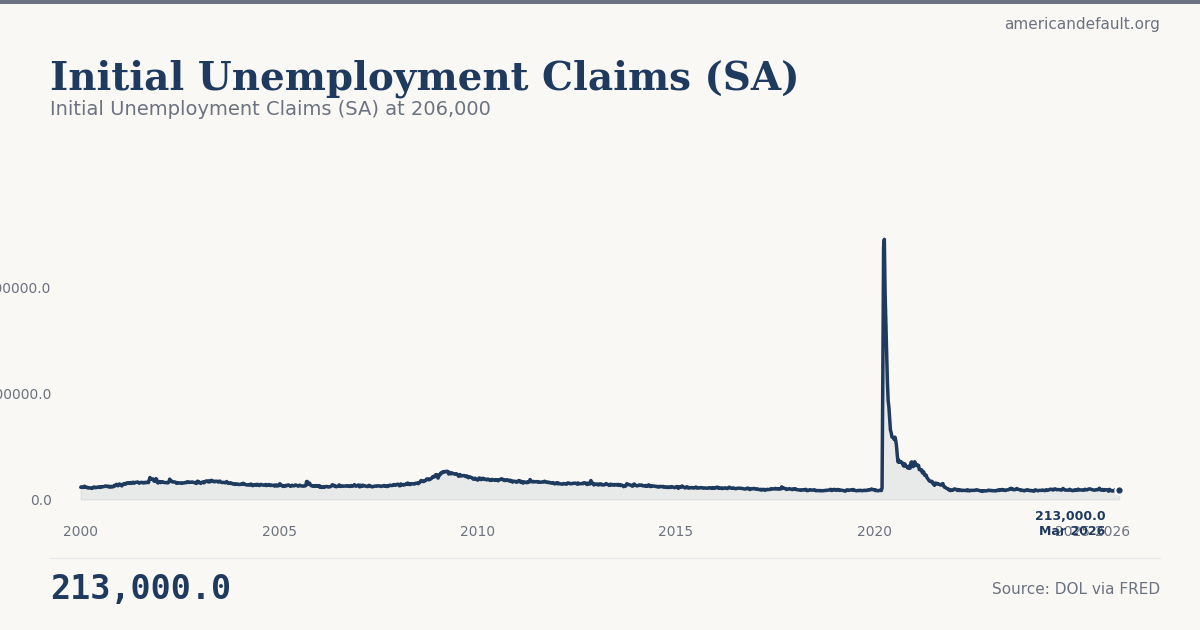
Initial unemployment claims averaged 213,000 per week in early March 2026, according to the Department of Labor (FRED series ICSA, seasonally adjusted). This weekly filing count is the highest-frequency labor market indicator in the American Distress Index, tracking how many workers file for unemployment insurance for the first time. Claims remain below the 2015–2024 baseline average of roughly 240,000, signaling a historically tight labor market — though any sustained move above 250,000 would warrant close monitoring. Source: DOL via FRED (ICSA).
Initial Unemployment Claims (SA) at 206,000
Tracking improving relative to recent baseline.
Explore Further
How has Initial Unemployment Claims (SA) changed over time?

| Period | Value | YoY Change |
|---|---|---|
| Mar 2026 | 205,000 | −20000.00 |
| Mar 2026 | 213,000 | −9000.00 |
| Feb 2026 | 214,000 | −10000.00 |
| Feb 2026 | 211,000 | −30000.00 |
| Feb 2026 | 208,000 | −15000.00 |
| Feb 2026 | 230,000 | +14000.00 |
| Jan 2026 | 230,000 | +10000.00 |
| Jan 2026 | 211,000 | −1000.00 |
| Jan 2026 | 210,000 | −13000.00 |
| Jan 2026 | 201,000 | −18000.00 |
| Jan 2026 | 207,000 | +1000.00 |
| Dec 2025 | 203,000 | −9000.00 |
Frequently Asked Questions
What are initial unemployment claims?
Initial unemployment claims (FRED series ICSA) count the number of workers filing for unemployment insurance benefits for the first time each week. It is the highest-frequency labor market indicator available and the primary input to the American Distress Index's Labor Market component.
What level of initial claims signals trouble?
Claims below 250,000 per week are generally considered healthy. Between 250,000 and 300,000 indicates softening. Above 300,000 signals material labor market deterioration. During the 2008 crisis, claims peaked above 650,000. The COVID shock briefly exceeded 6 million.
How do initial claims connect to the American Distress Index?
Initial claims are the sole indicator in the ADI's Labor Market component, which carries 15% of the composite score. Because claims are reported weekly with minimal revision lag, they provide the ADI's fastest signal of income disruption — the upstream force that drives mortgage and credit card delinquency.
Quick poll
Is this affecting you or your household?
Discussion
Get the numbers when they move.
New data drops, indicator updates, and ADI score changes — delivered when it matters. No spam.
or Create an Account for full access
Loading comments…