First Missed
0.7% — down from 0.8% a year ago; early-stage mortgage trouble easing slightly
What is the current First Missed?
CoreLogic's early-stage transition data tracks the rate at which current mortgages move to 30-day delinquency for the first time — the earliest measurable signal in the mortgage distress pipeline. A rising transition rate indicates that homeowners who were previously current are beginning to fall behind, often months before these mortgages appear in standard delinquency statistics. Source: CoreLogic Early-Stage Delinquency Transitions.
The national mortgage delinquency rate held steady at 3% in September 2025, unchanged year over year but up slightly from 2.9% in Q2 2025, with serious delinquencies inching up to 1% and the share of metros with rising foreclosure rates jumping from 8% to 39% year over year despite a stable 0.3% national foreclosure inventory rate.
Tracking improving relative to recent baseline.
Explore Further
Is this happening to you?
Did you miss your first mortgage payment recently?
How has First Missed changed over time?
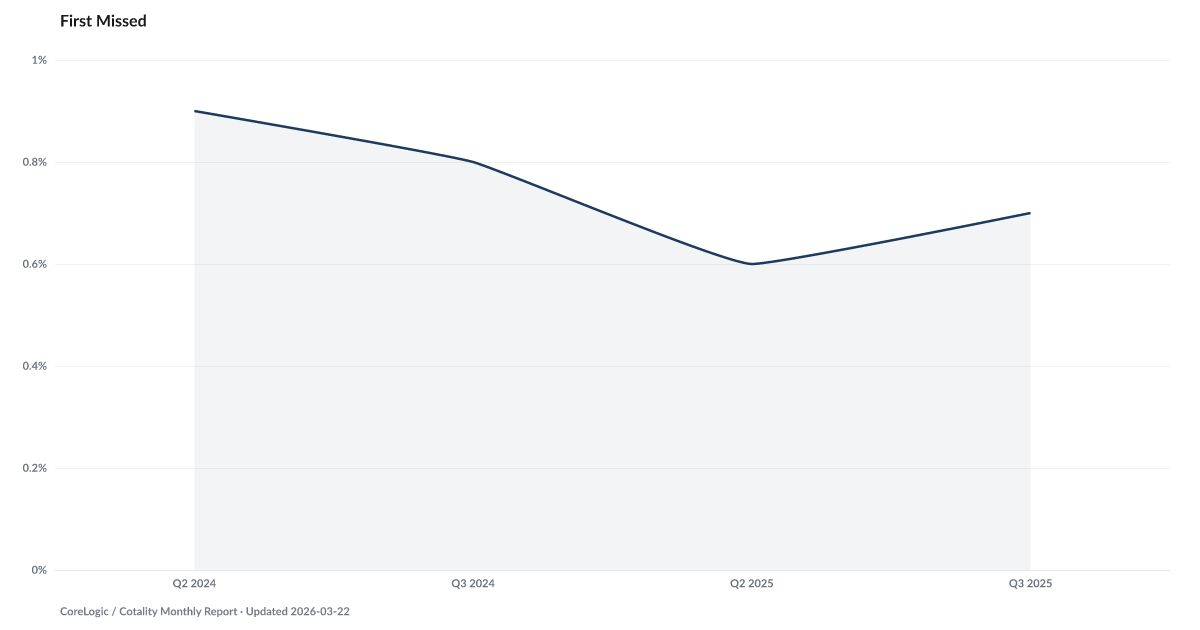
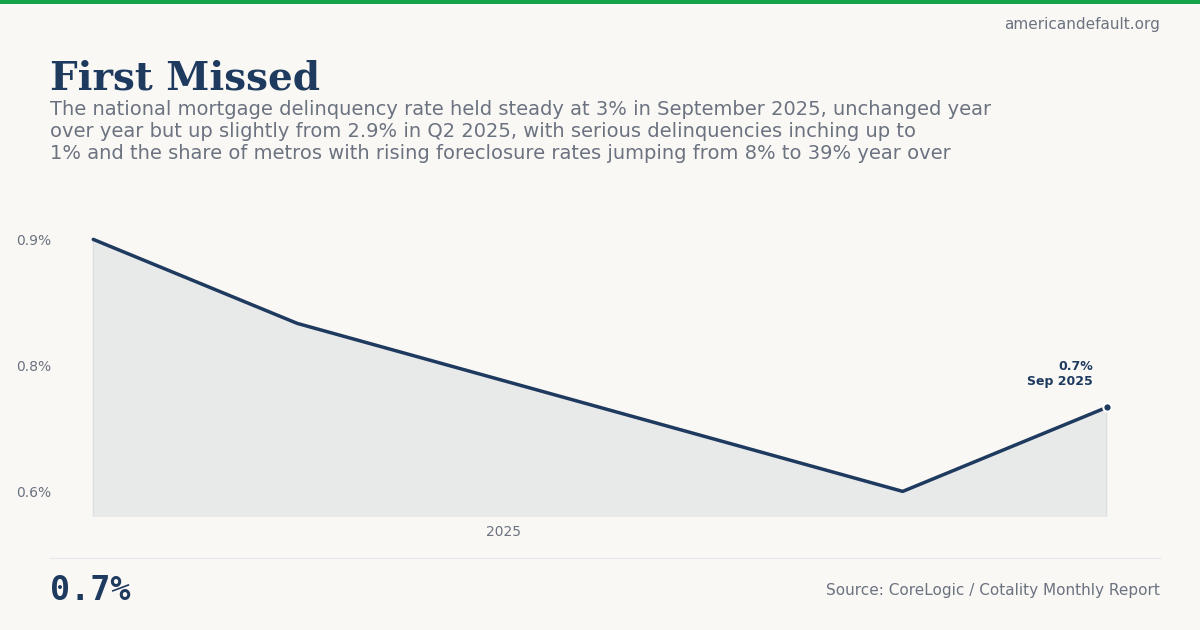

| Period | Value | YoY Change |
|---|---|---|
| Sep 2025 | 0.7% | −0.1 pts |
| Jun 2025 | 0.6% | −0.3 pts |
| Sep 2024 | 0.8% | — |
| Jun 2024 | 0.9% | — |
Frequently Asked Questions
What does the early-stage transition rate measure?
It measures the rate at which current (performing) mortgages transition to 30-day delinquency for the first time. This is the earliest measurable signal in the mortgage default pipeline, capturing new distress before it shows up in standard delinquency statistics.
Why is this an early warning indicator?
Standard delinquency rates count all loans that are behind — including those already deep in the default pipeline. The early-stage transition rate specifically isolates new delinquencies, showing whether the rate of new households falling behind is accelerating or decelerating.
Where does this data come from?
CoreLogic tracks mortgage performance data from its loan-level database, which covers a large share of the U.S. mortgage market. Early-stage transition metrics are published in CoreLogic's monthly Loan Performance Insights reports.
Quick poll
Is this affecting you or your household?
Discussion
Get the numbers when they move.
New data drops, indicator updates, and ADI score changes — delivered when it matters. No spam.
or Create an Account for full access
Loading comments…