Share of Student Loan Balances 90+ Days Delinquent
Share of student loan balances 90+ days past due
What is the current Share of Student Loan Balances 90+ Days Delinquent reading?
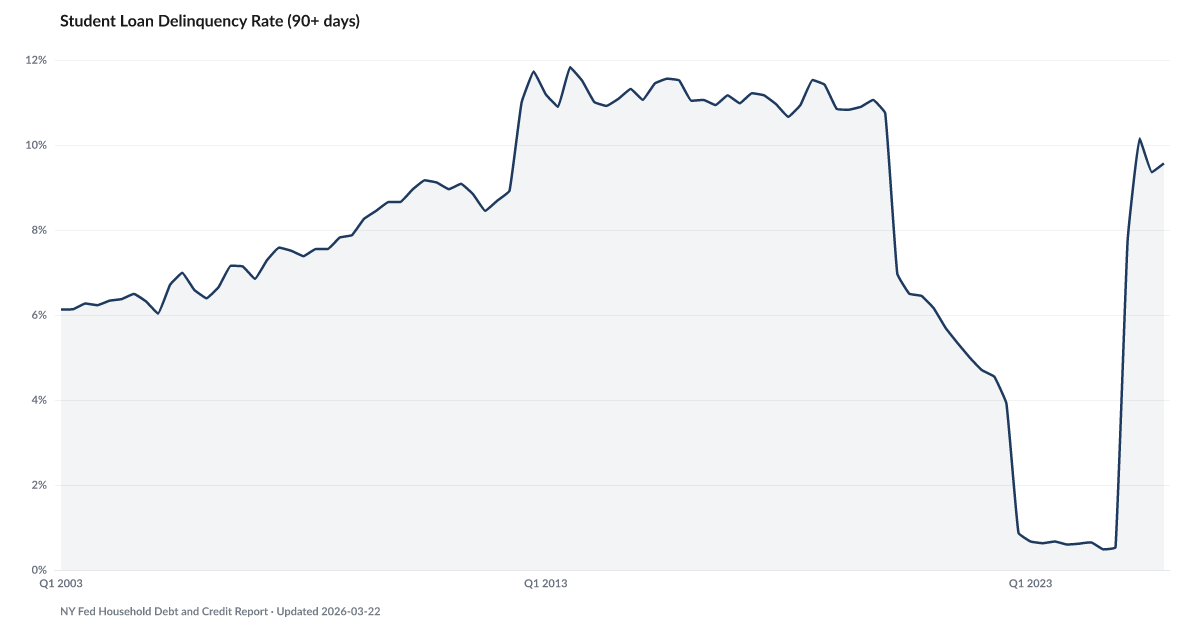
The share of student loan balances 90 or more days delinquent stood at 10.6% in Q2 2026, according to the Federal Reserve Bank of New York Consumer Credit Panel. This is a balance-level rate, not a share of borrowers. Source: Federal Reserve Bank of New York Consumer Credit Panel.
Measurement basis: Percent of outstanding student loan balances that are 90 or more days delinquent, using the "STUDENT LOAN" series in the New York Fed table "Percent of Balance 90+ Days Delinquent by Loan Type" (unit: Percent; source: New York Fed Consumer Credit Panel/Equifax). This is a balance-level rate, not a share of borrowers.
Student loan serious delinquency jumped from 0.53% in Q4 2024 to 10.6% in Q2 2026 after the payment pause ended, returning to roughly pre-pandemic levels.
The payment pause on federal student loans lasted 42 months. When it ended, the delinquency data disappeared too — the Department of Education stopped reporting defaulted balances to credit bureaus during the on-ramp period, and the NY Fed's series flatlined near zero from Q4 2022 through Q4 2024.
Then the reporting resumed. In Q1 2025, the series jumped from 0.53% to 7.74%. By Q2 2026 it had climbed to 10.6% of student loan balances 90 or more days past due. Before the pandemic, the balance-level rate averaged 10 to 11%. What we're watching is post-pause distress becoming visible again in the NY Fed series.
The borrowers falling behind are disproportionately those who already owed more than they could repay. Graduates in for-profit programs. Borrowers with partial degrees and no credential. Parents who took out PLUS loans against retirement they will now need. The income-driven repayment options that were supposed to absorb the shock are caught up in litigation over the SAVE plan, which left borrowers with monthly payments they didn't expect and couldn't budget for.
Credit Card Delinquency and Auto Loan Serious Delinquency both climbed in the same quarters that student loan reporting resumed. The overlap identifies simultaneous payment stress across household balance sheets. Timing alone cannot establish that resumed student loan payments caused either increase.
Explore Further
How has Share of Student Loan Balances 90+ Days Delinquent changed over time?

Most affected counties
Counties with the highest delinquency scores in the County Distress Index.
Explore all 3,144 counties →| Period | Value | YoY Change |
|---|---|---|
| Q2 2026 | 10.6% | +0.44 pp |
| Q1 2026 | 10.34% | +2.6 pp |
| Q4 2025 | 9.57% | +9.04 pp |
| Q3 2025 | 9.36% | +8.87 pp |
| Q2 2025 | 10.16% | +9.51 pp |
| Q1 2025 | 7.74% | +7.12 pp |
| Q4 2024 | 0.53% | -0.07 pp |
| Q3 2024 | 0.49% | -0.18 pp |
| Q2 2024 | 0.65% | +0.02 pp |
| Q1 2024 | 0.62% | -0.05 pp |
| Q4 2023 | 0.6% | -0.27 pp |
| Q3 2023 | 0.67% | -3.25 pp |
Frequently Asked Questions
What is the student loan serious delinquency rate?
The student loan serious delinquency rate measures the share of student loan balances that are 90 or more days past due. As of Q2 2026, 10.6% of student loan balances were seriously delinquent, according to the NY Fed.
Why does student loan delinquency matter for financial distress?
Student loan delinquency signals that borrowers are struggling to meet basic debt obligations. When combined with rising delinquency in credit cards and auto loans, it indicates broad-based household stress.
Where does the student loan delinquency data come from?
This data comes from the NY Fed Consumer Credit Panel, based on Equifax credit bureau records. It is published quarterly as part of the Quarterly Report on Household Debt and Credit.


Quick poll
Is this affecting you or your household?
Discussion
Get the numbers when they move.
New data drops, indicator updates, and ADI score changes — delivered when it matters. No spam.
or Create an Account for full access
Loading comments…