Delinquency Rate on Consumer Loans (ex credit card)
Non-credit-card consumer loan delinquency
What is the current Delinquency Rate on Consumer Loans (ex credit card)?
The delinquency rate on consumer loans excluding credit cards — covering auto loans, personal loans, and other non-revolving consumer credit — was 2.27% in Q4 2025, according to the Federal Reserve Board. This measure isolates installment loan performance from the higher-volatility credit card segment, providing a cleaner signal of consumer repayment capacity on fixed-payment obligations like auto loans and personal loans. Source: Federal Reserve via FRED (DROCLACBS).
Delinquency Rate on Consumer Loans (ex credit card) at 2.3%
Tracking improving relative to recent baseline.
Explore Further
How has Delinquency Rate on Consumer Loans (ex credit card) changed over time?
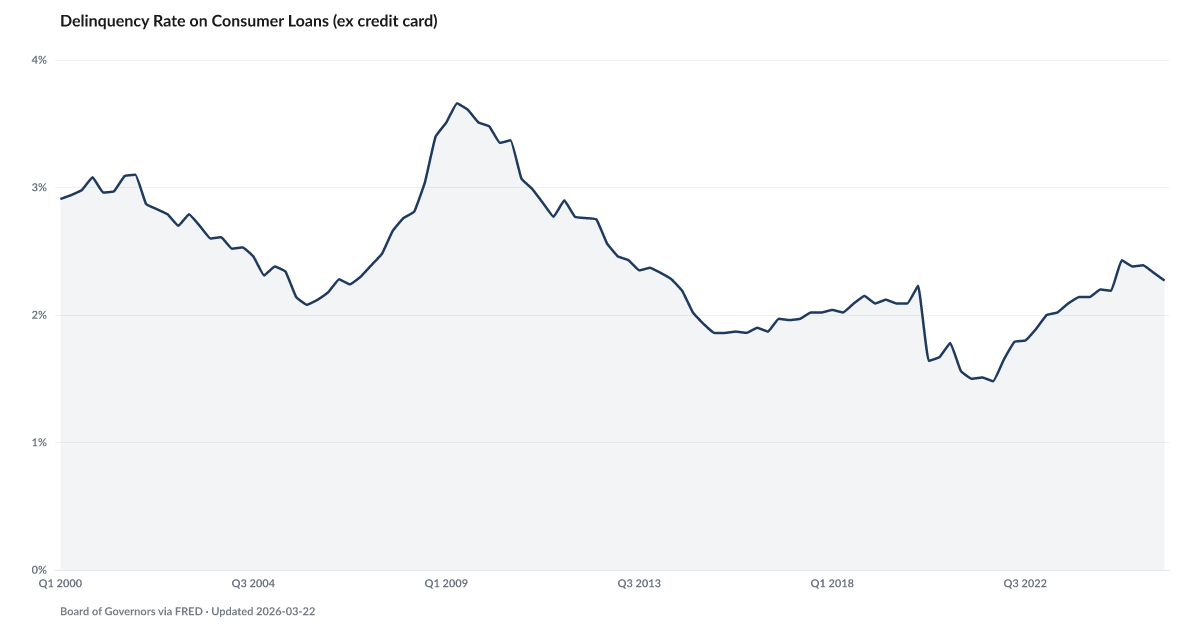
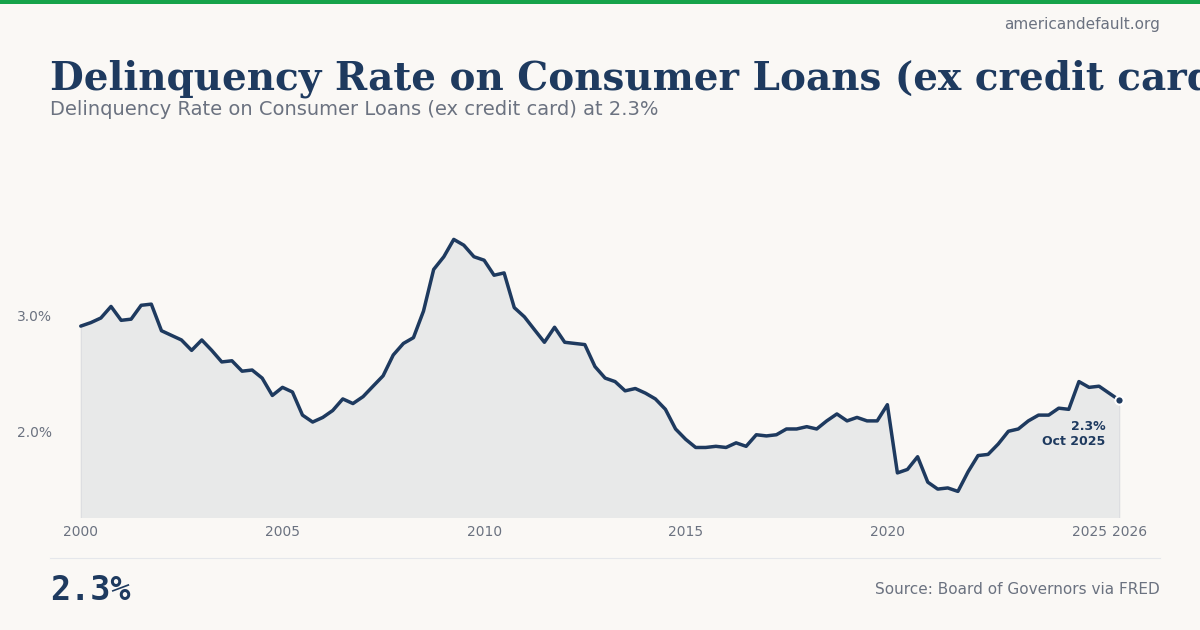

| Period | Value | YoY Change |
|---|---|---|
| Q4 2025 | 2.27% | −0.2 pts |
| Q3 2025 | 2.33% | +0.1 pts |
| Q2 2025 | 2.39% | +0.2 pts |
| Q1 2025 | 2.38% | +0.2 pts |
| Q4 2024 | 2.43% | +0.3 pts |
| Q3 2024 | 2.19% | +0.1 pts |
| Q2 2024 | 2.2% | +0.2 pts |
| Q1 2024 | 2.14% | +0.1 pts |
| Q4 2023 | 2.14% | +0.3 pts |
| Q3 2023 | 2.09% | +0.3 pts |
| Q2 2023 | 2.02% | +0.2 pts |
| Q1 2023 | 2% | +0.4 pts |
Frequently Asked Questions
What is the consumer loan delinquency rate excluding credit cards?
The consumer loan delinquency rate excluding credit cards was 2.27% in Q4 2025, per the Federal Reserve Board (FRED series DROCLACBS). This rate covers auto loans, personal loans, and other installment consumer credit at commercial banks, excluding revolving credit card balances.
Why exclude credit cards from consumer loan delinquency?
Credit cards have structurally higher delinquency rates and different payment dynamics than installment loans. Separating them reveals the performance of fixed-payment obligations — auto loans, personal loans — where missed payments more directly signal income disruption rather than revolving balance management.
How does this relate to credit card delinquency?
The all-bank credit card delinquency rate (2.94% in Q4 2025) runs higher because revolving credit is easier to fall behind on. When non-card consumer loan delinquency rises alongside credit card delinquency, it signals broader household payment stress — not just credit card overextension.
How does consumer loan delinquency connect to the American Distress Index?
Consumer loan delinquency is a component of the Debt Stress dimension in the American Distress Index, which carries 25% of the composite score. It complements credit card delinquency and mortgage delinquency to capture the full spectrum of household debt performance across loan types.
Where does this data come from?
The Federal Reserve Board publishes this quarterly as part of its Charge-Off and Delinquency Rates on Loans and Leases at Commercial Banks report. American Default tracks it via the FRED series DROCLACBS, which covers all commercial banks.
Quick poll
Is this affecting you or your household?
Discussion
Get the numbers when they move.
New data drops, indicator updates, and ADI score changes — delivered when it matters. No spam.
or Create an Account for full access
Loading comments…