The Note
Washington County, Mississippi

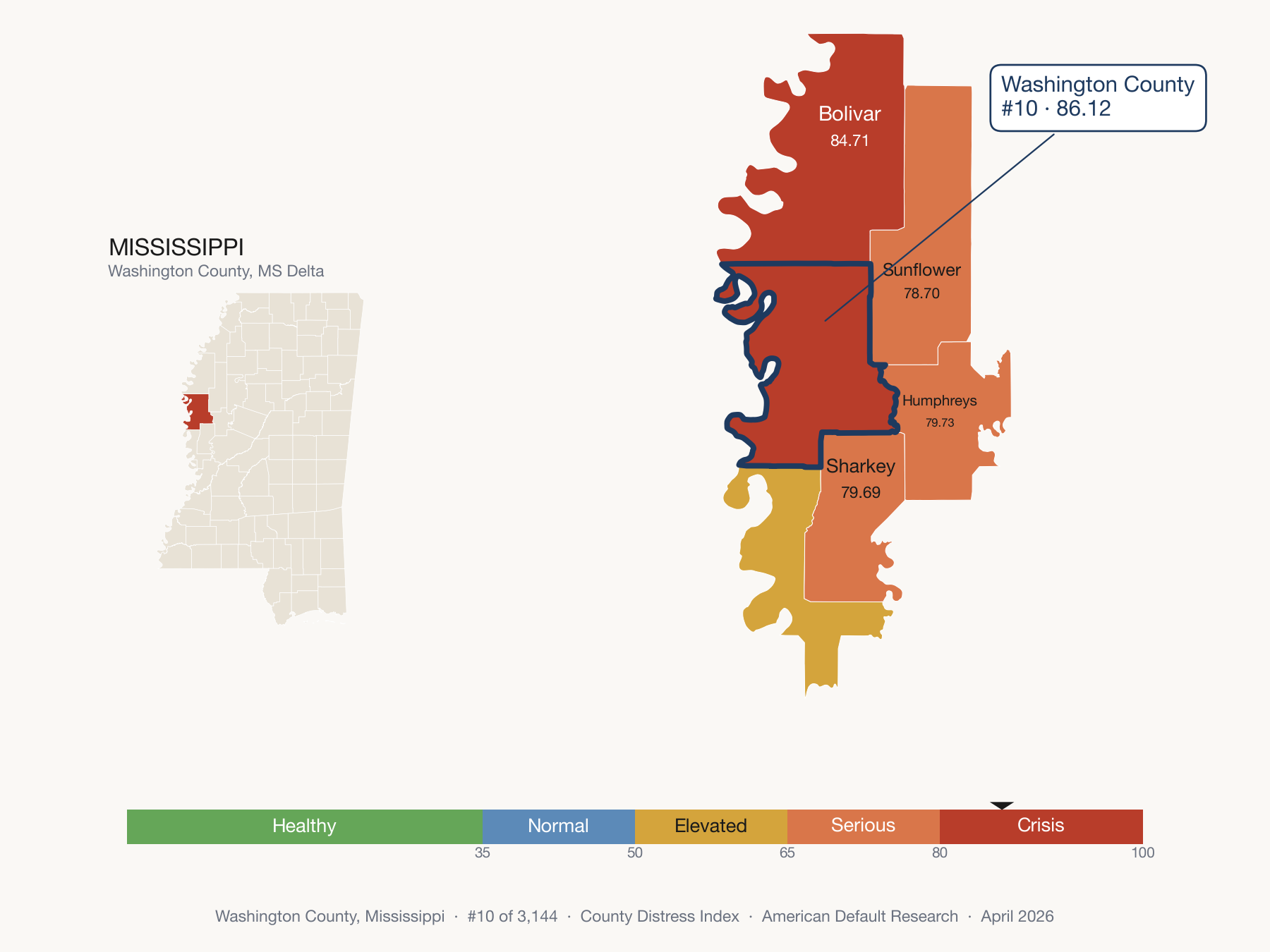
Fifth most distressed county in America in June 2026. One in five auto loans is sixty days past due — the highest rate in the country. Greenville, the county seat, was the literary capital of the Mississippi Delta. Forty-seven percent of its children now live below the federal poverty line.
The car payment in the Delta
In rural Mississippi, the car is the job. Greenville is ninety minutes from Jackson and two hours from Memphis. Washington County stretches along the Mississippi River between cotton ground and the Delta interior. There is no transit. There is no walking to work. The labor market is whatever a working car can reach.
In Washington County in 2026, twenty percent of auto loans are sixty days past due. The national median is five percent. One in five drivers in the county is, in lender language, in default on the vehicle that gets them to the job that pays the loan.
The car note in the Delta is what the mortgage was in the suburbs in 2007 — the household’s tightest monthly contract, the one whose default cascade tells you how the rest of the balance sheet is doing. In Washington County, both ends of the auto loan are running near records. The accounts are 99th-percentile delinquent. The bankruptcy filing rate is at 346 per 100,000 — the 94th percentile.
What Greenville used to mean
Greenville is the county seat. The city’s population peaked in 1990 at 45,226. The 2020 Census counted 29,670. The county is forty-two thousand.
This was the literary capital of the Mississippi Delta. Shelby Foote was born in Greenville in 1916 and used the town as the model for the fictional Bristol, Mississippi in his novels. He wrote his three-volume The Civil War: A Narrative — a million and a half words across two decades — in Memphis, but the Delta voice in the trilogy is Greenville’s. Walker Percy was orphaned as a teenager and raised by his cousin Will Percy, who took him in at the family house in Greenville. Walker grew up there and won the 1962 National Book Award for The Moviegoer. Hodding Carter II edited the Delta Democrat-Times and won the 1946 Pulitzer Prize for Editorial Writing — for editorials calling for racial and religious tolerance, written and published in Greenville at a moment when the position cost him advertising and friends.
The local newspaper had a Pulitzer. The local novelists had a National Book Award and three volumes that defined how Americans read the Civil War. In June 2026 the county ranked fifth most distressed in America.
The 1927 flood and what stayed
On April 21, 1927, the Mississippi River levee at Mound Landing, eighteen miles north of Greenville, gave way. The breach poured water into the Delta at a flow described by contemporaries as more than double Niagara Falls. Within days, an area roughly the size of South Carolina was underwater. Greenville sat under water for weeks.
About thirteen thousand African American Delta residents — most of them tenant farmers from Washington County and surrounding counties — were gathered onto the crown of the Greenville levee and held there for days without food or clean water. The episode has been documented at length in John M. Barry’s Rising Tide. Conditions on the levee included armed national guardsmen, forced labor on the levee repair, and a Red Cross relief operation that channeled aid to White planters first.
The flood disrupted sharecropping for many Delta families because the displacement broke the seasonal labor contract. The Great Migration, already underway, accelerated. The Delta’s Black population had peaked. It started a long decline that has not reversed. The composition of the county today is the inheritance of the plantation economy that the flood disrupted but never replaced.
The numbers
The numbers below are the June 2026 reading of the County Distress Index.
CDI score: 92.0. The most distressed fifth. Fifth of 3,144 counties nationally. Third of eighty-two in Mississippi.
Forty-two percent of residents with a credit file carry debt in collections — the ninety-seventh percentile. Forty-five percent are subprime. Credit card delinquency runs at thirteen percent. The Delinquency domain ranks third in the country at 99.33, with auto loan delinquency at the 99.9th percentile and credit card delinquency at the 99th.
What sits underneath the credit numbers is the income picture. Median household income in Washington County is about eighty percent of Mississippi’s median, in a state whose median sits well below the national. The local poverty rate is thirty-six percent — the ninety-ninth percentile. Forty-seven percent of children live below the federal poverty line. One in four residents reports a disability.
Renting in a state of owners
Mississippi has the highest homeownership rate in the country. About three quarters of Mississippi households own the place they live. In Washington County, the rate is fifty-seven percent — among the lowest in the state. The county is renting at scale in a state where renting is the exception.
Twenty-seven percent of Washington County renters spend more than half their income on rent. That severe-burden rate sits at the ninety-second percentile nationally. The home values that haven’t risen in proportion — Washington County recorded a positive year-over-year house-price change, but absolute prices are low and the volume of transactions is small — sit in the same ledger as the wage stagnation that produced the rent burden in the first place.
The Delta corridor
I’ve written enough of these county profiles to know the Delta isn’t isolated distress. Every one of Washington County’s Mississippi neighbors lands in the most distressed fifth. Bolivar County to the north — home to Cleveland and Mound Bayou — scores 87.1. Sunflower County to the east, whose seat Indianola was Senator James Eastland’s home, scores 82.7. Humphreys scores 88.2 and Sharkey 84.0 to the southeast. Across the river, Chicot County, Arkansas scores 85.9 — also the most distressed fifth.
The fifth Mississippi neighbor, Issaquena County directly south, sits at 73.5 — still the most distressed fifth, but the drop is sharp. Issaquena has roughly thirteen hundred residents along the river and below the Yazoo Basin’s cotton ground. Where the cotton ground gives out, the credit distress eases with it.
The note that comes due
Greenville’s water tower carries the slogan “Heart and Soul of the Delta” — language from the years when Delta Democrat-Times editorials shaped the moral position of the state. The newspaper still publishes; the staff is much smaller. Walker Percy is buried in Covington, Louisiana. Shelby Foote is buried in Memphis. Hodding Carter II is buried in Greenville Cemetery, off Highway 1.
The literary heritage left. The plantation labor economy that produced the original wealth was disrupted by the 1927 flood, mechanized through the mid-century, and never structurally replaced. What stayed is the human inheritance — the racial composition, the poverty distribution, and now the household debt.
In the rural Delta, the auto loan note is the working family’s tightest monthly contract. It buys the car that gets to the job, and the job pays the note. When twenty percent of those notes are sixty days past due, the contract is breaking at the household level at the highest rate in the country. The note is the levee. The water has come up to the crown.