The Drainage
Pemiscot County, Missouri

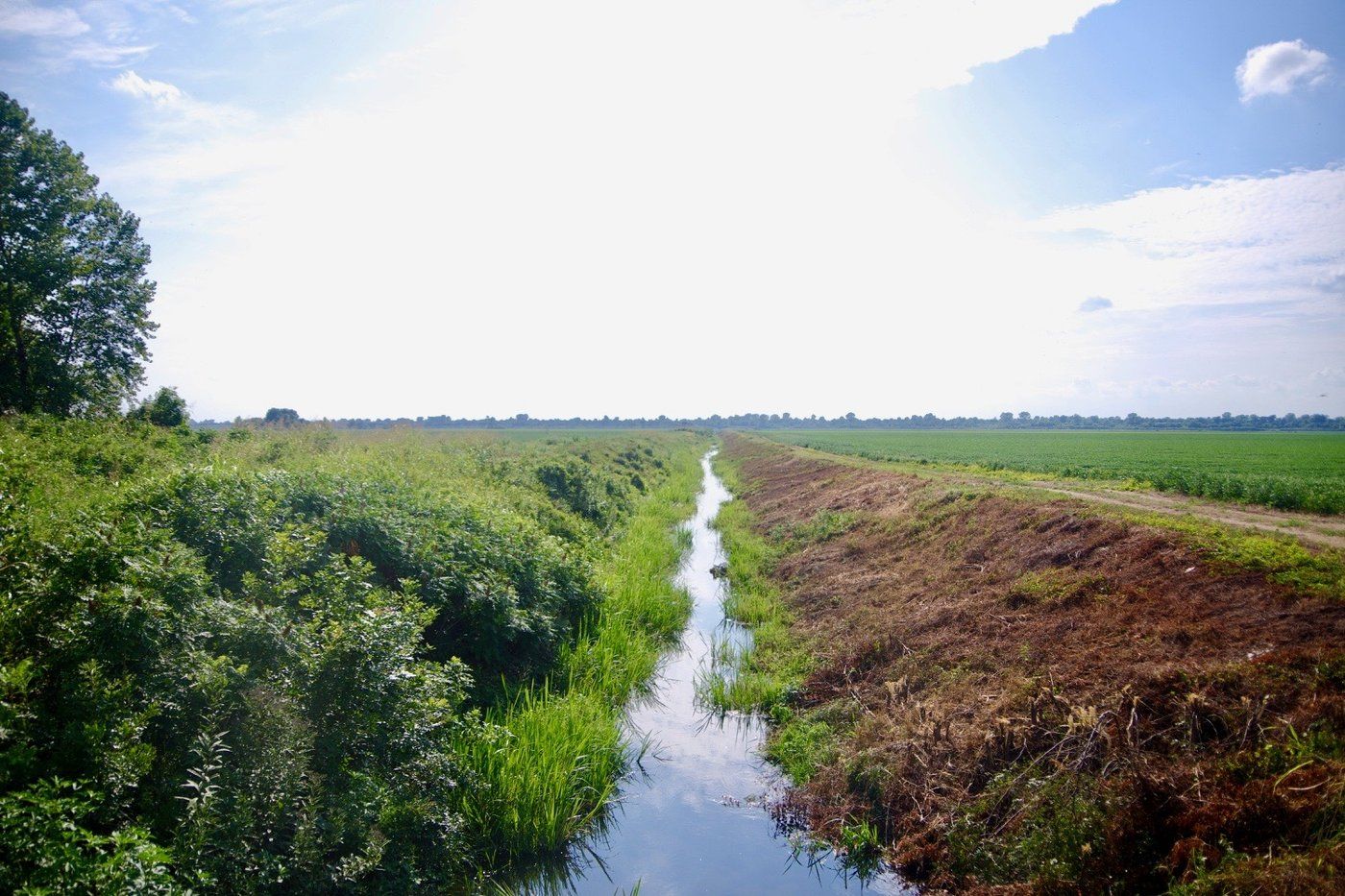
Fourteenth most distressed county in America. First in Missouri. Population peaked at 46,857 in 1940. Fourteen thousand remain. The drainage never stopped.
The swamp that became cotton country
Before 1907, Pemiscot County was swamp. Two million acres of bottomland along the Mississippi, flooded most of the year. The Meskwaki name for the place was pem-eskaw. Liquid mud.
The Little River Drainage District changed that. Incorporated in 1907, finished by 1928. Nearly a thousand miles of ditches. Three hundred miles of levees. Hundreds of thousands of acres of wetland converted to farmland. At the time, the largest drainage project in the history of the world.
Cotton moved in. By the 1920s, most farm operations in Pemiscot County were tenant-worked. The population reached 46,857 by 1940. Then the mechanical cotton harvester arrived, and the people who worked the fields became unnecessary.
The county has lost nearly 70% of its population since that peak. 14,613 remain.
Small debts, structural insolvency
Pemiscot County is a drainage. The original one turned swamp into cotton country. The one running now turns cotton country into something that works without people. Soybeans, corn, rice. The economy is still built on agriculture, highly mechanized, employing almost nobody relative to the acreage.
Here’s what defines the place in the data. A CDI score of 90.23. Extreme county distress. Fourteenth of 3,144 counties nationally. First in Missouri. The number that matters most sits underneath the composite — the median debt in collections, $1,619.
Nearly half the county, 46.4%, has debt in collections. The 95th percentile nationally. The median amount is sixteen hundred dollars. Not overleveraged mortgages. Not credit card binges. A car repair. An ER visit. A utility bill that got away.
Credit card delinquency sits at 12.9%, also the 95th percentile. Eighty-nine percent of recorded bankruptcies are Chapter 7, while Chapter 13 accounts for two of 44 filings. Those counts describe chapter composition; they do not establish filers’ income, assets, motives, eligibility, or case outcomes.
The wages behind full employment
What compounds it is the wages. Unemployment is 5.4% as of May 2026. Not catastrophic. People are working. The average weekly wage is $766, bottom 3.2% of all U.S. counties.
The labor market produces what it produces — employment that can’t sustain the people it employs. Median household income is $42,080, roughly 75% of Missouri’s median. Poverty rate: 27.4%, double the national average. Child poverty: 35.9%.
Housing looks manageable on paper. A two-bedroom apartment rents for $888 a month. Against a $42,080 income, that’s still a quarter of gross earnings. Forty-nine percent of renters are cost-burdened. The rent is cheap. The denominator is the problem.
The hospital held, the casino opened
The institution that held is the hospital. Pemiscot Memorial Health Systems in Hayti, the county’s only hospital, nearly closed multiple times. It lost more than $3 million in 2013. Obstetrics shut down the following year. Pregnant women now drive 20 to 70 miles to deliver. At least three babies have been born in the ER since.
In December 2025, Pemiscot Memorial converted to Rural Emergency Hospital status, a federal designation that increases Medicare reimbursements. The doors stayed open.
The same year, Century Casino opened a $51.9 million facility in Caruthersville. Five hundred ninety-nine slot machines. Seventy-four hotel rooms. The newest building in one of the most distressed counties in America is a casino.
In May 2022, Cargill announced a soybean processing plant near Caruthersville, one of its largest in North America, with 45 permanent jobs. In June 2023, Cargill put the project on hold, citing “shifting market dynamics.” As of April 2026, no public indication it has resumed.
One line on the map, three states of distress
Every county bordering Pemiscot carries moderate-high county distress or worse. Dunklin County to the north: 81.9. Mississippi County, Arkansas: 78.8. Lake County, Tennessee across the river: 77.8. New Madrid County: 72.4. Dyer County, Tennessee: 63.4. The Bootheel is a contiguous belt of distress stretching across three states.
The Bootheel itself exists because of one man. John Hardeman Walker, a landowner, lobbied Congress to draw 980 square miles of what would have been Arkansas Territory into Missouri so his holdings fell under Missouri law. Missouri entered the Union as a slave state. The line that defines the Bootheel’s northern boundary, 36°30’, is the Missouri Compromise line.
In January 1939, more than 1,500 sharecroppers, Black and white, camped along U.S. Highways 60 and 61 after landowners pocketed New Deal subsidies meant for tenants and evicted them. The demonstration produced the Delmo Homes program: 595 single-family houses across ten settlements. Six for white families. Four for Black.
The cotton economy shaped everything: the racial composition, the tenant farming structure, the poverty that mechanization locked in when it eliminated the work but not the people.
What stays when the drainage runs
CDI score: 90.23. Extreme county distress. Fourteenth of 3,144 counties nationally. First of 115 in Missouri.
The Cargill decision, when it comes, will either be 45 jobs in a county of 14,613 or one more thing that drained away.