The Fallow
Mendocino County, California

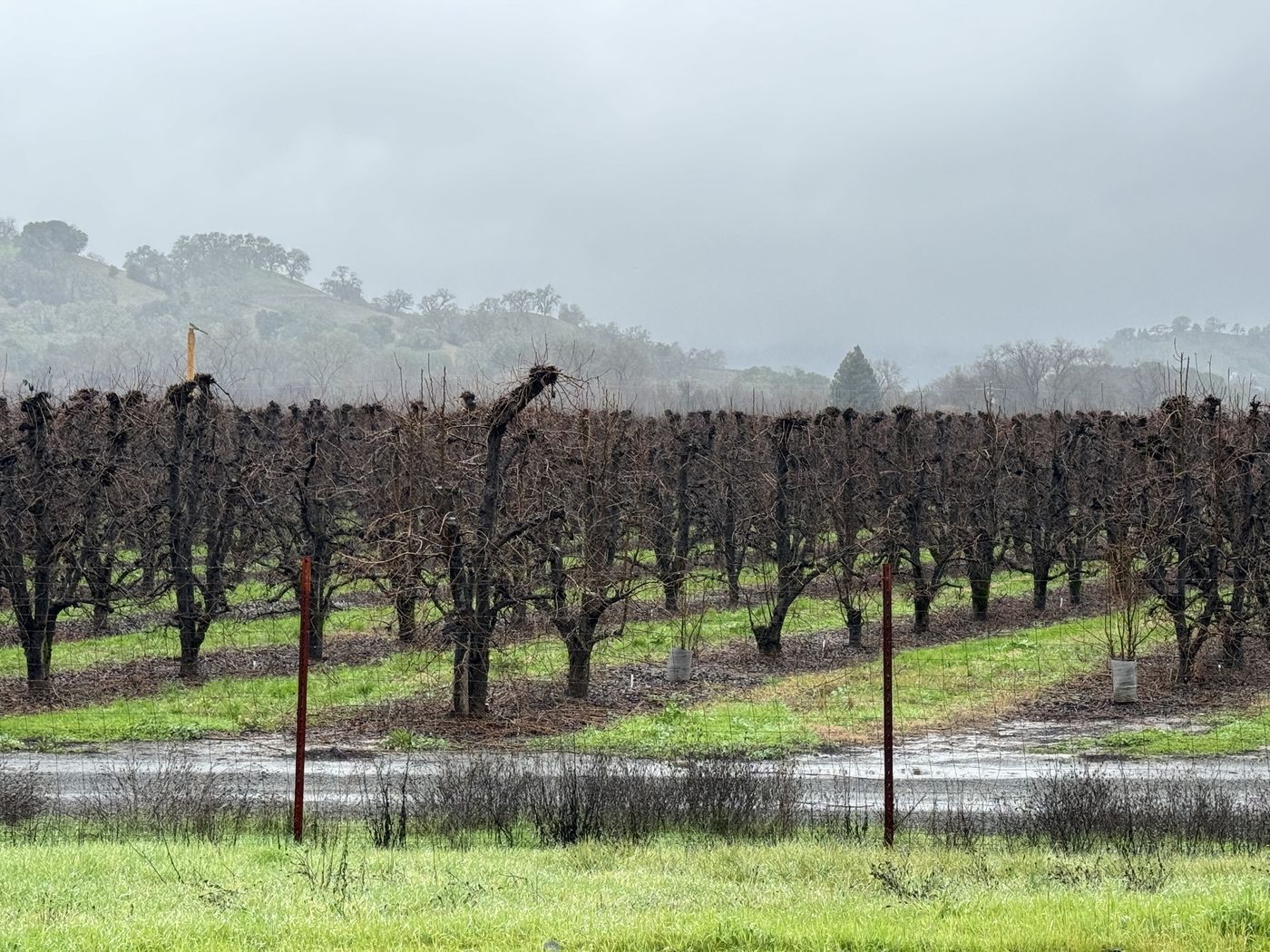
The county is writing an ordinance for what happens when vineyards die. Not buildings. Not businesses. The land itself.
An ordinance for abandoned vineyards
In March 2026, the Mendocino County Board of Supervisors began drafting a vineyard abandonment ordinance. Not a building code or a zoning update. A set of rules to fine owners $500 to $1,000 per acre for grapes left to die on the vine. Vineyards that attract pests, become fire hazards, or simply rot into blight.
In a county where nearly a quarter of the Chardonnay crop sold for $500 a ton or less in 2024, the abandonment explains itself. The harder question is what happens to a place when the thing it grows stops being worth harvesting.
Three industries going fallow at once
Mendocino County defined itself for half a century by what comes out of the ground. Timber from the redwood forests that run from Ukiah to the coast. Grapes from the Anderson Valley and the inland vineyards that helped build California’s wine country reputation. And cannabis — the crop that the counterculture brought here in the 1960s when back-to-land migrants from San Francisco settled in remote forest valleys and turned the Emerald Triangle into the most famous cannabis-producing region in the country.
All three are in retreat at the same time.
Cannabis cultivation is down 80% from its peak. The average price for licensed flower fell from $1,377 per pound in 2020 to $721 in 2024. Only 12 of 832 active cannabis farms — 1.4% — have received full annual licenses, six years after legalization. The Mendocino Cannabis Alliance called the industry “on the brink of irreversible failure.” Flow Cannabis, once the county’s largest private employer, has been mothballed.
The wine industry is on the same arc. Timber is already a memory.
The word that keeps surfacing across every domain in the data is fallow. Not a single failing industry. An entire county going dormant.
The wage-to-rent story the composite hides
The top employers now are the county government and Adventist Health. A two-bedroom apartment at fair market rent eats roughly 38% of average gross pay before taxes, food, insurance, or gas touch the math. The CDI’s wage-to-rent ratio puts Mendocino in the 95th percentile nationally — only five percent of U.S. counties have a worse relationship between what people earn and what they pay to live. Rent-to-income pushes that even harder, to the 97th percentile.
Here’s the part that stopped me. The Economic Vitality domain — the one that measures whether a place’s wages, rents, and home prices let people survive there — scores 92.08 out of 100. Mendocino ranks 9 of 3,144 U.S. counties on that domain. Nine. Housing Cost Burden sits just behind, at rank 230 — the 93rd percentile nationally. Structural Poverty ranks in the 82nd. But the Consumer Credit Distress domain scores 30.36 — the 28th percentile, well below the national median.
People aren’t borrowing their way through this. Credit card delinquency runs near the middle of the national pack. Medical debt in collections is functionally zero. In a county where renters are cost-burdened at the 95th percentile and the average wage doesn’t cover a two-bedroom apartment, the debt numbers should be worse. They’re not. There’s nothing left to borrow against.
Three hospitals, 3,509 square miles
Mendocino County covers 3,509 square miles. That’s larger than Delaware and Rhode Island combined. Three small hospitals serve the entire area. The only one with a labor and delivery ward is in Ukiah.
Fort Bragg’s hospital — the sole facility on the Mendocino coast — closed its obstetrics unit after annual births fell from 250 in the 1980s to 50. Women on the coast who go into labor drive 57 miles over a winding mountain pass to Ukiah. In October 2024, Adventist Health threatened to terminate its lease on the Fort Bragg facility entirely.
Over 70% of Adventist Health’s patients in Mendocino rely on Medicaid or Medicare. About 44% of the county is enrolled in Medi-Cal. A healthcare summit in September 2025 warned that federal Medicaid cuts could eliminate 600 jobs. Long Valley Health Center’s CEO said it plainly: “I’m afraid. I’ve been in public health for 30 years, and I’m afraid.”
The county government itself is hollowing out. A state audit in December 2025 found $30.6 million in uncollected taxes and a projected $16 million deficit for 2026-27. In April 2025, the county offered employees up to $25,000 to voluntarily resign. Mental health clinician positions carry a 70% vacancy rate.
The institutions are going fallow alongside the fields.
Nine years to a recovery program
In October 2017, the Redwood Complex Fire burned through Redwood Valley and Potter Valley — communities where the vacancy rate was near 1%. The fire destroyed 387 homes and killed 9 people. A year later, the Mendocino Complex Fire burned 459,123 acres across four counties, the largest wildfire in modern California history at the time.
In February 2026 — nine years after the Redwood Complex Fire — a homebuyer assistance program finally opened for displaced survivors. Zero-interest loans, up to $350,000, forgiven after five years. Nine years to get recovery money to people whose homes burned in a community where there were no vacant homes to move into.
Insurance premiums across Mendocino rose 60% from 2014 to 2024. The California Department of Insurance designated the county a “distressed area.” The fire destroyed housing. The insurance market made rebuilding unaffordable. The population peaked at 91,367 in 2020 and has declined every year since — down to 89,108 and still falling.
Where wine country softens into the upstate economy
Mendocino County scores 53.9 on the County Distress Index. Elevated zone. Twenty-fourth of California’s 58 counties, right at the state median — which is the part I keep catching on. A composite that lands middling for a place where the Economic Vitality domain ranks 9 of 3,144. The average hides the edge.
The neighbors tell the same split story. Lake at 67.98, Serious. Tehama at 64.4, Elevated. Humboldt and Glenn sit beside Mendocino in the low 50s. Sonoma at 40.18 and Trinity at 39.16, both Normal. Mendocino lands on the line where wine country softens into the upstate economy.
The low debt domain is the number I keep coming back to. When wages can’t cover rent and the Housing Cost Burden domain ranks in the 93rd percentile nationally, a Consumer Credit Distress score in the 28th percentile doesn’t signal prudence. It signals the absence of a credit economy that would let people bridge the gap. There’s no borrowing runway. When the next shock hits — another fire season, another Medicaid cut, another year of $721-per-pound flower — there’s nothing to absorb it.
Fallow, in agriculture, is intentional. You rest the soil so it can produce again. The question for Mendocino is whether the fallow is a pause or a permanent condition. The indicator to watch is that Economic Vitality rank — 9 of 3,144, the wage-to-rent story the composite keeps averaging down. If the county can replace even a fraction of what cannabis and wine once provided, that rank moves. If it can’t, 3,509 square miles of California keeps losing people, one year at a time.