The Shade
Gadsden County, Florida

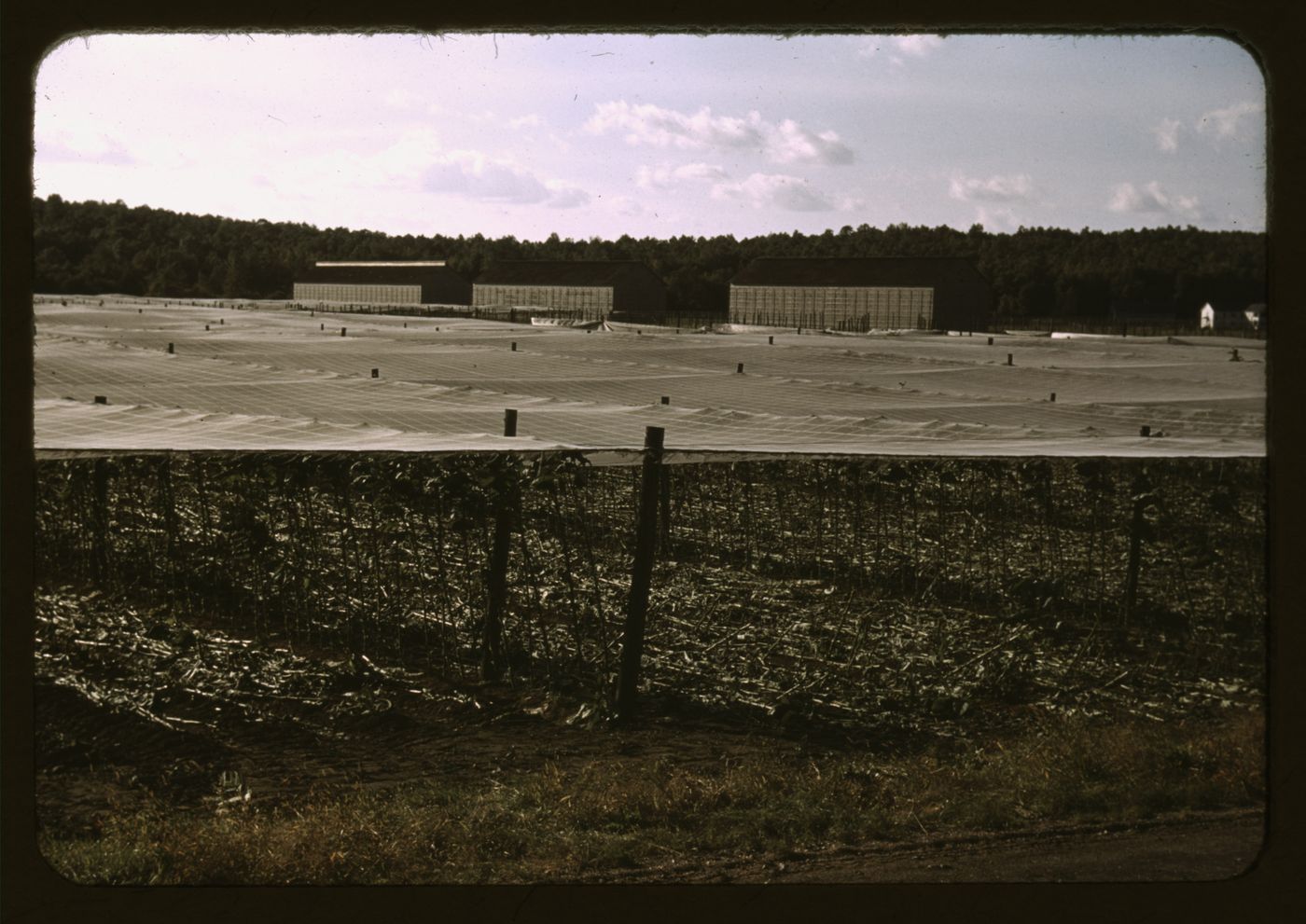
In 1896, someone discovered tobacco grown under cloth shade was worth ten times the price. The shade left. The county is still under it.
The crop that organized the county
In 1896, someone in Gadsden County discovered that tobacco grown under cloth shade produced cigar wrappers worth ten times the price of sun-cured leaf. By the early 1900s, miles of white cheesecloth stretched on wooden poles covered the fields around Quincy and Havana. At the Paris World’s Fair in 1900, Gadsden County shade tobacco was rated the finest in the world.
The structures required labor on a scale that organized the entire county around them. Black farmworkers — many of them children — spent summers under the cloth, harvesting in heat that topped 100 degrees. The town of Havana was named for its association with Cuban cigar tobacco. By the mid-1960s, more than 6,000 acres were under shade, over 2,200 barns operating.
Then it ended. Changes to labor laws shifted production to Central America. Cigar consumption declined. The last crop was harvested in 1977. Byron Spires, editor of the Havana Herald, put the aftermath in one sentence. “We’re still experiencing the repercussions of that. We’ve never put that many people back to work.”
The wealth that stayed, and who it stayed for
Here’s what makes Gadsden County different from the other distressed counties I’ve written. In most of them, the wealth left. Tobacco, coal, timber, cotton — the industry collapsed and the money went with it. In Gadsden, the wealth stayed. It just wasn’t visible to everyone.
In 1919, Pat Munroe, a Quincy banker, watched people spend their last nickels on Coca-Cola and began urging his white depositors to buy Coke stock at $40 a share. He underwrote bank loans backed by the shares. By mid-century, Quincy had 67 Coca-Cola millionaires — more Coke stock per capita than anywhere in the country.
The Coke millionaires were white. The people who worked the shade fields were not. A single share from 1919 is worth an estimated $10 million today with reinvested dividends. The median household income in Gadsden County is $51,288.
Thelma Todd Conner, who manages the Shade Tobacco Museum in Havana, grew up in the fields. “I grew up here, and I grew up poor,” she told Tallahassee Magazine. “But I didn’t know I was poor.”
Distress scores in a working county
The CDI score is 90.25. Extreme county distress. Thirteenth most distressed county in America, out of 3,144. First in Florida.
The primary domain is Delinquency at 94.19 — rank 95 in the nation. Credit card delinquency sits at the 96th percentile. Subprime share at the 94th. Auto-loan delinquency at the 93rd. People are falling behind on the everyday credit that holds a household together, in a county where the median income reaches 77% of Florida’s statewide median. The Default and Legal domain carries its own weight here. Forty-one percent of residents carry debt in collections. Median amount: $3,048.
The bankruptcy data shows a different chapter composition from other counties near the top of the ranking. In Pemiscot County, Missouri — one of the most distressed counties in America — 89% of recorded bankruptcies are Chapter 7. In Gadsden, 37% of 92 filings are Chapter 13. Those counts do not establish filers’ income, assets, motives, eligibility, or case outcomes.
The homeownership rate here is 72.9%. That aggregate rate and the bankruptcy chapter counts are separate measures; together they still do not show whether a filing was made to retain a home or whether a home was retained.
Thirty miles from the capital
Tallahassee is thirty miles east. Leon County scores 70.17 on the CDI. Rank 484 of 3,144. Gadsden County records extreme county distress. Rank 13.
The proximity is the mechanism, not the solution. Gadsden exports its workers to the capital and imports its poverty back. Florida State Hospital in Chattahoochee, opened in 1876, is the county’s largest employer. Gadsden Correctional Facility, a private women’s prison run by the Management and Training Corporation, is the second. Capacity: 1,544. The two anchors of the local economy are a mental hospital and a prison — institutions the state placed here because they needed to be somewhere.
The uninsured rate is 16.4%, 91st percentile. State Rep. Alan Williams described the consequence. “If someone has a cardiac arrest and has to be transported to Tallahassee, there’s a strong chance they won’t survive.” One in five residents has a disability. A quarter are on SNAP. Most neighboring counties carry high, very high, or extreme county distress. Calhoun, Jackson, Liberty in Florida, Decatur and Seminole across the Georgia line. Grady County, Georgia scores 71.58. Leon County sits in the middle of this belt, buffered by something more durable than distance.
What Dean Mitchell painted
Dean Mitchell grew up in Quincy painting the tobacco barns he worked in as a child. His grandmother Marie Brooks bought him a paint-by-numbers set from the local five-and-dime. He went on to become a nationally recognized painter. The barns he painted were, in his own description, “structurally magnificent” — and inseparable from the poverty of the people who worked inside them. Beauty and exploitation in the same structure. The Marie Brooks Gallery in downtown Quincy is named for his grandmother.
I don’t fully understand the business formation number. At 17.6 applications per thousand residents, Gadsden County’s business formation runs well above the national rate. Seven hundred seventy-one new business applications in 2024, up 48% since 2019. For a county with extreme county distress, that’s anomalous. It could be Tallahassee spillover — entrepreneurs filing in the cheaper jurisdiction next door. Or it could be something genuine taking root. In January 2024, Florida A&M University partnered with the Gadsden County Development Council on a $500,000 federal workforce grant targeting agriculture, technology, and manufacturing.
The population peaked at 46,389 in 2010 and dropped to 43,826 by 2020. New retail — ALDI, hardware stores — is arriving in Quincy and Midway. Whether that’s the beginning of something or a final echo is the question that hangs over every data point in this county.
What grows here next
Gadsden County scores 90.25. Extreme county distress. Thirteenth in the nation, first in Florida. The indicator to watch is the rent-to-income ratio — at the 97th percentile, measuring whether the generation that stayed can afford to keep staying. The shade cloth came down half a century ago. What grows here next depends on who it grows for.